- Resources
- WhatsApp for Marketing: The Complete Guide for Indian Businesses (2026)
WhatsApp for Marketing: The Complete Guide for Indian Businesses (2026)
Prashanth Kancherla
Jun 4, 2026 | 15 mins read
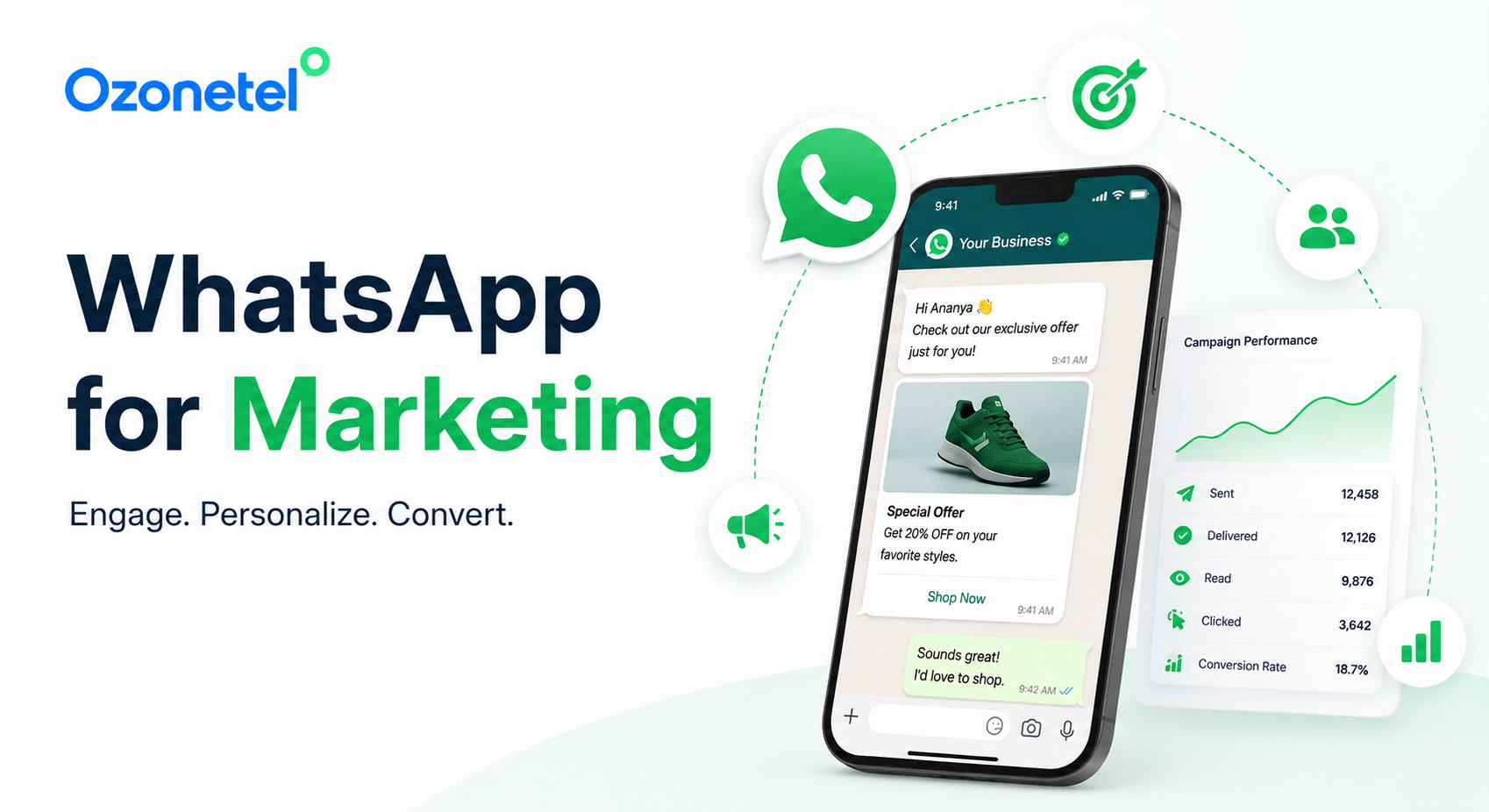
India doesn’t really do email. Or rather, it does — and then it ignores it. With a national average email open rate stuck below 20% and SMS increasingly filtered into DND oblivion, Indian brands are fighting for attention on channels their customers have mentally checked out of.
WhatsApp is the exception. With 535+ million monthly active users in India — more than any other country on earth — and messages that get read within minutes of delivery, WhatsApp is not just another marketing channel. It is the channel where Indian consumers actually live their digital lives.
But there is a wide gap between businesses that use WhatsApp and businesses that use it well. Most are still blasting broadcast messages to cold lists, accumulating blocks, watching their quality rating crater, and wondering why conversions are flat. The brands pulling ahead — from NBFCs to luxury hospitality to D2C — are using the WhatsApp Business API with AI-powered personalisation, CRM-connected automation, and campaign architectures built around the customer journey.
This guide covers every layer: what WhatsApp marketing actually is, why India is a category-defining opportunity, how the Business App and API differ, how to build a compliant subscriber list, which campaign types convert at which stages, how Meta’s post-2025 compliance rules work, and how to measure what matters
Key Takeaways
- India = world’s largest WhatsApp market: 535+ million monthly active users, on track for 900M by end-2026.
- Unmatched engagement: 98% open rate, 45-60% CTR, 80% of messages read within 5 minutes.
- App vs API: The Business App is free but capped at 256 contacts. The API unlocks unlimited scale, automation, and CRM integration.
- Opt-in is legally and operationally non-negotiable: No consent = account ban.
- Post-Oct 2025 limits are portfolio-wide: New numbers inherit portfolio limits instantly. Scaling checks run every 6 hours.
- Click-to-WhatsApp ads are the fastest-growing acquisition channel for D2C, NBFC, and real estate brands in India.
- AI-powered hyper-personalization (GenAI video, chatbots, CRM-driven messaging) is the 2026 differentiator.
- Ozonetel is a Meta-recognised BSP — live on WhatsApp Business API in under 5 minutes
In this article, we will explore:
- 1. What is WhatsApp Marketing?
- 2. WhatsApp in India: The 2026 Opportunity
- 3. WhatsApp Business App vs WhatsApp Business API
- 4. How to Set Up WhatsApp Marketing Step by Step
- 5. Building Your Subscriber List: Opt-In Strategies
- 6. WhatsApp Campaign Types and Use Cases
- 7. Best Practices for WhatsApp Marketing in India
- 8. Messaging Limits, Quality Ratings, and Compliance (2025 Update)
- 9. Case Studies: How Indian and Global Brands Win on WhatsApp
- 10. Measuring WhatsApp Marketing Performance
- 11. How Ozonetel Powers WhatsApp at Scale
What is WhatsApp Marketing?
WhatsApp marketing is the use of WhatsApp — through either the WhatsApp Business App or WhatsApp Business API — to engage customers across the full lifecycle: awareness, acquisition, conversion, retention, and re-engagement. It encompasses promotional campaigns, transactional notifications, automated chatbot journeys, customer support, and AI-powered personalised conversations.
The defining characteristic of WhatsApp marketing versus email or SMS is context. WhatsApp messages arrive in the same thread where a customer talks to their family. That proximity creates a fundamentally different relationship — one that demands higher relevance and rewards genuine personalisation.
In 2026, WhatsApp marketing for businesses means operating across two distinct modes:
- Business-initiated messages: Template-based messages (marketing, utility, authentication) sent proactively to opted-in users. Governed by Meta’s messaging limits and quality rating system.
- User-initiated conversations: Free-form conversations triggered when a customer messages the business. No template required. Free to respond within a 24-hour service window.
The most effective WhatsApp marketing programmes design for both — using business-initiated messages to trigger conversation, and the service window to convert.
WhatsApp in India: The 2026 Opportunity
If there is one market in the world where WhatsApp marketing is not optional, it is India. The numbers are not just large — they signal a structural shift in how Indian consumers expect to interact with brands.
Monthly active users in India
DataReportal / Meta
Message open rate vs 20% for email
Industry benchmark 2025
Indian online adults chat with businesses weekly
Kantar 2025
India-specific data points (2025-2026)
- Largest global market: India leads with 535+ million monthly active users, representing approximately 27% of WhatsApp’s 3.3 billion global user base. The platform is projected to cross 900 million Indian users by end-2026.
- Highest download velocity: India led all countries in WhatsApp Google Play downloads in Q3 2025 with 20.72 million in a single quarter.
- Deep business penetration: Over 73% of Indian businesses use WhatsApp for customer communication. India accounts for 480+ million cumulative WhatsApp Business app downloads.
- Daily engagement intensity: Indian users check WhatsApp approximately 23 times per day, with an average session duration of 38 minutes. 80% of messages are read within 5 minutes of delivery.
- Business messaging normalised: 91% of Indian online adults chat with businesses on WhatsApp every week (Kantar 2025). This is not a novelty — it is an expectation.
- D2C advantage: Indian D2C brands using WhatsApp for abandoned cart recovery and post-purchase engagement report 3-8x higher conversion rates than email.
- AI personalisation frontier: Brands deploying GenAI-powered personalised WhatsApp video campaigns are achieving 5x improvement in open rates and 3x revenue uplifts versus traditional SMS.
WhatsApp Business App vs WhatsApp Business API
This is the most consequential decision in your WhatsApp marketing strategy. The two products share a name but serve fundamentally different use cases. Choosing the wrong one means either overpaying or hitting a ceiling you cannot grow through.
| Feature | Business App (Free) | Business API (via BSP) |
|---|---|---|
| Target User | Freelancers, solo traders, micro-SMBs | SMBs, enterprises, and contact centres |
| Concurrent Agents | 1 primary device (up to 4 linked devices) | Unlimited agents on a single number |
| Broadcast Reach | Up to 256 saved contacts | Virtually unlimited (subject to Meta tiers and opt-ins) |
| Automation / Bots | Basic auto-replies and greeting messages | Full conversational AI, workflows, and chatbots |
| CRM Integration | Not supported | Salesforce, HubSpot, Zoho, LeadSquared and more |
| Message Templates | Not available | Pre-approved Marketing, Utility, and Authentication templates |
| WhatsApp Flows | Not available | Full support for forms and workflows inside chat |
| Catalog / Payments | Product catalog only | Catalog + Payments (India supported) |
| Analytics | Basic delivery and read receipts | Delivery, read rates, response analytics, CSAT, and campaign reporting |
| Pricing | Free | Per-message pricing + BSP platform fees (service replies remain free) |
| Meta Business Verification | Not required | Required for scaling beyond Tier 0 |
| Green Tick (Official Business Account) | Not available | Available after Meta verification |
How to Set Up WhatsApp Marketing: Step by Step
Setting up the WhatsApp Business API requires a Meta-approved Business Solution Provider (BSP) like Ozonetel. Here is the complete process — from zero to your first campaign.
Step 1: Create and verify your Meta Business Portfolio
Go to business.facebook.com. Create your Meta Business Portfolio — the container for all WhatsApp assets including phone numbers, templates, and billing. Complete business verification by uploading the required documents. Verification unlocks the ability to scale messaging limits and apply for the Official Business Account (green tick).
Step 2: Choose a BSP and onboard your number
Choose a Meta-recognised Business Solution Provider like Ozonetel. You will register your existing business phone number on the WhatsApp Business Platform through the BSP’s embed flow. Ozonetel’s one-click setup gets you live in under 5 minutes — no developer resources required.
Step 3: Build your Business Profile
Complete every field: business name, category, description, address, website, and operating hours. Businesses with complete profiles see measurably higher response rates. Your description is indexed — treat it like a mini-SEO exercise.
Step 4: Create and submit message templates
All business-initiated messages require pre-approved templates. Templates fall into three categories: Marketing, Utility, and Authentication. Submit them via your BSP dashboard or Meta Business Manager. Approval takes minutes to a few hours.
Step 5: Integrate your CRM
Connect WhatsApp to your CRM via Ozonetel’s omnichannel routing and CRM integration layer. This pulls customer name, segment, purchase history, and lifecycle stage into every conversation — enabling the personalisation that separates top-performing WhatsApp programmes from broadcast blasters.
Step 6: Configure automation and chatbot flows
Deploy a WhatsApp AI chatbot to handle Tier 1 queries automatically — FAQs, appointment booking, order tracking, lead qualification — with seamless bot-to-human handoff when complexity escalates.
Step 7: Build opt-in capture flows
Before any business-initiated message can be sent, the recipient must explicitly opt in. See the next section for how to build this correctly.
Building Your Subscriber List: Opt-In Strategies
WhatsApp opt-in is not a legal formality. It is the foundation of your quality rating. Every block and spam report from an unsolicited message chips away at your number’s ability to scale. Build opt-in from the ground up and your subscriber list becomes a high-quality asset; skip it and you will be rebuilding from a banned account.
Opt-in channels that perform in India
- Click-to-WhatsApp (CTWA) ads: Run Facebook and Instagram ads with a ‘Send WhatsApp Message’ CTA. Users who click have opted in to that conversation.
- Website WhatsApp widget / QR code: Users who initiate a chat from your website or a QR code are opted in for that 24-hour service window. High-intent signal — they came to you.
- Checkout and lead form opt-in: Checkbox at checkout: ‘Get order updates on WhatsApp.’ This is your highest-value opt-in.
- Post-purchase or post-service SMS/email opt-in prompt: ‘Get your next order updates faster on WhatsApp — tap to opt in.’
- IVR or call-end opt-in: At the end of a support call, prompt: ‘Would you like to continue getting updates on WhatsApp? Press 1 to confirm.’
- Social media and email campaigns: Run dedicated opt-in campaigns (‘Message us on WhatsApp for exclusive offers’) as an awareness campaign.
WhatsApp Campaign Types and Use Cases
Effective WhatsApp marketing maps campaign types to customer lifecycle stage. Sending a promotional broadcast to someone who just raised a support ticket is a fast path to an opt-out. Here is the full taxonomy:
Promotional broadcasts
Scheduled, template-based messages sent to a curated opted-in segment. Best for: flash sales, seasonal campaigns (Diwali, Dhanteras, Eid), new product launches, event invitations, referral programmes. Always include: first-name personalisation, a rich media element (image or video), and a single clear CTA button.
Transactional notifications
Automated messages triggered by a customer action: order confirmation, shipping update, delivery alert, appointment reminder, EMI due date, payment receipt. Use Utility templates. These have the highest delivery and read rates of any WhatsApp message type.
Abandoned cart and browse recovery
Trigger a WhatsApp message within 30-60 minutes of abandonment with a product image, name, price, and direct checkout link. Industry benchmark: WhatsApp abandoned cart recovery converts at 3-8x the rate of email.
Lead nurturing sequences
For high-consideration purchases — real estate, insurance, NBFC loans, edtech — WhatsApp multi-touch nurturing sequences outperform email drip campaigns significantly.
AI-powered hyper-personalised campaigns
The 2026 frontier. GenAI tools now allow brands to create individually personalised video messages at scale — where the brand ambassador addresses each recipient by their actual name in a video. Deltin achieved a 70% video open rate (5x their SMS baseline) using this approach on WhatsApp.
Re-engagement campaigns
Target users who have not interacted in 60-90 days. Frame the message as a question or a genuine value-add, not a hard sell. If users do not engage after 2 attempts, remove them from your active list — they are a quality rating liability.
Customer support and self-service
Let customers initiate support on WhatsApp instead of calling. An AI-powered WhatsApp chatbot handles Tier 1 queries automatically and escalates to a human agent with full conversation context when needed.
WhatsApp Flows: forms inside the conversation
WhatsApp Flows embed forms, booking widgets, surveys, and intake screens directly inside the chat. No browser redirect. No drop-off. For appointment booking, loan application intake, insurance quote collection, or post-purchase feedback.
Ozonetel’s WhatsApp solution supports broadcasts, GenAI personalisation, CRM integration, and bot-to-agent handoff.
Best Practices for WhatsApp Marketing in India
Reach customers where they are with personalized, compliant, and high-impact campaigns. Here are the best practices for maximizing engagement and conversions on WhatsApp.
Personalise beyond the first name
CRM-driven personalisation means using segment, city, purchase history, and lifecycle stage to craft messages that feel individually relevant. A customer in Pune who bought an air purifier 11 months ago needs a filter replacement alert — not a generic product blast.
Write like a knowledgeable friend
Short sentences. One key point per message. Emojis where natural, not decorative. No marketing jargon. ‘Your booking is confirmed for Friday’ lands better than ‘We are pleased to confirm your reservation for the upcoming event.’
Time messages for Indian consumer behaviour
Peak engagement windows: 10 AM-12 PM and 7 PM-9 PM for B2C. Tuesday-Thursday, 10 AM-5 PM for B2B. Avoid messages before 9 AM, after 9:30 PM, and during major religious observances.
Use rich media where it reduces friction
Product images close more sales than product descriptions. Short demo videos answer questions text cannot. Voice notes from a relationship manager build more trust than a typed message.
Always make opting out effortless
Include ‘Reply STOP to unsubscribe’ in all promotional messages. An easy opt-out reduces blocks and reports, which protects your quality rating and keeps your list healthy and deliverable.
Honour the 24-hour service window
When a customer messages you, you have 24 hours to respond in free-form text. Outside that window, you need a pre-approved template. Design your support workflows around this constraint.
Test templates before scaling
Run a small-batch send to 500-1,000 contacts before scaling to your full list. Monitor delivery rate, read rate, and block rate in real time. A high block rate on a small batch is a signal to rework the template.
Messaging Limits, Quality Ratings, and Compliance (2025 Update)
WhatsApp’s compliance framework changed materially in the second half of 2025. If you are operating on pre-2025 documentation, several of your assumptions are wrong.
Messaging tiers (portfolio-wide since October 2025)
As of October 7, 2025, messaging limits are no longer per phone number — they are set at the Meta Business Portfolio level. All numbers under your portfolio share a single limit. A new number you add immediately inherits the portfolio’s current tier.
| Tier | Daily Unique Users | How to Reach It |
|---|---|---|
| Tier 0 (Default) | 250 | All newly registered WhatsApp Business API numbers begin at this tier. |
| Tier 1 | 1,000 | Deliver 1,000 messages within 30 days while maintaining a high quality rating. |
| Tier 2 | 10,000 | Automatically upgraded from Tier 1. Meta evaluates eligibility approximately every 6 hours. |
| Tier 3 | 100,000 | Automatically upgraded from Tier 2 based on message quality and delivery performance. |
| Unlimited | No Cap | Automatically upgraded from Tier 3 after demonstrating sustained high-quality messaging. |
Quality ratings
Quality rating (Green / Yellow / Red) reflects how users respond to your messages over the last 7 days — specifically block and spam report rates.
- Green (High): Positive engagement. Scaling proceeds normally.
- Yellow (Medium): Elevated negative feedback. Review templates and targeting urgently.
- Red (Low): High complaint rate. Limit advancement paused. (Post-Oct 2025: no longer causes automatic downgrade, but prevents all scaling.)
User-level frequency cap (new in 2025)
Meta introduced a user-level cap in 2025: individual WhatsApp users can receive approximately 2 marketing template messages per day across all businesses — not just yours. If a user has already received 2 marketing messages from other brands that day, your message will not be delivered even if your tier allows it.
Template pricing (post-July 2025)
Since July 1, 2025, WhatsApp uses per-message pricing for all template categories. Marketing templates cost the most; Utility and Authentication are cheaper. Service conversations — user-initiated, replied to within 24 hours — remain free.
TRAI compliance for Indian businesses
Indian businesses must also comply with TRAI’s Digital Consent Acquisition (DCA) framework for commercial communications. WhatsApp opt-in should be documented and stored with timestamp and channel of consent.
Case Studies: How Indian and Global Brands Win on WhatsApp
Muthoot Gold Bullion Corporation: Zero-Inventory Phygital Launch Engages 5M+ Customers
Increase in average order value (Rs 20K to Rs 50K)
WhatsApp impressions in 9 months
Automated EMI calls in 5 months
Background
Muthoot Gold Bullion Corporation is a group company of the Muthoot Group — India’s No. 1 NBFC in gold loans. With 5,000+ branches and a customer base of 10 million people, Muthoot is one of India’s most trusted financial brands. When they launched Indivara, their gold jewellery vertical, they faced a challenge unique to high-value retail: jewellery sales demand continuous engagement, a premium ambiance, and specialised staff — none of which existed at their existing branch offices.
Muthoot’s response was a bold ‘phygital’ go-to-market strategy: create the luxury experience entirely through digital channels, then fulfil at branches. No retail stores. No printed catalogs. No inventory risk.
WhatsApp as the engagement layer
Muthoot deployed Ozonetel’s CCaaS Platform for WhatsApp to publish and distribute an intelligent digital jewelry catalog through a WhatsApp chatbot. The catalog was integrated directly into Muthoot’s website and synced with their ERP, enabling one-step updates across all 5,000 branch centers simultaneously.
Voice bot for EMI collection
In five months, the voice bot made 43,500 automated calls, saving Muthoot Rs 2,00,000 in agent costs and freeing both agents for higher-value roles — a measurable workforce optimisation outcome.
Data-driven campaign personalisation
With 10 million customers and a database of 5 million+ active relationships, Muthoot continuously segments their audience and runs personalised digital campaigns. This approach drove average order value from Rs 20,000 to Rs 50,000 — a 2.5x increase — within the first year of the Indivara launch.
Deltin Royale: GenAI-Powered Hyper-Personalised Campaign Delivers 5X Open Rate and 3X Revenue
Increase in open rate vs prior SMS campaigns
Dormant customers successfully reactivated
Revenue increase from campaign
Background
Deltin Royale operates India’s largest floating casino, anchored off Goa. For their flagship Deltin Star Weekend event, they needed to dramatically expand reach into Tier 2 and Tier 3 cities, re-engage dormant high-value patrons, and generate an event atmosphere that began before guests arrived.
The campaign architecture
On New Year’s Eve, Deltin sent AI-personalised videos via WhatsApp. In each video, Tamannaah Bhatia addressed the recipient by their actual name — a different video for every individual in the database, generated at scale using GenAI. A few days later, the second wave deployed: a personalised invitation to the Deltin Star Weekend event.
Results
- 70% video open rate — a 5x improvement over their 12-13% SMS baseline.
- 89% WhatsApp delivery rate — 3x better than traditional channels.
- 100% event bookings secured within two weeks of campaign launch.
- 7,800 attendees at the event — a record footfall for Deltin Royale.
- 16% of dormant/inactive patrons successfully reactivated.
- 3x increase in revenue attributed to wider reach and hyper-personalised engagement.
Flipkart: Rs 20 Crore in Revenue from a Single WhatsApp Campaign
Increase in conversions
Revenue attributed to campaign
Rich media engagement (images, audio, video, emoji)
Flipkart deployed WhatsApp to generate buzz for their Big Billion Days sale with an interactive KBC-inspired chatbot experience featuring Amitabh Bachchan. Customers played emoji games and solved puzzles to discover sale deals. The campaign delivered a 3.5x increase in conversions and $2.5 million in attributed revenue.
21K School: 72% Growth in Customer Acquisition and 200% Agent Productivity Gain
Increase in new customer acquisition (11 months)
Increase in agent productivity
WhatsApp deployed awareness through re-engagement
21K School, an online K-12 institution offering Indian, American, and British curricula to students aged 3-18, deployed WhatsApp across the full customer lifecycle. The result: 72% growth in new customer acquisition within 11 months and a 200% improvement in agent productivity post-automation.
Kaarva: Scaling a Financial Health Platform to 100,000 Customers on WhatsApp
Customers generated, qualified, and supported on WhatsApp
Unified touchpoint replacing 3 separate accounts
WhatsApp-first: acquisition through post-sales support
Kaarva, a financial health platform for employee wellbeing, migrated from three separate WhatsApp Business accounts to a unified WhatsApp Business API deployment. Result: 100,000+ customers generated, qualified, and supported through a single WhatsApp-first model.
From zero-inventory jewelry launches to GenAI personalisation campaigns — we have built it across industries.
Measuring WhatsApp Marketing Performance
WhatsApp does not have a native analytics dashboard the way Google Analytics or HubSpot does. Performance measurement requires pulling data from your BSP platform and CRM. Here are the KPIs that matter — and what good looks like:
| Message Category | What It Covers |
|---|---|
| Utility | Transactional messages such as order confirmations, payment receipts, shipping notifications, appointment reminders, and OTPs. |
| Authentication | Account verification messages including login OTPs, two-factor authentication (2FA) codes, password resets, and identity verification. |
| Marketing | Promotions, discounts, product launches, abandoned-cart reminders, customer re-engagement campaigns, and other revenue-generating communications. |
| Service | Any message sent within 24 hours of a customer-initiated conversation. These messages are generally free in most markets during the active customer service window. |
Revenue attribution
The most robust method is connecting WhatsApp conversation IDs to CRM records and tracking the downstream purchase event. For e-commerce: pass a UTM-tagged checkout link inside the WhatsApp message. For B2B: log the WhatsApp conversation as an activity against the lead record.
How Ozonetel Powers WhatsApp Marketing at Scale
Ozonetel is a Meta-recognised WhatsApp Business Solution Provider and India’s leading AI-powered contact centre and CX platform. We have powered WhatsApp deployments for Muthoot, Deltin, 21K School, Kaarva, and 3,500+ other businesses across India and internationally.
Platform capabilities
- One Business, One Number: Your customers reach you on a single number whether they call or WhatsApp. Ozonetel routes both channels seamlessly with full context.
- Deep CRM integration: Native connectors for Salesforce, HubSpot, Zoho, LeadSquared, Freshdesk, and more. Every WhatsApp conversation logged automatically.
- AI-powered WhatsApp chatbot: Deploy a chatbot for Tier 1 query resolution, lead qualification, appointment booking, and OTP delivery — in multiple Indian languages, 24/7.
- WhatsApp Cloud API — direct access: Ozonetel has direct access to the WhatsApp Cloud API, enabling enterprise-grade throughput with full Meta compliance.
- Flexible campaign automation: Build fully or partially automated conversation flows with rich media templates. Define bot scope, escalation logic, and agent assignment rules from a single dashboard.
- Seamless bot-to-agent handoff: When a conversation exceeds bot scope, it routes instantly to the right human agent via Ozonetel’s intelligent routing engine — with full conversation history visible.
- Number masking and lead security: Prevent offline diversion of leads. Protect lead data with virtual number masking across WhatsApp and voice interactions.
- OTP via WhatsApp: Enterprise-grade OTP delivery via WhatsApp with higher delivery rates and better UX than SMS OTP.
- D2C and vertical solutions: Purpose-built configurations for D2C brands, NBFC, real estate, insurance, and more.
- 5-minute onboarding: One-click embed flow — no developer resources required.
Conclusion
WhatsApp is not a channel Indian businesses are choosing — it is the channel their customers have already chosen for them. With 535+ million users in India, 98% open rates, and 91% of Indian online adults messaging businesses weekly, WhatsApp is the default communication layer for a billion-plus market.
But the gap between businesses that use WhatsApp and businesses that use it well is widening. The brands winning — Muthoot’s phygital zero-inventory model, Deltin’s GenAI personalised video campaigns, Flipkart’s KBC-inspired interactive experience — are not just broadcasting on WhatsApp. They are building engineered customer journeys with AI, CRM integration, and campaign architecture designed around how people actually behave in a conversation channel.
The fundamentals are non-negotiable: explicit opt-in, quality-first list management, personalisation beyond the first name, and compliance with Meta’s evolving framework. Get those right, then invest in the sophistication — chatbots, Flows, GenAI, multi-channel attribution — and WhatsApp becomes your highest-performing marketing asset.
3,500+ businesses trust Ozonetel for WhatsApp marketing at scale. Setup takes less than 5 minutes.
Frequently Asked Questions
The WhatsApp Business App is a free mobile app designed for micro-businesses and solo traders. It supports one device, manual broadcast of up to 256 saved contacts, and basic auto-replies. The WhatsApp Business API — accessed through a Meta-approved Business Solution Provider like Ozonetel — is designed for growth businesses and enterprises. It supports unlimited agents on one number, automated chatbot flows, CRM integration, bulk broadcasts to opted-in lists, pre-approved message templates, and full analytics. The API is charged on a per-message basis (post-July 2025).
New numbers start at 250 unique users per day (Tier 0). Tiers scale to 1,000, 10,000, 100,000, and unlimited based on message volume and quality rating. Since October 2025, limits are portfolio-wide, not per number, and scaling checks run every 6 hours.
Yes — when done correctly. WhatsApp marketing is legal in India provided you have explicit opt-in consent from every recipient before sending business-initiated messages, comply with Meta’s WhatsApp Business Policy, and follow TRAI’s Digital Consent Acquisition (DCA) framework for commercial communications.
A Click-to-WhatsApp (CTWA) ad is a Facebook or Instagram advertisement with a CTA that opens a WhatsApp conversation with your business rather than directing to a website. CTWA ads are one of the fastest-growing acquisition channels for Indian brands — particularly D2C, NBFC, and real estate — because they capture high-intent users at the moment of interest and immediately begin a conversion conversation
The green tick (Official Business Account) is awarded by Meta after completing Business Verification in Meta Business Manager and demonstrating that your business is a well-known brand. Verification requirements include: a Meta Business Portfolio, business documentation, a working website with matching business name, and an active WhatsApp Business API deployment through a BSP
WhatsApp’s quality rating (Green / Yellow / Red) reflects how users have responded to your messages over the last 7 days — specifically block rates and spam reports. A Green rating means you are free to scale your messaging tier. A Red rating pauses your ability to advance to a higher tier. Since October 2025, a Red rating no longer causes automatic downgrade of your current tier, but it prevents all future scaling until the rating recovers.
Yes — and it is underutilised in B2B. WhatsApp is effective for B2B lead nurturing, meeting reminders, document sharing, contract follow-ups, and post-sale account management. For B2B, the key is keeping messaging frequency low and content value high.
WhatsApp Flows are interactive forms, surveys, and widgets that run inside the WhatsApp chat interface — no browser redirect required. Common use cases include appointment booking, loan application intake, insurance quote collection, feedback forms, and product customisation. Flows reduce drop-off at high-friction moments by keeping the entire interaction within WhatsApp.
Prashanth Kancherla
Chief Operating Officer, Ozonetel Communications
Over the past decade, Prashanth has worked with 3000+ customer experience and contact center leaders...
Chief Operating Officer, Ozonetel Communications
Over the past decade, Prashanth has worked with 3000+ customer experience and contact center leaders to comprehensively understand the need for effective and efficient customer communications at every step of their journey with a brand. Deeply embedded in today’s CCaaS ecosystem, he has been instrumental in Ozonetel's growth and contributed in various roles including product management, sales, and solution architecture.