- Resources
- Virtual Phone Numbers for Business: What They Are, How They Work, and Why You Need One
Virtual Phone Numbers for Business: What They Are, How They Work, and Why You Need One

Rampradeep Kumar
Jun 16, 2026 | 13 mins read
Here is a situation most businesses recognise. A delivery agent calls a customer from their personal number. The customer saves it. Weeks later, they call that number about a complaint — the agent has left the company, the issue goes unresolved, and the customer is frustrated. Or a sales team runs three campaigns at once and has no idea which one is driving inbound calls. Or a relationship manager goes on leave and ten client calls go unanswered because they all ring a desk phone in an empty office.
These are not edge cases. They are everyday communication failures that happen when businesses rely on physical lines, personal SIMs, and unmanaged call routing. Virtual phone numbers are what businesses use to fix them.
A virtual number lives in the cloud rather than on any physical device. You can route it to any team, any location, any device — and change that routing instantly. This guide covers what they are, how they work, the types available, eight proven use cases, a comparison against traditional lines, TRAI compliance requirements for India, and a six-point checklist for choosing the right provider.
Key Takeaways
- A virtual phone number has no physical SIM or desk phone — it routes calls through the cloud to any device, anywhere.
- Six types are available: toll-free, local/geographic, vanity, mobile virtual (VMN), international, and missed-call numbers.
- Local-number dialling delivers 2–4× higher answer rates than toll-free for outbound sales campaigns.
- Virtual numbers protect privacy — agents and customers never share personal numbers in delivery, field sales, or RM scenarios.
- Assign a separate number to each campaign and you get call-level attribution: which channel drove which calls.
- In India, virtual numbers support TRAI’s 160-series mandate, DLT consent management, and DPDP data minimisation requirements.
- When evaluating providers, prioritise telecom circle coverage, CRM integration depth, uptime SLA, and compliance tooling.
- Ozonetel virtual numbers cover 160+ countries and all 18 Indian telecom circles, with 100+ CRM integrations built in.
In this article, we will explore:
- 1. What Is a Virtual Phone Number?
- 2. Types of Virtual Numbers Available to Businesses
- 3. How Virtual Numbers Work: The Call Journey, Step by Step
- 4. 8 Ways Businesses Use Virtual Phone Numbers
- 5. Virtual Number vs. Traditional Phone Line vs. SIM-Based Mobile
- 6. Virtual Numbers and TRAI Compliance in India
- 7.How to Choose a Virtual Number Provider: Six Things That Matter
What Is a Virtual Phone Number?
No SIM card, no copper wire, no hardware — a virtual number is a cloud address your business owns and routes however it needs.
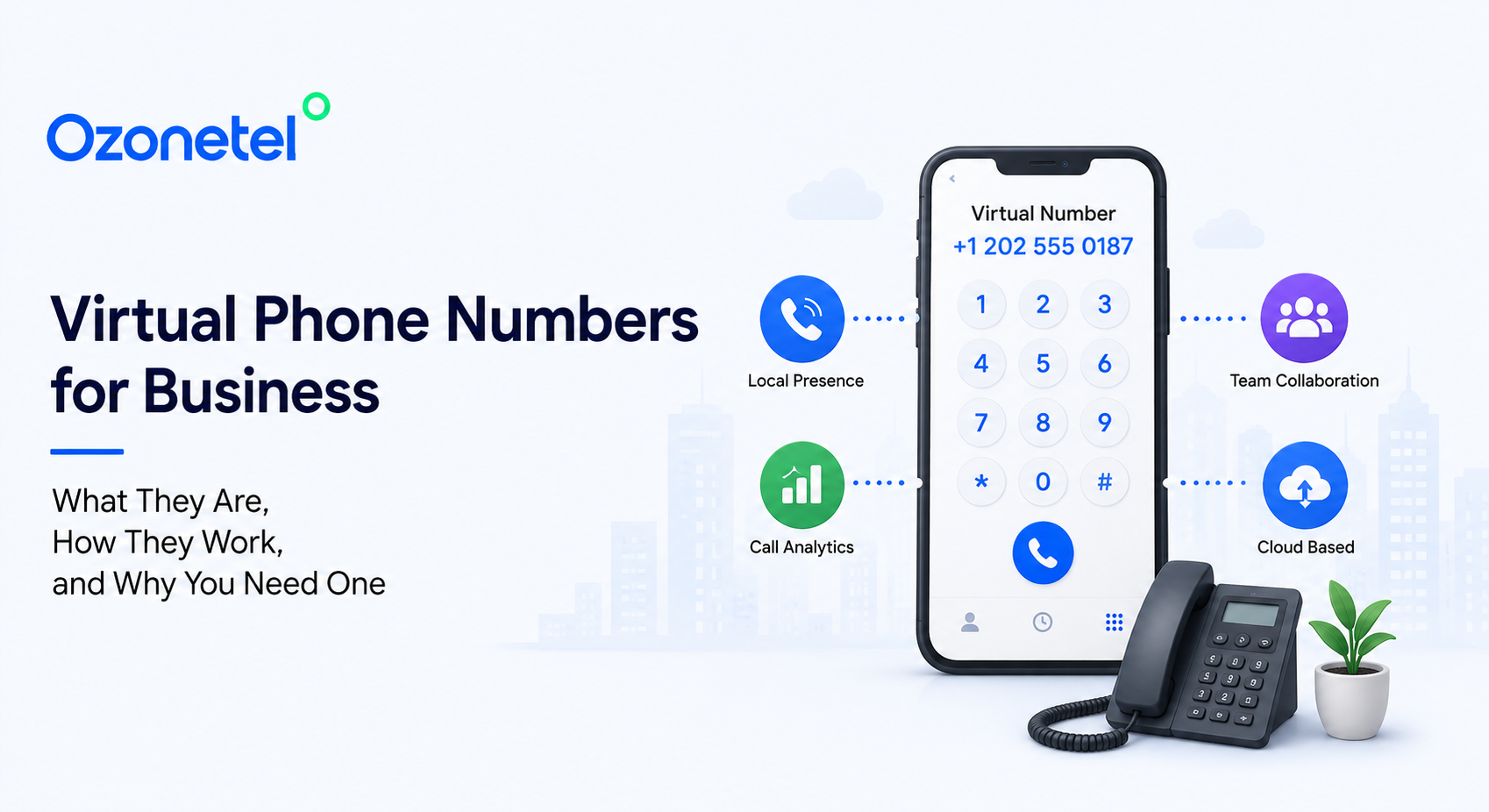
A virtual phone number looks and behaves exactly like a regular phone number. Your customers dial it, it rings, someone picks up. But there is no physical SIM card and no copper wire running to a telephone exchange. The number exists in the cloud.
When someone dials it, the call enters the Public Switched Telephone Network (PSTN) as any call would. It then hits a cloud telephony platform, which routes it over the internet to whichever device you have configured — a desk phone, a mobile handset, a laptop softphone, or a tablet. The caller hears a normal ring. The routing complexity is invisible.
A few terms you will encounter:
- DID number (Direct Inward Dialing) — the technical term inherited from older PBX systems. Means the number routes directly to a destination without a physical switchboard. Same concept as a virtual number, different terminology.
- VMN (Virtual Mobile Number) — a virtual number that operates specifically on the mobile network rather than the landline network. Widely used in India for field agent masking, delivery bridging, and missed-call campaigns.
- VoIP number — a specific type of virtual number that relies on internet protocol end to end. A virtual number is broader: it can bridge both PSTN and VoIP, which is why it works even when your customers are on older landline networks.
Types of Virtual Numbers Available to Businesses
Each type solves a different problem — choosing correctly determines whether your number drives results or just routes calls.
Not all virtual numbers are interchangeable. Here is how the main types differ and when each one is the right choice:
| Number Type | Best For | Key Advantage |
|---|---|---|
| Toll-Free (1800) | National helplines, customer service hubs | Customers call free; signals scale and trust |
| Local / Geographic | Outbound sales teams, regional support | 2–4× higher answer rates; local city presence |
| Vanity Number | Brand campaigns, memorable advertising | Improves recall and strengthens brand recognition |
| VMN (Virtual Mobile Number) | Field agents, delivery staff, relationship managers | Personal devices remain private while customers see a business number |
| International Number | Cross-border sales, global CX teams | Local presence abroad without establishing a legal entity |
| Missed-Call Number | Lead generation, opt-ins, Tier-2/3 campaigns | Zero cost for customers and highly effective in India |
India-specific note: Missed-call numbers deserve particular attention. India’s culture of missed-call engagement — where a customer gives a missed call to signal intent — predates smartphones. Businesses running lead-generation campaigns in Tier-2 and Tier-3 cities consistently find missed-call numbers among the most cost-effective top-of-funnel channels available, because the customer incurs zero cost and needs zero data connectivity.
Short-term campaign numbers: One underused application is temporary virtual numbers for campaigns. Assign a unique number to a specific ad, billboard, or email. When the campaign ends, retire the number. Your main helpline stays unchanged. Your campaign-level call data is cleanly separated in reporting. See how campaign number tracking works in the Ozonetel platform.
How Virtual Numbers Work: The Call Journey, Step by Step
Understanding the routing flow helps you configure IVR logic, overflow rules, and CRM logging from day one.
This is what happens from the moment a customer dials your virtual number to the moment an agent picks up:
1.The customer dials. The call enters the PSTN — the same network every regular phone call in India uses. Nothing unusual happens yet.
2.The cloud platform intercepts. Instead of routing to a physical phone line, the call hits a server in a data centre. The server checks the number’s configuration: where should this go?
3.Routing rules apply. IVR menus play if configured. Time-based rules redirect after-hours calls to voicemail. Skill-based routing finds the best available agent. These rules are set by your team in the platform dashboard
4. The call reaches the agent. The platform rings whichever device the agent is using — smartphone, desk phone, or laptop. The agent sees the caller’s number (or a masked version) on their screen.
The agent answers. From the customer’s side, this took 2–4 seconds. They heard a ring, someone answered. The call is recorded automatically and logged in your CRM.
The critical insight: the agent’s physical location is irrelevant. They could be in Mumbai while the customer is in Delhi. The call only travels through the PSTN for the first leg — from customer to cloud. After that, it is all internet-routed, so a distributed team looks and sounds identical to a single-office team from the customer’s perspective.
8 Ways Businesses Use Virtual Phone Numbers
From centralised helplines to AI-first customer journeys — these are the use cases already running in production across Indian enterprises.
1. Centralised customer support with IVR routing
Instead of publishing five numbers for five departments, businesses publish one. The IVR sorts callers: “Press 1 for billing, 2 for technical support, 3 for new connections.” Behind the scenes, calls route to different teams in different cities. The customer experience is seamless. Ozonetel’s platform enabled MeeSeva Telangana to run 580+ government services through a single virtual number infrastructure, serving over 3.25 lakh citizens.
2. Local presence for outbound sales
When a sales team in Bengaluru calls a prospect in Delhi using a Delhi local number, answer rates improve significantly. Local numbers signal proximity and don’t trigger the “spam call from another city” reflex. Businesses that switch from toll-free to local-number dialling routinely see answer rates move from around 20% to 60% or higher. For sales teams targeting specific city markets, this is the single highest-impact change they can make — no script change, no headcount increase required.
3. Marketing campaign tracking
Assign a unique virtual number to each channel — one for the billboard, one for the Google Ad, one for the email newsletter. When calls come in, the system logs which number was dialled, giving you granular attribution on which channel is actually driving conversations. This closes the loop between offline marketing spend and customer calls, something web analytics tools cannot do. When the campaign ends, retire the number. Your main business line stays unchanged.
4. Short-term campaigns without changing your main helpline
A common question from marketing teams: how do you run a limited-time campaign with a specific number without disrupting your main support line? The answer is a temporary virtual number. Spin it up for the campaign duration, route calls to whatever team is handling it, retire the number when done. Your permanent helpline number never changes. Your regular customers experience zero disruption.
5. Field agent and delivery privacy
Delivery agents and field sales reps carry out much of their customer communication from personal phones. This creates compliance risk (unrecorded conversations), data risk (customers have the agent’s personal number permanently), and operational risk (when the agent leaves, the customer has no business contact). Virtual numbers solve all three. The agent calls from a virtual number, the customer sees only the business number, every call is recorded, and when the agent moves on, the number stays with the company.
For delivery specifically: the platform temporarily bridges customer and agent through a virtual number for the delivery window. Once delivery is confirmed, the connection closes and the number is recycled. Neither party ever sees the other’s real number.
6. Relationship manager escalation routing
In banking and financial services, customers expect to reach their assigned RM directly. But when the RM is unavailable, the call must escalate intelligently — to a backup agent, a specialist queue, or voicemail with an automatic callback promise. Virtual numbers make this possible: the customer always dials the same familiar number; the routing logic handles the rest. HDB Financial Services used this architecture to unlock Rs. 7 crore in incremental revenue with 90% first-contact resolution on their Ozonetel deployment.
7. AI voice agents as the first point of contact
The newest and most transformative use case. When a customer calls your virtual number, an AI voice agent answers immediately — no wait time, available around the clock. The bot handles FAQs, collects intent, verifies identity, and completes straightforward transactions. When the query requires human judgment, the call transfers to a human agent with full conversation context passed along. The human starts the complex part, not the introduction. Ozonetel’s Voice AI Agents plug directly into virtual number infrastructure — no separate product, no complex integration.
8. Remote and hybrid team communication
When your support team is distributed across cities — or countries — a single virtual number keeps them reachable under one customer-facing identity. Agents in co-working spaces, satellite offices, or home environments all connect to the same number. The customer experience does not change. One Indian broking firm transitioned 650+ agents to fully remote operations using this architecture, efficiently handling over one lakh minutes of conversations daily.
Virtual Number vs. Traditional Phone Line vs. SIM-Based Mobile
The cost gap becomes pronounced at scale — 50 agents across five cities illustrates why cloud wins.
A business with 50 agents spread across five cities would need 50 physical lines, 50 desk phones, and 50 separate carrier contracts. With virtual numbers, the same business provisions 50 numbers online, routes calls to agents’ existing smartphones, and manages everything from one dashboard — at roughly 40–60% lower total cost of ownership.
| Dimension | Virtual Number | Traditional Landline | SIM-Based Mobile |
|---|---|---|---|
| Setup time | Minutes to hours (online) | Days to weeks (physical installation) | Hours (SIM activation) |
| Monthly cost | ₹150–₹800 local; ₹1,000–₹3,000 toll-free | ₹500–₹2,000 + hardware | Variable per-SIM cost |
| Scalability | Instant via dashboard | New physical lines required | Limited by SIM inventory |
| Call recording | Built-in, server-side | Requires additional hardware | Device-dependent |
| CRM integration | Native APIs, screen-pop, auto-logging | Middleware or manual entry required | App-based workarounds only |
| Remote access | Any device, any location | Fixed to office location | Tied to SIM and handset |
| Agent privacy | Personal numbers always masked | Not applicable | Agent number exposed |
| TRAI compliance | DLT, DND scrubbing, 160-series support built-in | Manual compliance processes required | No built-in compliance tooling |
Virtual Numbers and TRAI Compliance in India
Choosing a provider that handles compliance at the platform level removes regulatory risk from your team’s plate entirely.
TRAI’s regulatory framework has tightened substantially over the last three years. For any business running outbound campaigns or managing high-volume customer calls in India, four compliance requirements are non-negotiable:
The 160-series numbering mandate
TRAI requires all transactional and service voice calls from regulated entities — banks, insurers, brokers, and pension funds — to originate from numbers beginning with 160. This lets consumers identify legitimate business calls instantly. Non-compliance carries penalties of up to Rs. 10 lakh per violation and potential blacklisting of telecom resources for up to one year. Read Ozonetel’s full TRAI 160 compliance guide.
DND registry compliance
Businesses must scrub calling lists against the National DND registry before every campaign. Virtual number platforms integrate with Distributed Ledger Technology (DLT) portals to automate this. Every outbound call must be traceable to a registered template and a verified sender ID — manual scrubbing is not sufficient for the volume most businesses operate at.
Call recording and audit trails
For regulated sectors, every customer conversation must be recorded and retrievable. Virtual number platforms provide server-side recording — the recording happens at the platform, not on the agent’s device, making it tamper-proof and audit-ready. For BFSI businesses, this is not optional: RBI and IRDAI both specify retention requirements.
Number masking and DPDP compliance
When agents call customers, the platform masks both parties’ real numbers, displaying only the business’s virtual number. This protects customer privacy and supports compliance with the Digital Personal Data Protection (DPDP) Act’s data-minimisation requirements — you collect only what you need, and customers’ real contact details are never shared with third parties.
Ozonetel’s platform handles all four of these requirements at the infrastructure level — DLT integration, DND scrubbing, 160-series provisioning, server-side recording, and number masking are built in, not bolt-ons.
How to Choose a Virtual Number Provider: Six Things That Matter
Most providers can give you a number in minutes — these six factors reveal who will still be working well in six months.
Basic number provisioning is easy to find. The real differences emerge when call volumes scale, a carrier has an outage, your CRM needs call data without manual entry, or a regulator asks for 18 months of recordings. Here is the evaluation checklist:
- Geographic coverage. India has 22 telecom circles. A provider covering only 5 limits your customer reach. Look for coverage across at least 15–18 circles — Maharashtra, Tamil Nadu, Karnataka, Delhi-NCR, UP, Gujarat, and West Bengal together account for the majority of India’s business activity. Ozonetel covers 18 circles and provides numbers in 160+ countries for businesses with international call flows.
- CRM and helpdesk integration. The number is only as useful as its connection to your business software. Check for native, plug-and-play connectors with your existing CRM. The integration should support screen pop, automatic call logging, and click-to-dial. Ozonetel integrates with 100+ platforms including Salesforce, HubSpot, Zoho, Freshdesk, and LeadSquared, plus API access for custom stacks. See the full CTI integrations list.
- Call quality and uptime SLA. Look for a published uptime SLA of 99.9%+ and multi-carrier failover — if one carrier goes down, the platform switches automatically. Ask specifically about average MOS (Mean Opinion Score) for call quality, not just uptime percentage.
- IVR and routing capabilities. Basic forwarding is a starting point, not a destination. Verify support for multi-level IVR, skill-based routing, time-of-day routing, queue management, and callback scheduling. Businesses that need AI-powered intent detection at the IVR layer should confirm this separately. Ozonetel’s AI-powered IVR supports all of these.
- Compliance tooling. Confirm DLT registration support, 160-series provisioning (if you are in BFSI), server-side call recording, and number masking. These are legal requirements in India, not optional features. A provider that treats them as add-ons will create compliance exposure for your business.
- Pricing model transparency. Understand whether you are paying per number, per minute, per agent seat, or a platform subscription. For local numbers expect Rs. 150–Rs. 800/month; for toll-free, Rs. 1,000–Rs. 3,000/month. Ask for a total cost of ownership estimate including usage, IVR setup, recording storage, and integrations. Startups should ask specifically about scaled-down plans — most providers offer them but do not lead with them.
Summing Up
Virtual phone numbers are not primarily a technology decision — they are a control decision. Control over where your calls go, who answers them, how they are recorded, and what data you get from every interaction. For Indian businesses, that control now also includes compliance: staying on the right side of TRAI regulations, DND requirements, CLI registration, and sector-specific record-keeping mandates that are increasingly enforced.
Whether you are a startup that needs a professional number without a physical office, a field sales team that needs call tracking without exposing personal numbers, or an enterprise deploying AI voice agents at scale — virtual numbers are the foundation everything else is built on.
Ozonetel’s oneCXi platform powers virtual numbers for 3,500+ businesses globally, across 160+ countries and all 18 Indian telecom circles. The platform combines number provisioning with intelligent IVR, AI Voice Agents, conversation analytics, and 100+ CRM integrations — all compliant with TRAI, DLT, and DPDP requirements out of the box.
Ready to take control of your call transfer
experience for better CX outcomes?
Rampradeep Kumar
Ram Pradeep Kumar is Associate Director – Service Delivery, Global Operations at Ozonetel and a cu...
Ram Pradeep Kumar is Associate Director – Service Delivery, Global Operations at Ozonetel and a customer experience transformation leader with over 13 years of industry expertise. He works with enterprises to design AI-native CX strategies, modernize service operations, and unlock the full potential of intelligent automation. His work spans omnichannel customer engagement, contact center modernization, and enterprise AI adoption, helping organizations deliver seamless, scalable, and measurable customer experiences.
Frequently Asked Questions
A virtual phone number is a cloud-based number with no physical SIM or fixed line attached. When someone dials it, the call enters the PSTN, reaches a cloud telephony platform, and is forwarded to whichever device you have configured — smartphone, desk phone, or laptop. Routing, recording, and CRM logging all happen automatically. From the caller’s side, it is indistinguishable from a regular phone call.
A toll-free number (1800-XXX-XXXX) is one type of virtual number — the distinction is who pays for the call. With a toll-free number, the business pays the incoming call cost; the customer calls free. With a local virtual number, the caller may pay standard call rates. Toll-free is best for customer service lines where removing friction matters. Local virtual numbers are better for outbound sales where answer rates matter more than cost absorption.
VMN stands for Virtual Mobile Number. It is a virtual number that operates on the mobile network rather than the landline network. In India, VMNs are commonly used for field agent call masking, delivery agent-to-customer bridging, missed-call campaigns, and WhatsApp Business account registration. The ‘mobile’ in the name refers to the network it runs on, not the device that answers — a VMN can still be answered on a desk phone if your routing is configured that way.
Yes — this is one of the most common use cases. Set up a campaign-specific virtual number, route calls to whichever team is handling the campaign, and retire the number when the campaign ends. Your main helpline is completely unaffected. Your campaign call data is cleanly separated in reports. When the number is retired, it can be recycled and assigned to a future campaign, keeping costs in check.
Fully legal, provided the number is provisioned through a licensed cloud telephony operator. TRAI regulates how businesses use these numbers — key requirements include DND registry compliance, CLI registration, DLT-based consent management for outbound calls, and 160-series numbering for regulated entities. Using an unregistered grey-market provider carries regulatory risk; a licensed provider such as Ozonetel handles all of this at the platform level.
An alternate number is a secondary number that routes to the same destination as your primary number — often used so customers in different regions have a number that feels local. Virtual numbers are the standard technology for creating alternate numbers, since they can be provisioned quickly, routed to the same team, and retired without physical infrastructure changes. The terms are used interchangeably in practice; technically ‘alternate number’ describes the use case and ‘virtual number’ describes the technology.
Local numbers typically cost Rs. 150–Rs. 800 per month. Toll-free 1800 numbers range from Rs. 1,000–Rs. 3,000 per month. International numbers run roughly $3–$6/month from global providers. Most providers also charge per-minute rates for incoming calls — check whether your plan includes bundled minutes or is purely pay-as-you-go. Enterprise plans with IVR, CRM integration, and call recording bundled in cost more per seat but deliver better unit economics at scale. For startups, ask specifically about entry-level plans.
For a new WABA setup: Meta Business Verification (3–5 days) + number provisioning (1–2 days) + template approval (3–7 days) + bot flow configuration and CRM integration (3–5 days) + agent training + go-live. Total: 10–14 business days for a standard deployment. For businesses migrating from another BSP with existing Meta verification, 5–7 business days. See Ozonetel’s WhatsApp Business Solution for current onboarding details.