- Resources
- TRAI AI Voice Call Rules 2026: What Businesses Need to Know About A2P Calls
TRAI AI Voice Call Rules 2026: What Businesses Need to Know About A2P Calls

Prashanth Kancherla
Sep 28, 2026 | 11 mins read
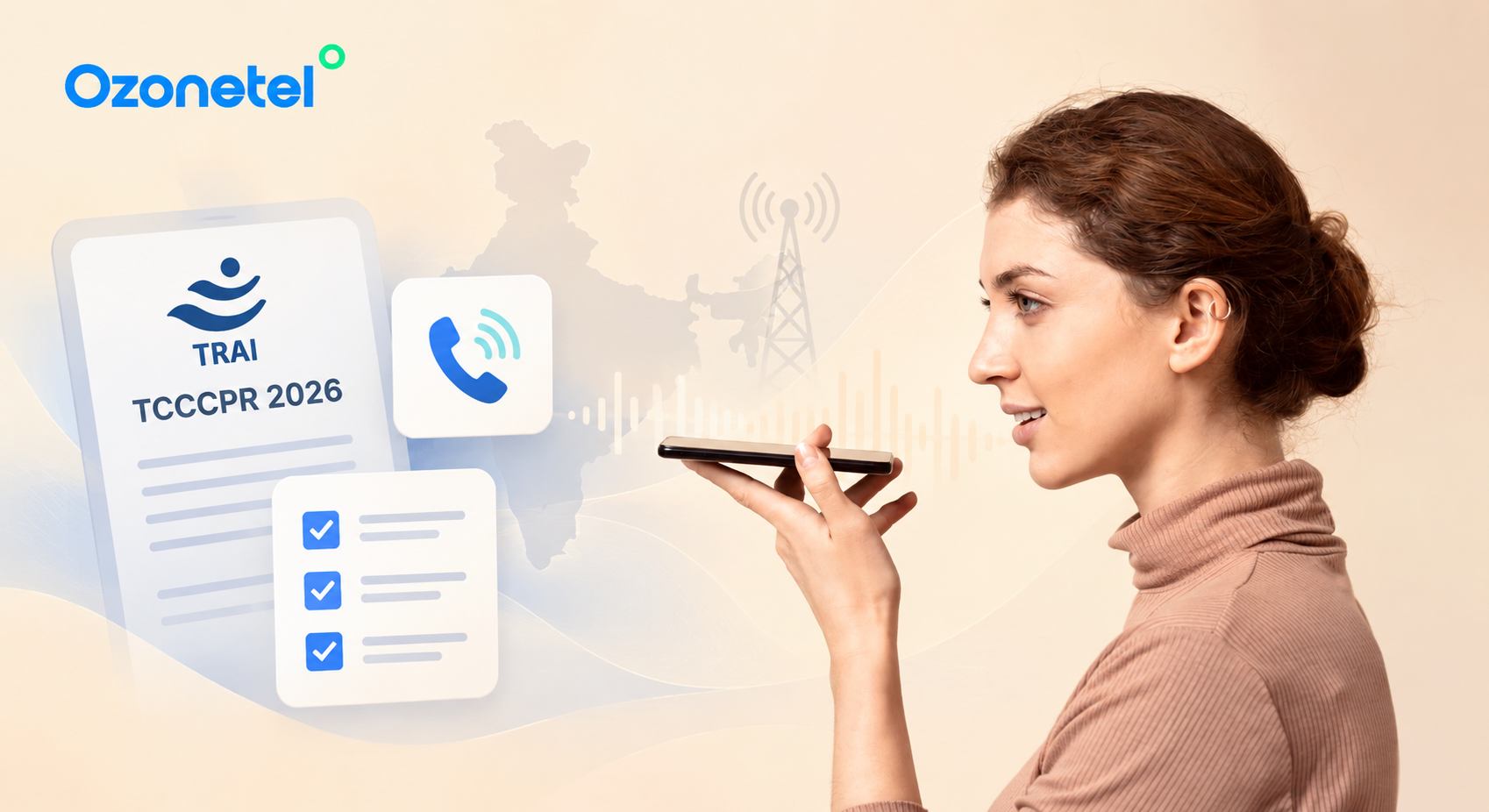
If your business uses an AI voice bot, autodialer, robocall system, or other automated platform to make outbound calls in India, the latest TRAI rules bring new compliance requirements you need to know about.
On 18 September 2026, TRAI notified its 2026 TCCCPR amendment, introducing new rules for commercial communications and UCC in India.
A key change is the formal definition of Application-to-Person (A2P) voice calls. An A2P call is an automated voice call initiated by an application, software system, or platform rather than a person manually dialling the number. The definition includes autodialled, robocall, prerecorded and artificial-voice calls.
For businesses using Voice AI, the question is no longer just:
“Can we use AI voice to call customers?”
It is:
“How do we run AI-powered outbound calling while staying compliant with TRAI’s A2P, consent, numbering and UCC requirements?”
Here’s what businesses need to know.
Key Takeaways
The short version, before you get into the comparison table and full provider profiles below:
- Cloud telephony replaces on-premise PBX hardware with cloud-hosted calling, IVR, recording, routing, and analytics, helping teams manage business calls without maintaining physical telecom infrastructure.
- Ozonetel pairs telephony with AI-powered routing, 50+ CRM integrations, omnichannel engagement, and contact-centre automation. It is built for scale rather than basic call handling, and pricing is custom-quoted rather than publicly listed.
- Budget-first options like MyOperator and Acefone can cover basic IVR, virtual numbers, and call tracking, but buyers should compare them carefully against AI depth, CRM workflow maturity, omnichannel capability, and enterprise support needs.
- TRAI/DoT compliance, DLT support, DND scrubbing, call recording controls, and data-handling rules are hard requirements for India-facing providers, not optional checkbox features.
- G2 scores vary by both rating and review volume. A 4.6 rating from hundreds of reviews carries a different level of confidence than a 5.0 rating from one or two reviews.
In this article, we will explore:
- 1. What Are A2P Calls?
- 2. Are AI Voice Calls A2P Calls?
- 3. What are the new TRAI rules for AI voice calls?
- 4. What about customer-requested callbacks?
- 5.When do the new TRAI rules take effect?
- 6. What should Voice AI businesses do now?
- 7. What do the new TRAI AI voice rules mean for businesses?
- 8. Compliance-ready Voice AI, out of the box
- 9. What This Means for Voice AI Businesses in India
What Are A2P Calls?
A2P calls are voice calls started by software instead of a human agent pressing the dial button. They include autodialled calls made through automated dialers, robocalls triggered by software, prerecorded voice calls, and artificial or AI-generated voice calls. The key distinction is who or what initiates the call, not which voice is used.
| Human-dialled call | A2P call |
|---|---|
| A person manually initiates the call | An application or automated platform initiates the call |
| An agent decides when to dial | Software triggers the call |
| Example: a salesperson manually calls a lead | Example: an autodialer automatically calls a lead |
| The conversation may use a human voice | The call may use a human, prerecorded, or artificial voice |
Are AI Voice Calls A2P Calls?
They can be. An AI voice agent that automatically initiates a call to a customer falls within the A2P definition, as does an autodialer making the same kind of call. A human agent who manually dials a customer does not make an automated A2P call. The amendment does not create a separate “AI voice” category; instead, artificial voice is covered within the A2P framework.
The mode of origination and the purpose of the call together determine which provisions apply. This covers AI voice agents used for lead qualification, appointment reminders, payment or collection reminders, customer-requested callbacks, service notifications, transaction-related communication, and automated sales or marketing calls.
What are the new TRAI rules for AI voice calls?
The amendment does not create a separate regulatory category called “AI voice calls.” Instead, it brings automated voice calling—including calls using artificial or prerecorded voice—within the broader A2P framework.
This matters because A2P calling now comes with specific requirements around:
- Declaring A2P calling to your telecom provider
- Declaring the Calling Line Identities (CLIs) being used
- Consent and consent registration
- UCC detection and complaint monitoring
- Numbering and commercial communication rules
- Potential termination charges
- KYC verification and enforcement for suspected UCC activity
In other words, the technology used to generate the voice does not remove the underlying telecom compliance obligations. The same amendment also restricts caller-ID apps like Truecaller from tagging or blocking calls on designated commercial number series, and adds a consumer right to appeal wrongly closed spam complaints—changes that sit alongside the A2P framework but are worth knowing about separately.
1. AI-powered outbound calls can fall under the A2P framework
TRAI defines an A2P call as a voice call initiated by an application, software system or automated platform without direct human dialing.
The definition expressly covers:
- Autodialling
- Robocalls
- Prerecorded voice
- Artificial voice technologies
This is particularly relevant to businesses using AI voice agents for use cases such as:
- Lead qualification
- Appointment reminders
- Payment or collection reminders
- Customer-requested callbacks
- Service notifications
- Transaction-related communication
- Automated sales or marketing calls
The important distinction is that AI voice itself is not the legal classification. The call’s mode of origination and its purpose determine which provisions apply.
2. Businesses must declare A2P calling before they start
Businesses using A2P calls must notify their originating telecom provider in advance about their use of A2P calling and the relevant CLIs, as Voice&Data’s coverage of the amendment confirms.
This creates a new operational requirement for Voice AI platforms and businesses running automated outbound campaigns.
If your platform can make calls from multiple numbers, compliance cannot stop at registering the company or the platform. You need visibility into which CLIs are being used for automated calling.
That makes CLI inventory and governance an important part of Voice AI operations. Regulated BFSI entities should note this sits alongside a separate, already-enforced obligation: the mandatory migration of service and transactional voice calls to the 1600/1601 number series.
What should businesses check?
Before launching or scaling an AI voice campaign, verify:
- Which numbers are being used for outbound calls?
- Which numbers are registered for A2P traffic?
- Has the use of A2P calling been declared to the telecom provider?
- Are promotional, service and transactional calls being handled under the appropriate numbering framework?
- Can your platform maintain an audit trail of the calls and their purpose?
Also read: TRAI 1600 Series: Compliance Guide & Deadline Status
3. Undeclared A2P calls can be treated as UCC
One of the most significant compliance risks is making A2P calls without the required prior declaration.
The regulations provide for action where a sender makes A2P calls without the required declaration, bringing such traffic into the UCC enforcement framework.
For businesses, this means “we have a legitimate business purpose” is not enough on its own.
The calling infrastructure, number resources, declarations, consent records and communication purpose all need to line up.
4. TRAI introduces a termination charge of up to 5 paise per minute
The amended framework allows the terminating access provider to charge the originating access provider up to ₹0.05 per minute for A2P calls, TelecomLead reports.
The regulation also provides exemptions for specified government, authorised and designated commercial communication number-series traffic.
For high-volume Voice AI deployments, this can become a factor in unit economics. Businesses should evaluate cost per connected minute plus telecom charges, AI voice cost, platform cost and compliance overhead, rather than looking at the AI voice cost alone.
The exact commercial impact will depend on the applicable number series, traffic configuration and arrangements between telecom operators.
5. AI/ML systems will play a bigger role in detecting suspected spam
TRAI has also formalised the use of AI/ML-based UCC_Detect systems for identifying suspected UCC activity.
Under TRAI’s February 2026 direction, terminating access providers use AI/ML systems to identify and flag a sender’s CLI as a “Suspected UCC CLI.”
Once flagged, the information must be shared with the concerned originating access provider through the DLT platform immediately and, in any case, within two hours, under the new Regulation 21A.
This changes the operating environment for high-volume outbound calling. Businesses can no longer treat complaint handling as a purely retrospective activity. They need systems that can monitor:
- Call volumes
- Calling patterns
- Complaint rates
- Number-level activity
- Campaign behaviour
- Consent status
- UCC flags
6. Three complaints can trigger action when AI has also flagged the sender
The amended framework introduces a lower complaint threshold in certain circumstances. The existing framework provides for action when there are five or more complaints from unique recipients within 10 days.
The amended framework also provides for action when three or more complaints from unique recipients occur within 10 days and a CLI associated with the sender has also been flagged as suspected UCC by the access provider’s AI system.
This combination is important for businesses running large outbound campaigns. A small number of complaints may become operationally significant when they coincide with an AI-generated spam signal.
7. Five flagged CLIs can trigger graded enforcement
The regulations also establish action based on the number of CLIs associated with the same sender that have been flagged as suspected UCC.
Where five or more CLIs belonging to a sender are flagged within 10 days, access providers can move through a graded enforcement process. The framework includes:
- KYC re-verification
- Physical KYC verification in subsequent instances
- Barring of outgoing telecom resources in specified circumstances
- More stringent action for repeat violations, including disconnection and blacklisting
For enterprises using several numbers across campaigns, this makes number-level monitoring critical.
8. Existing consent can still be recognised—but it needs to be registered
The amendment also changes how explicit consent is defined. Consent obtained through verifiable means before or outside the Consent Registration Function framework can be recognised if it is subsequently registered in the Consent Register according to the procedure specified by TRAI.
This is particularly relevant for businesses that already collect customer consent through:
- Website forms
- Mobile apps
- CRM workflows
- Customer service interactions
- WhatsApp or other digital channels
- Existing customer relationships
The key takeaway is not that businesses can simply rely on old consent records. They should be able to prove where consent came from, what it covered, and how it was subsequently registered and maintained.
What about customer-requested callbacks?
The amended framework also provides for specific service and transactional communication scenarios, including calls connected to customer enquiries and commercial transactions.
For businesses, this creates an important distinction between “the customer asked us to contact them” and “we decided to contact a customer as part of a promotional campaign.” Those are not necessarily treated the same way under the telecom framework.
If your Voice AI system supports enquiry-based callbacks, maintain a clear record of:
- The original customer enquiry
- Date and time of the enquiry
- Purpose of the requested callback
- Number used for the callback
- Outcome of the interaction
That audit trail can become important when demonstrating why a call was made
When do the new TRAI rules take effect?
TRAI notified the Third Amendment on 18 September 2026. The final regulation provides different commencement periods:
- 30 days after publication for the general provisions
- 60 days for specified provisions
- 90 days for provisions listed in the Annexure
This is more precise than treating the entire amendment as having a single enforcement date. Businesses should therefore map their compliance work against the specific provision and commencement period, rather than relying on a single October or December deadline.
What should Voice AI businesses do now?
If your organisation uses AI voice agents, autodialers or automated outbound calling, the regulatory change should translate into a practical compliance checklist.
1. Audit every outbound CLI
Create a complete inventory of the numbers your platform can use.
2. Classify your calls
Separate:
- Promotional calls
- Service calls
- Transactional calls
- Customer-requested callbacks
- Other automated communications
3. Verify A2P declarations
Confirm that your use of automated calling and relevant CLIs has been declared to the appropriate telecom provider.
4. Audit consent
Know exactly:
- Where consent came from
- What the customer consented to
- When it was obtained
- Whether it has been revoked
- Whether legacy consent needs to be registered
5. Monitor complaints and AI flags
Don’t wait for a campaign to fail. Build monitoring around:
- Complaint volume
- Complaint velocity
- CLI-level flags
- Sender-level flags
- Campaign-level patterns
6. Build compliance into the Voice AI platform
Compliance should not sit in a spreadsheet maintained by one operations team. Your platform should ideally provide visibility into the full chain: campaign, number, call, consent, complaint and compliance status—creating an auditable trail from the campaign decision to the customer interaction.
This is also where the underlying calling architecture matters: whether your outbound traffic runs on PSTN, a compliant hybrid VoIP setup, or international VoIP routes changes what’s permitted under Indian telecom law.
Also read: VoIP in India (2026): What’s Allowed, What’s Changed, and What Businesses Need to Know
What do the new TRAI AI voice rules mean for businesses?
The bigger change is not simply that TRAI has mentioned AI-generated or artificial voice technology. It is that automated voice calling is becoming part of a more structured, machine-assisted telecom compliance framework.
Voice AI platforms now need to think beyond conversation quality. A successful outbound AI voice system needs to consider:
- Can it make the call?
- Should it make the call?
- Which number should it use?
- Does the customer have the appropriate consent or relationship?
- Can the business prove why the call was made?
- What happens if the number is flagged?
For businesses scaling AI voice in India, compliance therefore becomes part of the architecture—not something to check after a campaign goes live.
Compliance-ready Voice AI, out of the box
Ozonetel’s Voice AI Agents and Auto-Dialers are built to keep declared CLIs, consent status and complaint flags visible in one place—so your outbound campaigns can be managed with compliance requirements in mind.
Talk to our team →
What This Means for Voice AI Businesses in India
TRAI’s 2026 TCCCPR amendment does not make Voice AI illegal. It is the latest step in a pattern of incremental tightening of India’s UCC rules dating back to TCCCPR, 2018. It makes automated outbound calling more accountable.
For businesses, the priority now is to bring together number management, A2P declaration, consent, campaign governance, complaint monitoring and AI-based UCC detection into one compliance workflow.
If you’re building or scaling an AI voice platform in India, the question is no longer just how naturally your AI can speak. It’s whether your entire calling infrastructure can demonstrate why it called, who authorised the call, which number it used, and how it responds when the telecom network says something is wrong.
Explore Ozonetel’s AI Voice Calls A2P Calls
Frequently Asked Questions
No. The 2026 amendment does not ban AI voice calls. Instead, it brings automated voice calls—including calls using artificial or prerecorded voice—within the A2P framework and introduces additional declaration, monitoring and enforcement requirements.
An automated voice call can qualify as an A2P call when it is initiated by an application, software system or automated platform without direct human dialing. TRAI’s definition expressly includes artificial voice technologies.
A2P calling now comes with requirements around A2P declaration, Calling Line Identity (CLI) declaration, consent and consent registration, commercial communication numbering, UCC detection, complaint monitoring, and KYC verification for suspected UCC activity. The technology that generates the voice does not remove these telecom obligations.
Businesses using A2P calling are required to declare the use of A2P calls and the relevant CLIs to the originating access provider in advance.
The amended framework permits a termination charge of up to 5 paise per minute for A2P calls, subject to the exemptions specified in the regulations.
The amended framework permits a termi
TRAI’s framework enables AI/ML-based detection of suspected UCC. Depending on the number of flagged CLIs, complaints and the sender’s compliance history, actions can include KYC re-verification, physical verification, barring of outgoing services, disconnection and blacklisting in specified circumstances.
nation charge of up to 5 paise per minute for A2P calls, subject to the exemptions specified in the regulations.
Consent obtained through verifiable means outside the Consent Registration Function can be recognised if it is subsequently registered in the Consent Register according to TRAI’s prescribed process. Businesses should maintain clear records proving the source and scope of consent.
The amendment was notified on 18 September 2026. Different provisions have 30-day, 60-day and 90-day commencement periods, so businesses should check the applicable provision rather than rely on a single enforcement date.
This is a regulation update, not legal advice. Verify commencement schedules and applicable requirements against TRAI’s official notification before setting internal compliance deadlines.