AI Call Quality Monitoring That Tells You What’s Actually Resolved
AI Call Quality Monitoring That Tells You What’s Actually Resolved
Rakesh Kr Jha
Sep 24, 2026 | 7mins read
Most call quality monitoring still measures the things that are easy to hear — tone, pace, whether the agent said the right disclosure. What most tools don’t measure is whether the customer’s actual problem got fixed. A call can score 95% on a QA scorecard and still end with the same customer calling back three days later because the fix was wrong.
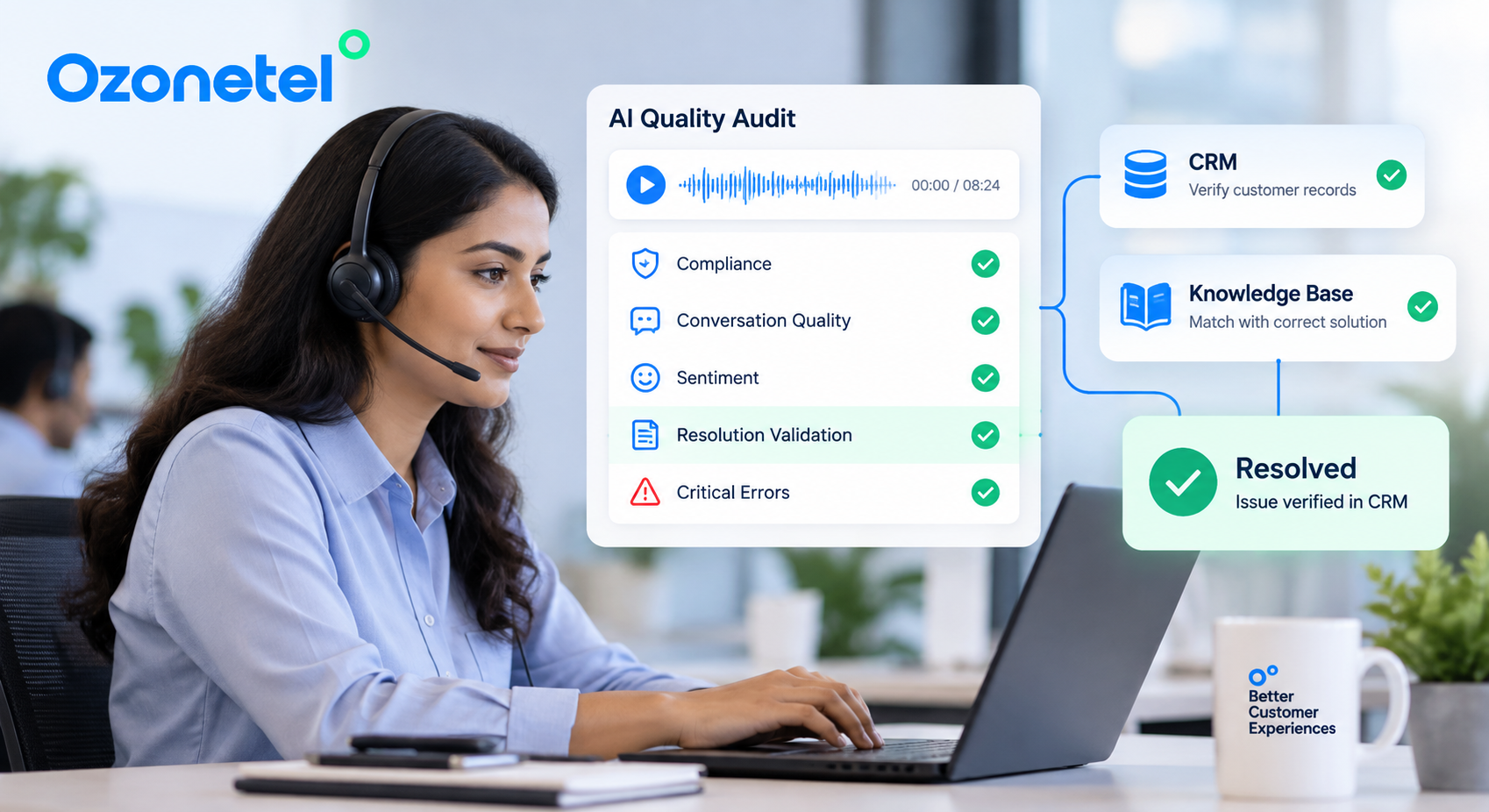
That’s the gap resolution validation closes. Instead of trusting an agent’s closing note, it checks the resolution against the CRM and knowledge base — the systems that actually know what should have happened. It’s the difference between QA that scores how a call sounded, and QA that confirms what actually got solved. Ozonetel’s AI Quality Audits are built around exactly that: 100% conversation coverage, with every resolution checked against your own systems of record, in real time, across every channel and language.
Key Takeaways
Most call quality monitoring scores how a call sounded — tone, pace, compliance language — not whether the customer’s issue was actually solved.
Resolution validation checks the agent’s response against CRM and knowledge-base records in real time, instead of trusting the agent’s own closing note.
AI-powered QA has largely solved coverage — most tools can now audit 100% of conversations. Far fewer verify resolution, support regional languages natively, or audit AI agents alongside human ones.
Not every error carries the same risk: fatal vs. non-fatal scoring means an incorrect resolution can fail a call outright, while a filler word or a long pause doesn’t.
QA that’s native to your contact center platform — not bolted on as a separate tool — means every conversation gets scored in real time, with nothing extra to integrate.
Sample-based QA has two structural limits. Coverage: most teams review just 1-2% of calls, so the vast majority of conversations are never checked at all. And depth: even the calls that do get reviewed are usually scored on tone, script adherence, and compliance — not on whether the issue was actually resolved. A polite, on-script call that ends in the wrong fix still passes.
AI-powered QA fixed the coverage problem — most tools today can audit 100% of conversations instead of a sample. Far fewer have fixed the depth problem. Scoring how a call sounds is the easy half of QA. Confirming what it actually solved is the half that matters most to the customer, and it’s the one most tools skip.
What Resolution Validation Actually Means
This is the core of how Ozonetel’s AI Quality Audits work. Every conversation is cross-checked automatically against CRM and knowledge-base records — not the agent’s own note that the issue was “resolved.” If what the agent told the customer doesn’t match what the record says should have happened, the call gets flagged.
Flags aren’t all treated the same way, either. Incorrect resolutions are scored against business-defined criticality — a wrong refund amount and a wrong callback time don’t carry the same risk, so they shouldn’t carry the same score. That’s also where fatal vs. non-fatal scoring comes in: a compliance miss or an incorrect resolution can fail a call outright, while a filler word or a slightly long pause doesn’t.
What AI Should Evaluate in a Conversation
A resolution check works alongside — not instead of — the rest of the scorecard:
Compliance — did the agent follow mandatory disclosures and processes?
Accuracy — was the information given to the customer correct?
Resolution — validated against CRM/knowledge base, not self-reported
Conversation quality — did the agent listen, respond appropriately, communicate clearly?
Customer sentiment — how did it shift across the call, not just at the end?
Critical (fatal) errors — did anything happen that needs immediate escalation?
Ozonetel scores each of these with Yes/No/Not Applicable logic instead of a rigid pass/fail — so an agent isn’t marked down for a dropped network or an angry customer calling about something unrelated. Across 40+ configurable parameters, teams weight what matters to their business, and AI suggests new parameters as patterns emerge, for a QA or business lead to review and approve.
Where Most AI QA Tools Still Fall Short
Moving to AI-powered QA solves the coverage problem, but not every tool solves what comes after. Four gaps show up often:
Resolution is scored, not verified. Most tools infer resolution from tone or a closing phrase, instead of checking it against the CRM or knowledge base — the same gap manual QA had, just automated.
English-first, regional languages an afterthought. Many AI QA platforms are built for English and struggle with regional accents and code-switching common on Indian support lines.
Human agents only. As voicebots and AI agents take on a growing share of first-line conversations, most QA tools still can’t audit them — so a bot’s fast, wrong answer looks identical to a rep’s slow, right one in the dashboard.
Bolted on, not built in. A separate QA tool means separate integration, separate data pipes, and a gap between when a call happens and when it’s actually scored.
Ozonetel’s Quality Audits close all four: resolution validation against CRM and knowledge-base records, native support across 13+ Indian languages, scoring for both human agents and AI/voicebots on the same standard, and audits that run natively inside the same platform handling the conversations — voice, chat, email, and social — so there’s nothing extra to wire up.
From Score to Coaching
A quality score sitting in a dashboard doesn’t change anything on its own. Ozonetel’s coaching layer turns scores into action automatically:
Parameter-level gaps surfaced per agent, not just a team average
Top performers flagged so their behaviors can be studied and replicated
Campaign and skill-level trends tracked automatically every 30 minutes
Variance between AI and manual QA highlighted, so scoring stays calibrated over time
QA shouldn’t just tell agents where they went wrong. It should show them how to do better next time — and show it fast enough to matter.
Proof, Not Just Promises
3,500+ brands run quality audits on Ozonetel’s platform
Up to 35% improvement in first call resolution reported by enterprises using this approach
One deployment audited 122,000+ hours of conversations across 11 languages to improve citizen engagement for 550 million people
Audits run across voice, chat, email, and social from a single platform, with unified visibility instead of siloed channel reports
How to Choose Call Quality Monitoring Software
If you’re comparing vendors, the checklist that actually separates them:
100% conversation coverage — not a bigger sample, every interaction
Resolution validated against CRM/knowledge base — not inferred from tone or a closing note
Multilingual, not English-only — built for the languages your customers actually speak
Covers human and AI agents — the same standard for reps and voicebots alike
Native to your contact center platform — not a bolt-on with its own integration project
Coaching insights, not just scorecards — agent-level, delivered fast enough to act on
The Future of Call Quality Monitoring
The trajectory is clear: sampling → 100% monitoring → AI evaluation → resolution validation → continuous improvement. The future of QA isn’t about reviewing more calls. It’s about knowing, for every conversation, whether the customer’s problem actually got solved — and turning that into intelligence the business can act on.
Is Cloud Telephony Right for Your Business?
If your team is still running calls through personal mobiles, a physical PBX, or a patchwork of forwarding rules, cloud telephony almost always pays for itself quickly in call visibility alone. The real decision is not whether to move to cloud telephony, but which tier you need: basic virtual-number-and-IVR, CRM-connected sales calling, programmable voice APIs, or a fuller CCaaS platform with AI routing and omnichannel support.
See how Ozonetel’s AI Quality Audits validate resolution against your CRM and score 100% of conversations — not just how they sound
Call quality monitoring is the process of evaluating agent-customer conversations against defined standards — compliance, resolution, communication, and customer experience — to measure and improve service quality.
Resolution validation means checking whether a customer’s issue was actually fixed by comparing the agent’s response against CRM and knowledge-base records, instead of trusting the agent’s own closing note. It catches cases where a call sounds fine but the fix was wrong.
It’s the only way to catch compliance risks, coaching gaps, and recurring customer issues before they turn into churn or regulatory penalties. Without it, contact centers are making decisions based on a fraction of what’s actually happening on calls.
Traditional QA reviews a manual sample — typically 1-2% of calls — and scores tone, script adherence, and compliance. AI call quality monitoring audits 100% of conversations automatically, and the more advanced tools also validate whether the issue was actually resolved, not just how the call sounded.
AI removes the sampling limit, applies the same scoring logic across every call, and surfaces patterns across thousands of conversations that manual QA would never catch in time.
Call monitoring usually just means recording or listening to calls. Call quality monitoring goes further — it scores those calls against defined standards and turns the results into coaching and process changes.
Yes, with the right platform. As voicebots and AI agents take on more first-line conversations, they need to be scored on the same standards as human reps — otherwise a fast, wrong bot resolution can look identical to a correct one in reporting.
At minimum: compliance, resolution (validated against CRM/knowledge base, not self-reported), communication quality, customer sentiment, and critical or fatal errors — all configurable to your business’s risk and quality priorities.
Rakesh, a senior writer at Ozonetel, draws on his decade-long journalism career to write about techn...
Rakesh Kr Jha
Senior Content Writer
Rakesh, a senior writer at Ozonetel, draws on his decade-long journalism career to write about technology. His articles delve into the latest advancements in the tech industry and provide valuable insights on improving customer experience.