- Resources
- TRAI 1600 Series: What It Means for Your Business and Your Customers
TRAI 1600 Series: What It Means for Your Business and Your Customers
Through 2024, spam calls, robocalls, and call-based fraud surged across India, steadily eroding customer trust. Most mobile subscribers reported receiving unwanted calls daily, even after registering on Do-Not-Disturb (DND) lists.
That constant exposure to spam changed how people answered the phone. Customers grew hesitant to pick up unknown numbers — a habit that didn’t just hurt marketing outreach, it also hit critical service communication. Enterprises saw missed OTPs, ignored transaction alerts, failed authentications, and declining brand credibility, especially in industries that rely on voice for time-sensitive communication.
In this article, we will explore:
- 1. The Regulatory Response: Purpose-Based Numbering
- 2. What Is the TRAI 1600 Number Series?
- 3. How the 1600 Series Works
- 4. How to Get a 1600 or 1601 Series Number
- 5. What the 1600 Series Enables for BFSI
- 6. What Is the 140 Number Series?
- 7. How to Get a 140 Series Number
- 8. Key Differences: 140 Series vs 1600 Series
- 9.The Cost of Using 140 Instead of 1600
- 10.The TRAI 1600 Series Mandate: Where Things Stand Now
- 11.Adopt the Mandatory 1600 Series with Ozonetel
The Regulatory Response: Purpose-Based Numbering
For banking, financial services, and insurance (BFSI) players — where voice is critical for security, authentication, and trust — this trust breakdown had a direct impact on both customer experience and business continuity.
To fix it, TRAI and the Department of Telecommunications (DoT) introduced dedicated numbering ranges — 140 and 1600 — under the Unified Communications Compliance (UCC) framework.
The principle is simple:
- 1600 series → Service and transactional voice calls
- 140 series → Promotional and telemarketing voice calls
This separation lets customers instantly recognise the purpose of a call, gives telecom operators a way to enforce controls at the network level, and gives regulators stronger tools to detect, block, and penalise misuse.
The effect is already visible in complaint data: unregistered-telemarketer complaints fell sharply through late 2024 as purpose-based numbering rolled out, while complaints against registered telemarketers stayed a fraction of that volume.
What Is the TRAI 1600 Number Series?
The 1600 series is a dedicated 10-digit numbering range, assigned by the DoT under TRAI’s UCC framework, reserved exclusively for service and transactional voice calls. It splits into two sub-ranges:
- 1600-prefix numbers — allocated to central and state government agencies and public sector organisations.
- 1601-prefix numbers — allocated to private-sector financial entities regulated by RBI, SEBI, IRDAI, and PFRDA (banks, NBFCs, insurers, stockbrokers, asset managers, and pension fund entities).
Typical use cases on the 1600/1601 range include:
- OTP and authentication calls
- Transaction confirmations
- Account and policy alerts
- Fraud warnings and risk notifications
Unlike regular 10-digit mobile numbers or the 140 promotional range, 1600/1601 numbers are reserved only for verified, non-promotional use and allocated exclusively to KYC-verified, regulated entities.
How the 1600 Series Works
Entity Verification
Only registered and verified Principal Entities — banks, NBFCs, fintechs, insurers, government bodies, and other regulated service providers — are eligible for a 1600 or 1601 number.
Purpose-Based Allocation
Calls placed using 1600-series numbers are strictly mapped to service or transactional use cases — never promotions, offers, or sales outreach.
Network-Level Validation
Telecom networks validate that calls from 1600-series numbers match approved templates and registered entities. Any deviation can trigger blocking or penalties.
Clear Identification for Customers
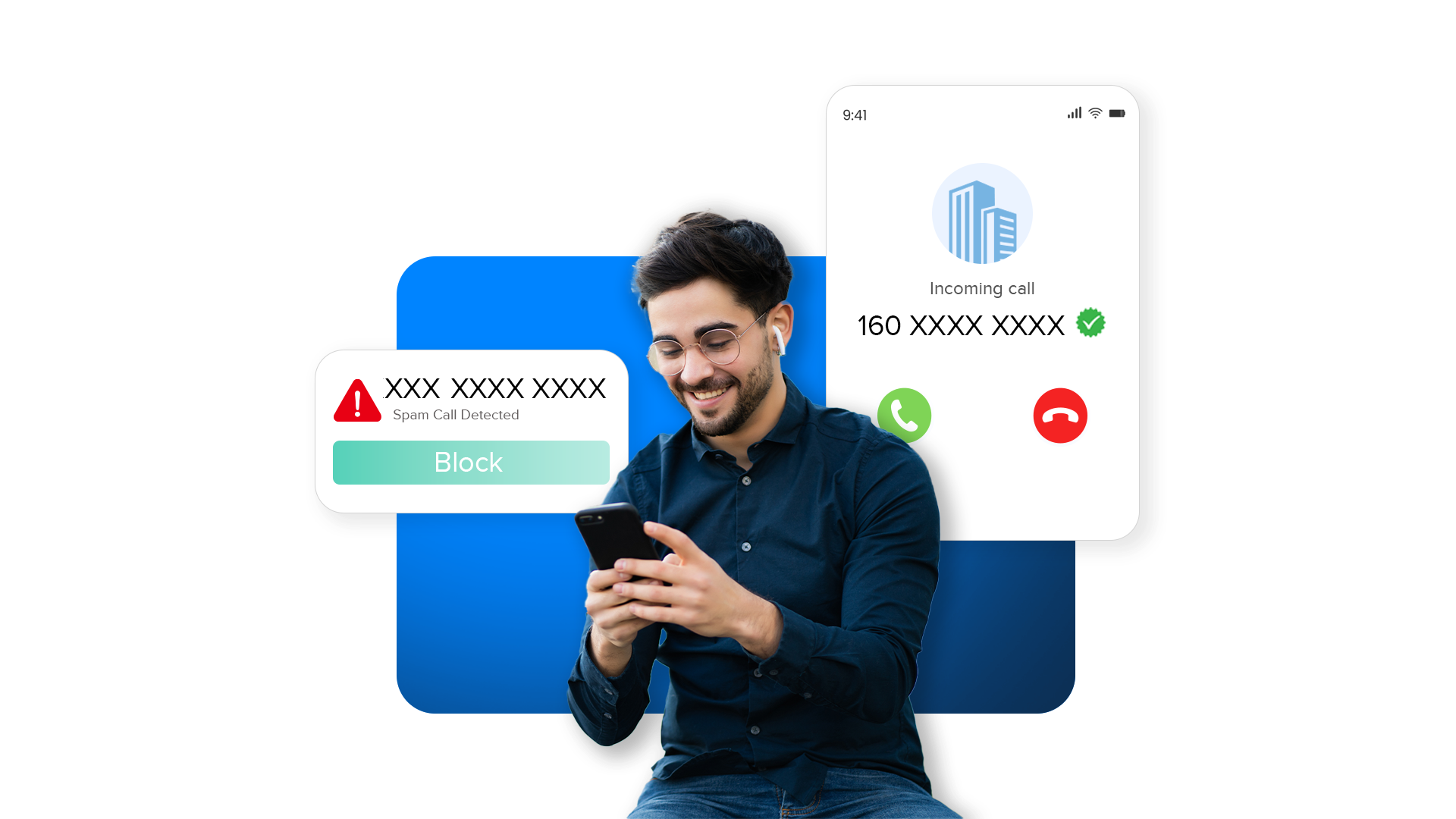
Because 1600/1601 is a recognised transactional prefix, subscribers can immediately identify these calls as legitimate service communications, not marketing calls.
Stronger Enforcement and Blocking
If a 1600-series number is misused, regulators and operators can quickly identify, trace, and block it — preventing large-scale abuse.
How to Get a 1600 or 1601 Series Number
- Confirm eligibility — only verified, regulated entities (banks, NBFCs, insurers, fintechs, government bodies) qualify.
- Complete entity verification and KYC as required by telecom and regulatory guidelines.
- Define approved use cases — service and transactional calls only (OTPs, alerts, fraud notifications), never promotions.
- Provision through an authorised telecom service provider or platform that supports TRAI–DoT compliance.
- Enable compliant calling — once assigned, all calls are validated at the network level against approved purpose and usage rules.
What the 1600 Series Enables for BFSI
For BFSI players, the 1600 series isn’t just a compliance checkbox — it’s a strategic enabler of trust, security, and CX. A verified 1600/1601 number raises pickup rates on OTPs and alerts, reduces the chance customers mistake a service call for spam, and gives compliance teams a clean audit trail for every transactional call.
What Is the 140 Number Series?
The 140 number series is TRAI’s dedicated range for promotional and telemarketing voice calls — designed to clearly identify marketing calls and ensure they reach only customers who’ve given the required consent.
- Used exclusively for promotional calls — offers, sales outreach, campaigns
- Mandatory registration of entities, headers, and call templates on the DLT platform
- Consent-based delivery, aligned with customer preferences and DND settings
- Strict monitoring and blocking if the series is misused or consent rules are violated
How to Get a 140 Series Number
- Choose a registered telemarketer or platform provider (such as Ozonetel).
- Ensure that telemarketer is registered on the DLT portal of at least one Telecom Service Provider (TSP).
- Register your business (Principal Entity) on the DLT platform with a valid Entity ID.
- Have the telemarketer link the 140 number to your Entity ID on the DLT portal.
- Register and get approval for your voice headers and call templates, and call only with valid customer consent.
Key Differences: 140 Series vs 1600 Series
| Aspect | 140 Series | 1600 / 1601 Series |
|---|---|---|
| Primary Use | Promotional and telemarketing voice calls | Service and transactional calls such as OTPs, alerts, and account notifications |
| Who Should Use It | Registered telemarketers and businesses approved for promotional outreach | Verified banks, BFSI organizations, government bodies, and regulated entities |
| Delivery & Screening | Subject to consent and opt-out rules; may be throttled if abused | Stricter verification and routing; treated as higher-trust traffic |
| Call Traceability | End-to-end traceability through DLT platforms | Immutable traceability with enhanced audit controls |
| DND Enforcement | Mandatory DND scrubbing; blocked for DND users without consent | Exempt from DND blocking for legitimate service calls to existing customers |
| Consent Requirement | Explicit opt-in consent required for promotional communication | Implied consent for existing customers; usage strictly monitored |
| Action on Misuse | Progressive penalties: template suspension, number suspension, and blacklisting | Immediate suspension, blacklisting, and regulatory escalation (RBI, SEBI, IRDAI, etc.) |
The Cost of Using 140 Instead of 1600
When enterprises use 140 numbers — or unregistered 10-digit numbers — for transactional or service calls, they expose themselves to real consequences.
Regulatory impact:
- Call blocking by telecom operators
- Suspension of headers or entities
- Penalties or disconnection of voice resources
- Blacklisting across operators under TCCCPR norms
Customer experience impact:
- Customers ignore calls, assuming they’re promotional
- OTPs and alerts go unanswered
- Transactions fail or get delayed
- Support escalations and churn increase
For BFSI and other regulated industries, this directly affects revenue continuity, compliance posture, and customer trust.
The TRAI 1600 Series Mandate: Where Things Stand Now
TRAI issued its direction mandating BFSI migration to the 1600/1601 series on November 20, 2025, with a phased rollout rather than a single cut-off:
| Regulator / Segment | Migration Deadline | Status |
|---|---|---|
| RBI — Commercial Banks | Jan 1, 2026 | Passed |
| RBI — Large NBFCs, Payment Banks, Small Finance Banks | Feb 1, 2026 | Passed |
| IRDAI — All Insurance Entities | Feb 15, 2026 | Passed |
| SEBI — Mutual Funds & AMCs | Feb 15, 2026 | Passed |
| PFRDA — Recordkeeping Agencies & Pension Fund Managers | Feb 15, 2026 | Passed |
| RBI — Remaining NBFCs, Co-operative Banks & RRBs | Mar 1, 2026 | Passed |
| SEBI — Qualified Stockbrokers | Mar 15, 2026 | Passed |
As of today, every phase of the mandate has closed. This isn’t a “deadline approaching” story anymore — it’s an enforcement story. Adoption has been uneven: large, well-resourced banks and NBFCs largely migrated on schedule, while smaller co-operative banks, regional rural banks, and smaller NBFCs are still catching up in patches.
What enforcement looks like for entities that haven’t migrated:
- Telecom-side blocking — the strongest lever isn’t a fine, it’s access providers refusing to complete outbound traffic from non-compliant CLIs. Campaigns simply stop connecting.
- Regulatory penalties as prescribed under the relevant TRAI direction and TCCCPR norms.
- Supervisory exposure — RBI and other sector regulators are expected to begin referencing 1600-series non-compliance in routine supervisory reviews later this year, with audit-level visibility likely by 2027.
If your organisation hasn’t completed migration, the practical next step is the same one it was in November 2025 — just more urgent: inventory every outbound CLI, confirm entity verification status, and provision through an authorised, compliant provider.
Adopt the Mandatory 1600 Series with Ozonetel
Ozonetel enables fast activation of the 1600/1601 series with secure, verified call routing and a trusted caller identity customers instantly recognise. Intelligent auto dialers automatically route service and transactional calls through the correct number series, ensuring timely delivery of OTPs, alerts, and confirmations — while improving pickup rates at scale.
By embedding purpose-based numbering directly into call workflows, Ozonetel helps enterprises meet TRAI guidelines, reduce fraud risk, and deliver a reliable, trusted voice experience — whether you’re completing a delayed migration or auditing an existing one.
Get 160-Series Ready with Ozonetel
Frequently Asked Questions
No. 1600 and 1601 numbers are TRAI-allocated to verified, regulated entities — banks, NBFCs, insurers, and government bodies — exclusively for service and transactional calls like OTPs, account alerts, and fraud warnings. They cannot legally be used for promotional or telemarketing calls.
Most likely because a bank, insurer, NBFC, or government body you have an existing relationship with sent you a service-related communication — an OTP, a transaction confirmation, an account alert, or a fraud warning. These numbers are reserved for that exact purpose.
140 numbers are used for promotional and telemarketing calls and require your consent under DND rules. 1600/1601 numbers are reserved for service and transactional calls from regulated entities and are exempt from DND blocking for existing customers. If you’re getting promotional content from a 1600/1601 number, that’s a compliance violation worth reporting.
Yes, you can block any number through your phone’s standard call-blocking settings. But because 1600/1601 numbers carry service-critical communication — OTPs, fraud alerts, payment confirmations — blocking them outright can mean missing time-sensitive account information.
No. 1600 and 1601 are domestic 10-digit prefixes allocated by India’s Department of Telecommunications specifically for BFSI and government service calls. Calling them back doesn’t incur premium charges beyond your normal calling rates.
Entities regulated by RBI (banks, NBFCs, payment banks, small finance banks), IRDAI (insurers), SEBI (mutual funds, AMCs, stockbrokers), PFRDA (pension fund managers, recordkeeping agencies), and central or state government bodies are mandated to migrate service and transactional voice calls to the 1600/1601 series.

You’re exposed to telecom-side call blocking on non-compliant numbers, penalties under the applicable TRAI direction, and growing supervisory scrutiny from your sector regulator. There’s no grace period built into the mandate — the practical fix is to migrate as quickly as possible through an authorised provider rather than wait for enforcement to escalate further.
Yes. TRAI’s phased mandate, issued November 20, 2025, closed its final phase (SEBI-regulated stockbrokers) on March 15, 2026. Every BFSI and government segment covered by the direction is now past its migration deadline, which means the current focus for regulators and telecom operators has shifted from rollout to enforcement.