- Resources
- Why Are Insurance Customers Leaving Their Insurers in India?
Why Are Insurance Customers Leaving Their Insurers in India?
Why are insurance customers leaving their insurers in India — even when premiums haven’t gone up and coverage hasn’t changed?
The numbers say it plainly: roughly 4 in 10 life insurance policyholders don’t renew even once, and industry-wide health insurance renewal rates average just 67%. Acquisition was never the hard part — keeping customers was. And when IRDAI looked into why, the answer wasn’t complex policy disputes. It was something simpler: communication gaps and avoidable delays. Not bad products. Bad conversations.
Key Takeaways
The short version, before you get into the comparison table and full provider profiles below:
- Cloud telephony replaces on-premise PBX hardware with cloud-hosted calling, IVR, recording, routing, and analytics, helping teams manage business calls without maintaining physical telecom infrastructure.
- Ozonetel pairs telephony with AI-powered routing, 50+ CRM integrations, omnichannel engagement, and contact-centre automation. It is built for scale rather than basic call handling, and pricing is custom-quoted rather than publicly listed.
- Budget-first options like MyOperator and Acefone can cover basic IVR, virtual numbers, and call tracking, but buyers should compare them carefully against AI depth, CRM workflow maturity, omnichannel capability, and enterprise support needs.
- TRAI/DoT compliance, DLT support, DND scrubbing, call recording controls, and data-handling rules are hard requirements for India-facing providers, not optional checkbox features.
- G2 scores vary by both rating and review volume. A 4.6 rating from hundreds of reviews carries a different level of confidence than a 5.0 rating from one or two reviews.
In this article, we will explore:
Why Policyholders Walk Away
Insurance is a trust business, and trust is built or broken in the moments between the policy sale and the claim, not at the point of sale itself. Most insurers don’t lose customers over pricing or coverage gaps. They lose them to a missed callback during a renewal window, a claims update that never arrived, or an IVR menu that loops a policyholder in circles instead of connecting them to a human who can help. None of these feel like big failures alone — which is exactly why they’re easy for an insurer to miss and easy for a customer to remember.
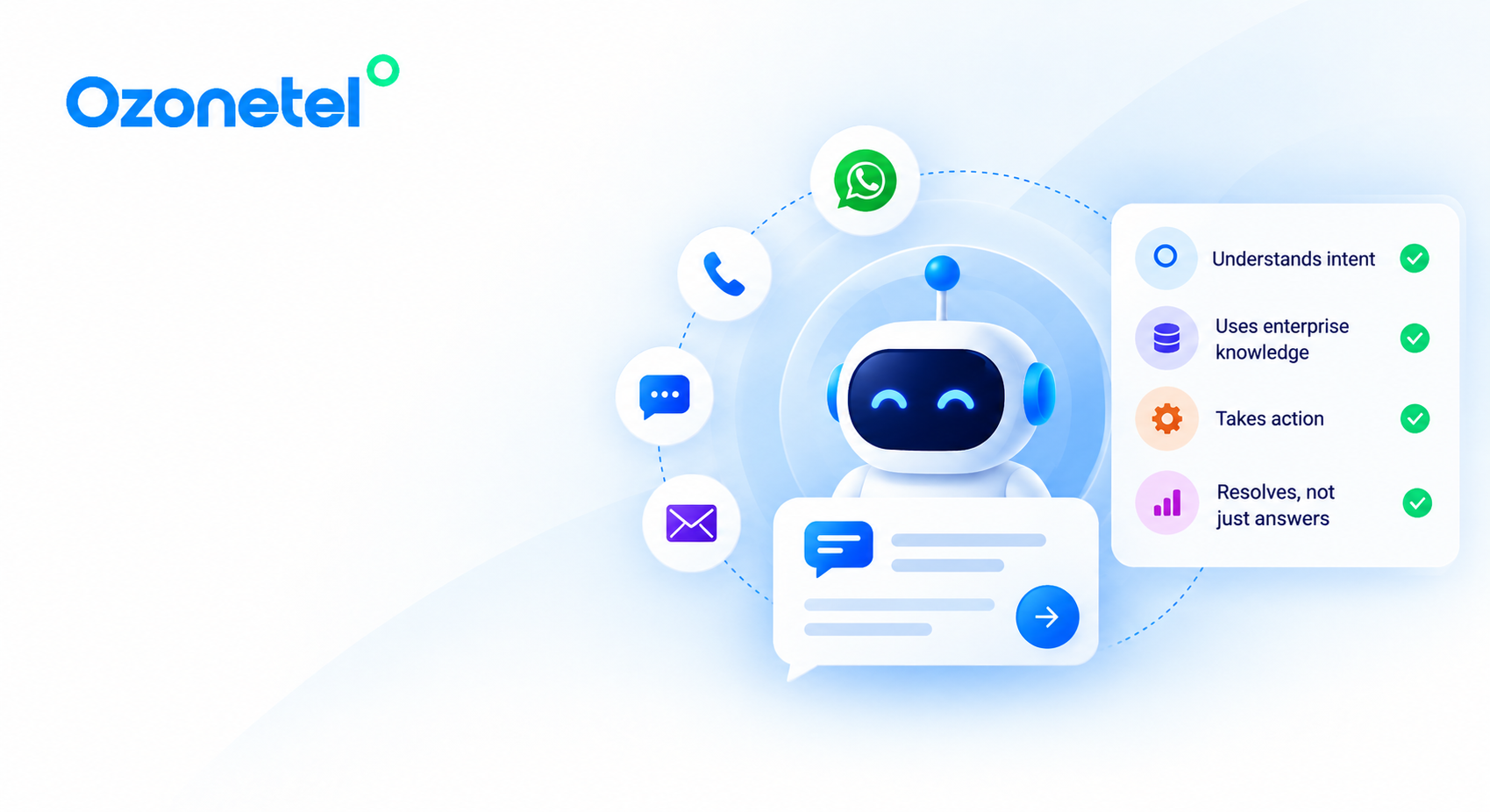
In a market this linguistically and geographically diverse — dozens of languages, a wide urban-rural split, millions of first-time buyers — these aren’t edge cases. A policyholder confused about their coverage, a claim status that never reaches them, a renewal reminder that arrives too late or through the wrong channel — that’s the default failure mode unless an insurer actively designs around it, unifying voice, chat, WhatsApp, and email into one continuous conversation the way Ozonetel’s CX platform for insurers does across the industry today. Done right, that’s exactly the revenue that would otherwise leak away silently, one unreturned call at a time.
How Leading Insurers Are Closing the Gap
The insurers actually closing this gap aren’t spending more on marketing — they’re fixing the conversation itself.
PM-JAY, India’s flagship public health insurance scheme, shows what CX looks like at national scale. Serving over 550 million citizens across dozens of languages and literacy levels, its National Health Authority used speech analytics on Ozonetel’s platform to automate quality monitoring across its network of remote healthcare advisors — analyzing over 122,000 hours of conversations across 11 vernacular languages instead of relying on manual sampling that could never keep pace. At that scale, CX infrastructure isn’t a nice-to-have; it’s the difference between a scheme that exists on paper and one that reaches people in remote regions with the same service quality as metro cities.
HDFC ERGO rebuilt renewals around a centralized outreach system instead of leaving them to intermediaries — automating reminders, callback scheduling, and agent routing instead of treating renewals as routine transactional calls. The shift moved renewals from reactive and agent-dependent to proactive and automated, freeing agents to focus on complex escalations. Result: an 85% renewal rate, renewal processing time cut by 50%, and complaints down 80%. Renewals, done right, turned out to be a growth function, not a support one.
ACKO faced a different pressure — customers expect app-like speed even when they pick up a phone. By layering self-service IVR with intelligent routing, letting simple queries resolve without agent intervention while complex ones reached the right person instantly, it lifted routing accuracy by 20% and delivered 50% faster resolutions — feeding a 90% CSAT score. For a digital-native insurer, the phone call finally moved at the same speed as the app.
At Kotak Life, the sales journey doesn’t end at policy issuance — it extends into onboarding, servicing, and eventual renewal, and friction anywhere along that path shows up later as a lapse. Integrating its CRM with a unified CX platform, automating lead validation and routing, and using skill-based segmentation and hybrid dialing got it 3X higher conversions, 72% connectivity, and 70% faster callback turnaround, with end-to-end visibility from acquisition through renewal.
Star Health, Niva Bupa, and Manipal Cigna are among the health insurers now running on the same Ozonetel platform — a sign of how standard this approach has become across India’s insurance industry, not an exception limited to a few early adopters.

See how HDFC ERGO, ACKO, and Kotak Life closed their CX gaps
Conclusion
Closing this gap comes down to three things: making policy information genuinely clear at the point of sale and beyond, carrying context across every channel so a customer never repeats themselves to a new agent, and communicating proactively instead of waiting to be asked. It’s a smaller shift than it sounds on paper — and the insurers making it are already seeing the payoff in stronger renewals, fewer complaints, and faster conversions. That’s the difference between a policyholder who renews without thinking twice and one who becomes another line in next year’s grievance report.
Ready to see where your own CX gap sits?
Frequently Asked Questions
A provider hosts your virtual numbers and call logic on cloud servers. Calls route through the provider’s network according to configured rules such as IVR menus, agent skills, business hours, and CRM context, then connect to agents on internet-connected devices.
The right provider depends on your business size, call volume, channels required (voice, WhatsApp, SMS), compliance needs, integrations, and scalability. Enterprises often need omnichannel and automation, while SMBs may prioritise affordability and ease of setup.
VoIP is the underlying technology that carries voice as data over the internet. Cloud telephony is a full business communication service built on top of VoIP, adding IVR, routing, recording, analytics, CRM integration, and compliance handling.
A traditional PBX is on-premise hardware a business owns, maintains, and scales manually. Cloud telephony moves that system to the provider’s cloud, reducing hardware maintenance and allowing agents to work from anywhere.
Cloud telephony pricing in India varies by provider, call volume, agent count, numbers, channels, integrations, and add-ons. Some vendors publish entry plans, while enterprise-focused platforms such as Ozonetel use custom quote-based pricing. Always ask about setup fees, number rental, per-minute charges, recording storage, API usage, AI add-ons, and support costs before comparing quotes.
Reputable providers offer encryption, access controls, defined data-retention policies, and audit logs. For BFSI, healthcare, education, and other regulated industries, confirm certifications, storage location, retention policies, and access controls directly with the provider.
Yes. Most established providers integrate with CRMs and helpdesks such as Salesforce, Zoho, HubSpot, Freshdesk, and LeadSquared either through pre-built connectors or APIs. Ozonetel offers 50+ pre-built integrations; buyers should still check the depth and maintenance quality of the specific connector they need.
For high-volume, AI-powered contact centres with deep CRM and omnichannel needs, Ozonetel is a strong fit because it is built for scale, routing depth, analytics, and agent productivity. For genuinely simple needs, providers such as MyOperator or Servetel / Acefone may be sufficient without over-buying.
Reputable India-facing providers should support TRAI and DoT compliance requirements, including DLT registration for messaging, DND scrubbing, and appropriate call recording and data-handling workflows. Confirm compliance as a baseline requirement with any provider, not an optional add-on.
Rakesh Kr Jha
Senior Content Writer
Rakesh, a senior writer at Ozonetel, draws on his decade-long journalism career to write about techn...
Rakesh Kr Jha
Senior Content Writer
Rakesh, a senior writer at Ozonetel, draws on his decade-long journalism career to write about technology. His articles delve into the latest advancements in the tech industry and provide valuable insights on improving customer experience.