- Resources
- How Enterprises Are Using Conversational AI to Improve Customer Experience
How Enterprises Are Using Conversational AI to Improve Customer Experience

Rakesh Kr Jha
May 28, 2026 | 13 mins read

Customer expectations have shifted dramatically. Today’s customers demand instant responses, personalized support, and seamless communication across every channel. Enterprises that fail to meet these expectations lose on retention, brand loyalty, and operational efficiency — all at once.
To close that gap, enterprises across industries are investing heavily in conversational AI — from AI-powered chatbots and virtual assistants to agentic voice agents that can execute complex, multi-step workflows without human intervention. Platforms like Ozonetel have already demonstrated what this looks like at scale: a DTH operator serving 12 million subscribers automating 55% of queries, an NBFC running 22,000 agents gaining 15% efficiency improvements, and a state government delivering 580+ public services through a single WhatsApp number — 24/7.
Conversational AI in customer experience is no longer a futuristic innovation. It is a strategic necessity — and the enterprises deploying it right are pulling ahead fast.
55%
query automation at a 12M-subscriber DTH operator (Ozonetel)
90%
first-call resolution rate achieved at a leading NBFC
3L+
citizen sessions/month via WhatsApp AI for state government services
In this article, we will explore:
- 1.What Is Conversational AI?
- 2. Why Enterprises Are Investing in Conversational AI
- 3. How Enterprises Use Conversational AI to Improve Customer Experience
- 4. Conversational AI Beyond Private Enterprise: Government-Scale Deployment
- 5. Industries Leading Conversational AI Adoption
- 6. Measurable Benefits of Conversational AI in Customer Experience
- 7. Challenges Enterprises Must Address
- 8. The Future of Conversational AI in Customer Experience
What Is Conversational AI?
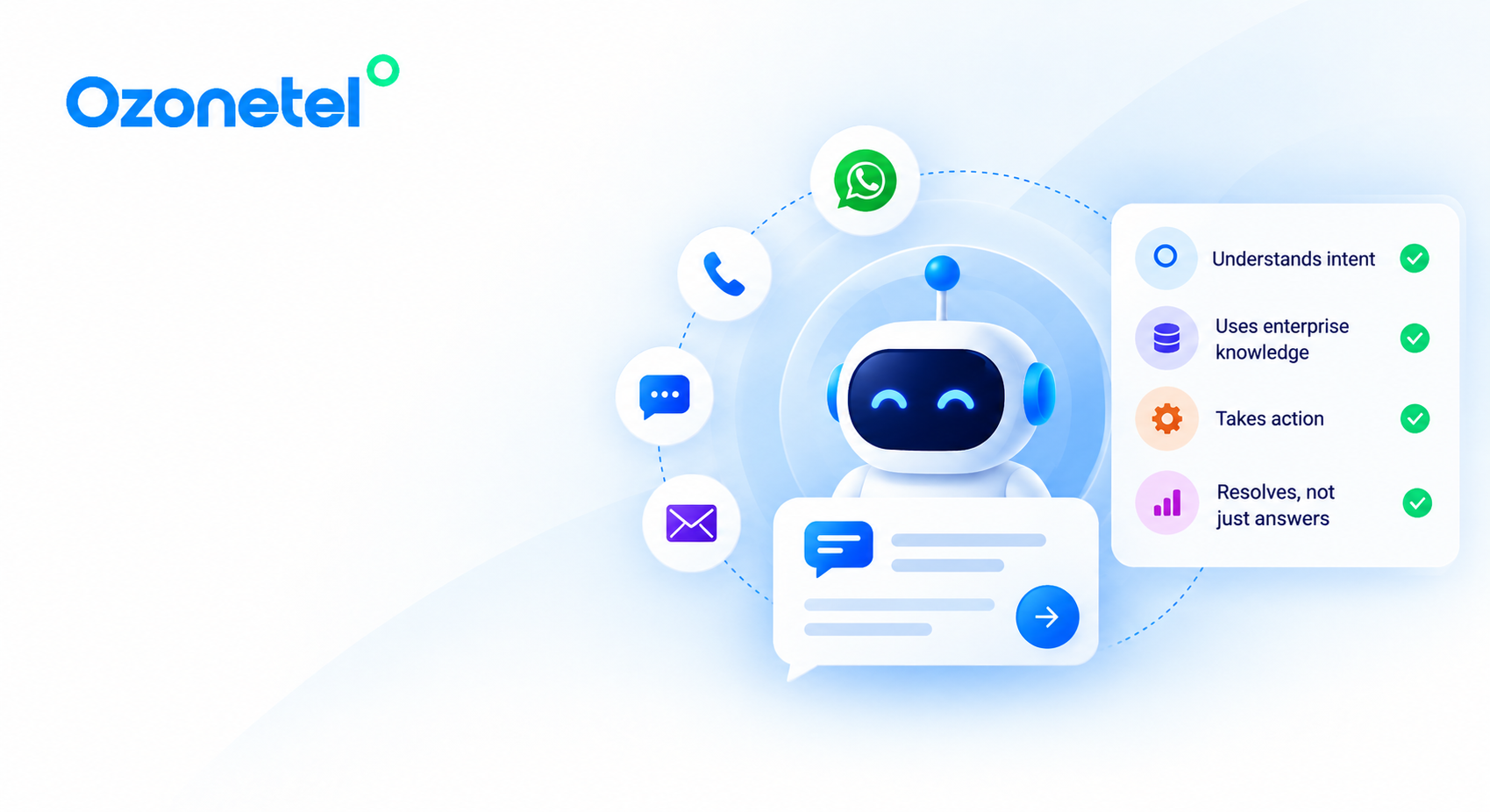
Conversational AI refers to technologies that enable machines to interact with humans using natural language. These systems combine natural language processing (NLP), machine learning, speech recognition, and large language models (LLMs) to understand, process, and respond to queries in real time.
Unlike traditional rule-based chatbots, modern conversational AI systems can:
- Understand context and intent across multi-turn conversations
- Deliver human-like responses that adapt to sentiment and urgency
- Learn continuously from customer interactions
- Handle complex, multi-step workflows end-to-end
- Provide multilingual support across voice and text channels
- Operate across websites, apps, WhatsApp, call centers, and social media
The Agentic Shift
The most important evolution in conversational AI is the move from reactive bots to agentic AI — systems that don't just answer questions but actually execute workflows: validating eligibility, triggering payments, updating CRMs, booking appointments, and escalating to a human agent only when genuinely required
Why Enterprises Are Investing in Conversational AI
Modern enterprises handle thousands of customer interactions daily. Managing these manually increases costs, slows response times, and frustrates customers. Conversational AI automates high-volume interactions while lifting satisfaction — but the enterprises winning with AI are those going beyond simple FAQ bots.
Several factors are accelerating enterprise adoption:
Rising Customer Expectations
Customers expect 24/7 support and instant responses. Agentic AI enables businesses to provide continuous, context-aware support without scaling headcount linearly.
Omnichannel Communication
Customers move fluidly across email, voice, chat, WhatsApp, and social media. Unified conversational AI maintains context and consistency across every channel, so customers never have to repeat themselves.
Demand for True Personalization
AI systems that analyze purchase history, browsing behavior, previous conversations, and demographic signals can deliver genuinely tailored responses — not just name insertion.
Cost Optimization at Scale
Conversational AI reduces repetitive query load on human agents, freeing them for complex, high-value interactions. At the NBFC scale — 22,000 agents — even a 15% efficiency improvement translates to significant operational savings.
Scalability Without Quality Trade-offs
During peak seasons, AI handles high conversation volumes without degradation in service quality — something impossible to achieve through staffing alone.
How Enterprises Use Conversational AI to Improve Customer Experience
1. Delivering 24/7 Support Without Scaling Headcount
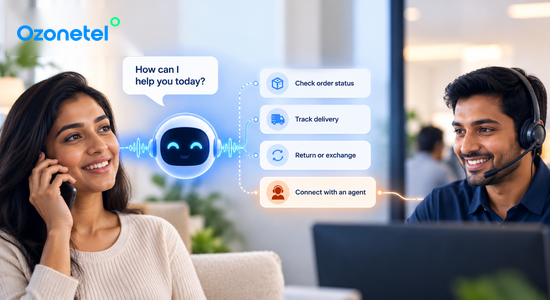
AI-powered virtual assistants answer FAQs, assist with troubleshooting, and resolve common issues — instantly, around the clock. Enterprises use them to handle:
- Order tracking and delivery updates
- Billing inquiries and payment processing
- Password resets and account management
- Appointment scheduling and confirmations
- Product recommendations and upsells
- Service status updates and alerts
This always-on model improves CSAT while reducing pressure on human support teams.
2. Agentic AI: From Answering Questions to Executing Workflows
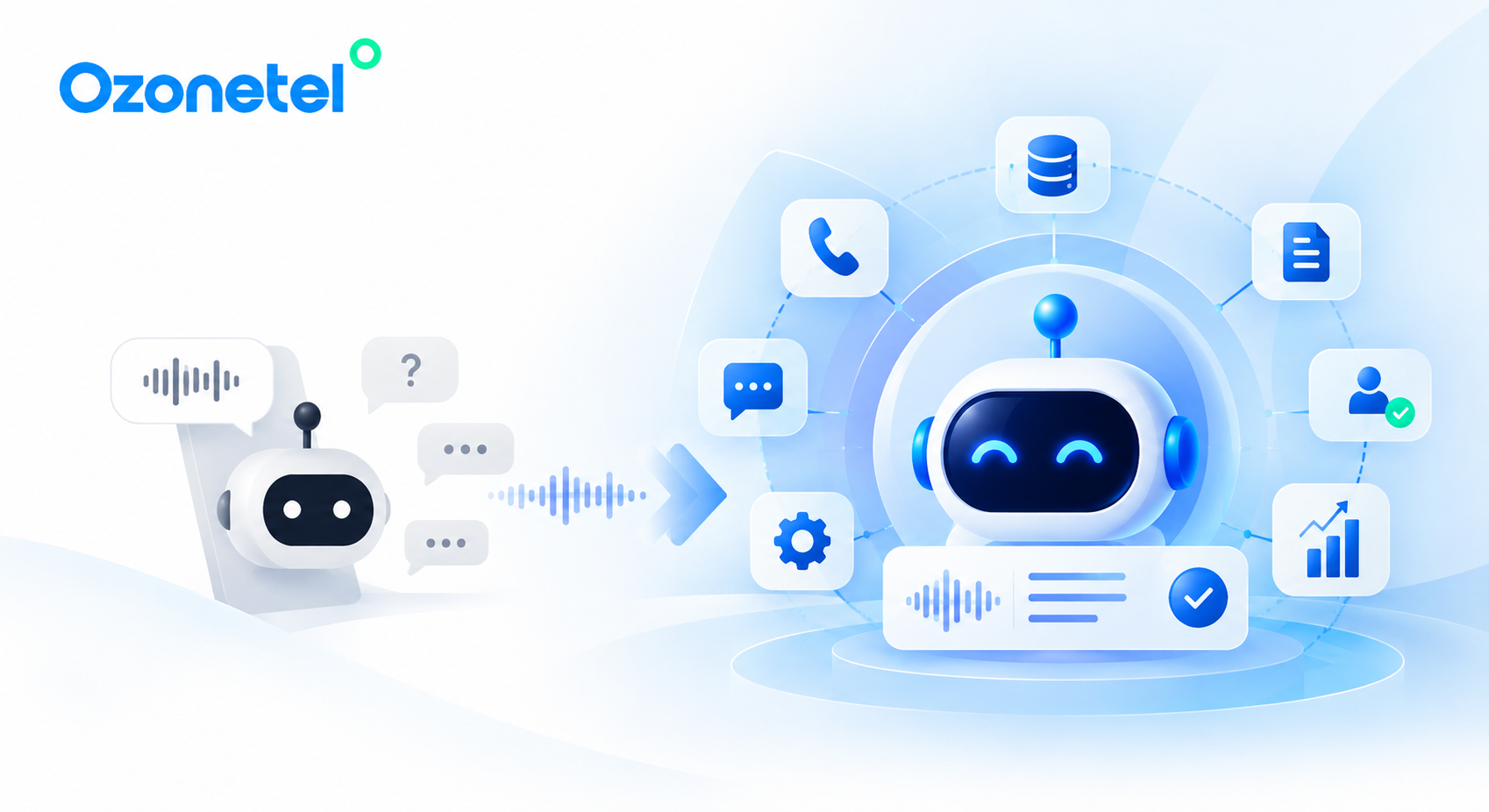
The most significant shift in enterprise CX is the move to agentic AI — systems that don’t just retrieve information but execute multi-step workflows, make decisions mid-conversation, and recover gracefully from unexpected inputs.
Ozonetel in Action: DTH Operator at 12M-Subscriber Scale
A leading DTH operator needed to serve customers in Hindi and 10+ regional languages across channel activations, error resolution, promotional queries, and value-added services — at a scale no traditional IVR could approach.
Ozonetel built a custom AI orchestration platform with hot-swappable TTS, ASR, and LLM providers, and domain-specific agents per workflow (one for channel activation, one for error resolution, one for VAS) — with clean handoffs between them and a deterministic data layer for zero-hallucination lookups via REST API.
Result: 55% customer queries automated (20% higher than self-service IVR), 88% QA score aligned with human audit benchmarks, across 6 service touchpoints.
The architecture principle behind this matters: use domain-specific agents, not one general agent. One AI handling billing, technical support, upgrades, and complaints simultaneously will be mediocre at all of them. Specialized agents, orchestrated by intelligent routing, consistently outperform.
3. Reducing Customer Wait Times with Intelligent Routing
Long wait times remain one of the top drivers of customer dissatisfaction. Conversational AI in customer support eliminates queue delays by instantly processing requests and routing conversations to the right department or agent — without unnecessary transfers.
AI voice agents in contact centers handle initial interactions, collect relevant context, and reduce average handling time. When a human does step in, they step in informed — with full conversation context already transferred.
4. Personalizing Interactions at Scale
Personalization plays a critical role in modern CX. Conversational AI enables enterprises to analyze purchase history, browsing behavior, previous conversations, customer preferences, and demographic data to deliver tailored, context-aware interactions.
An eCommerce company can use conversational AI to suggest products based on previous purchases. A banking institution can offer customized financial guidance. An NBFC can use conversation data to identify cross-sell opportunities mid-call — and act on them.
Ozonetel in Action: NBFC Revenue Intelligence at 22,000-Agent Scale
One of India’s largest NBFCs deployed Ozonetel’s agentic AI layer not just for self-service (overdue payments, loan inquiries, insurance updates) but for revenue intelligence: analyzing conversations to identify lost opportunities worth crores, detect buying patterns, surface churn signals, and score agent performance.
Voice AI agents now handle cross-sell outreach to existing customers — a revenue function that previously required human agents working manually sourced lists.
Result: 15% improvement in agent efficiency, 90% first-call resolution.
5. Enhancing Omnichannel Experience
Modern customers move across multiple communication channels throughout their buying journey — starting on web chat, continuing on WhatsApp, resolving on a call. Enterprises use conversational AI to maintain conversation continuity across all channels.
This omnichannel capability ensures consistent messaging, unified customer profiles, seamless context retention, and — critically — no repetition. Customers should never have to re-explain their situation simply because they switched channels.
6. Improving Contact Center Efficiency with Agent Assist
Contact centers face constant pressure to cut costs while improving quality. AI-powered Agent Assist solutions help by surfacing real-time recommendations during live conversations — extracting 3–5 critical keywords, mapping them to the most relevant knowledge base entry, and presenting a concise prompt. One clear recommendation, not five competing options.
Speed is non-negotiable here. A suggestion surfacing 8 seconds after a customer finishes speaking is useless in a live interaction. Enterprise-grade agent assist must process conversational context and surface a recommendation in under 1 second.
Paired with automated post-call summaries that update CRM directly, this eliminates the after-call work that typically consumes 20–30% of handle time.
7. Providing Multilingual Support Across Regions
Global enterprises struggle to support customers across different languages without building large multilingual teams. Modern conversational AI handles multiple languages — including regional dialects — with high accuracy.
Ozonetel’s DTH deployment operates fluently across Hindi and 10+ regional Indian languages. For enterprises serving diverse customer bases, this multilingual capability enables genuine inclusivity without proportional staffing cost.
8. Proactively Engaging Customers
Enterprises are moving beyond reactive support to proactive engagement. Agentic AI systems automatically send appointment reminders, notify customers about delivery updates, recommend products, follow up after purchases, and alert customers about service disruptions.
Airlines use conversational AI for real-time flight updates. Healthcare providers send automated appointment reminders and post-visit instructions. NBFCs send proactive EMI reminders and cross-sell offers — all through AI that can handle the response if the customer replies.
9. Collecting Actionable Business Intelligence
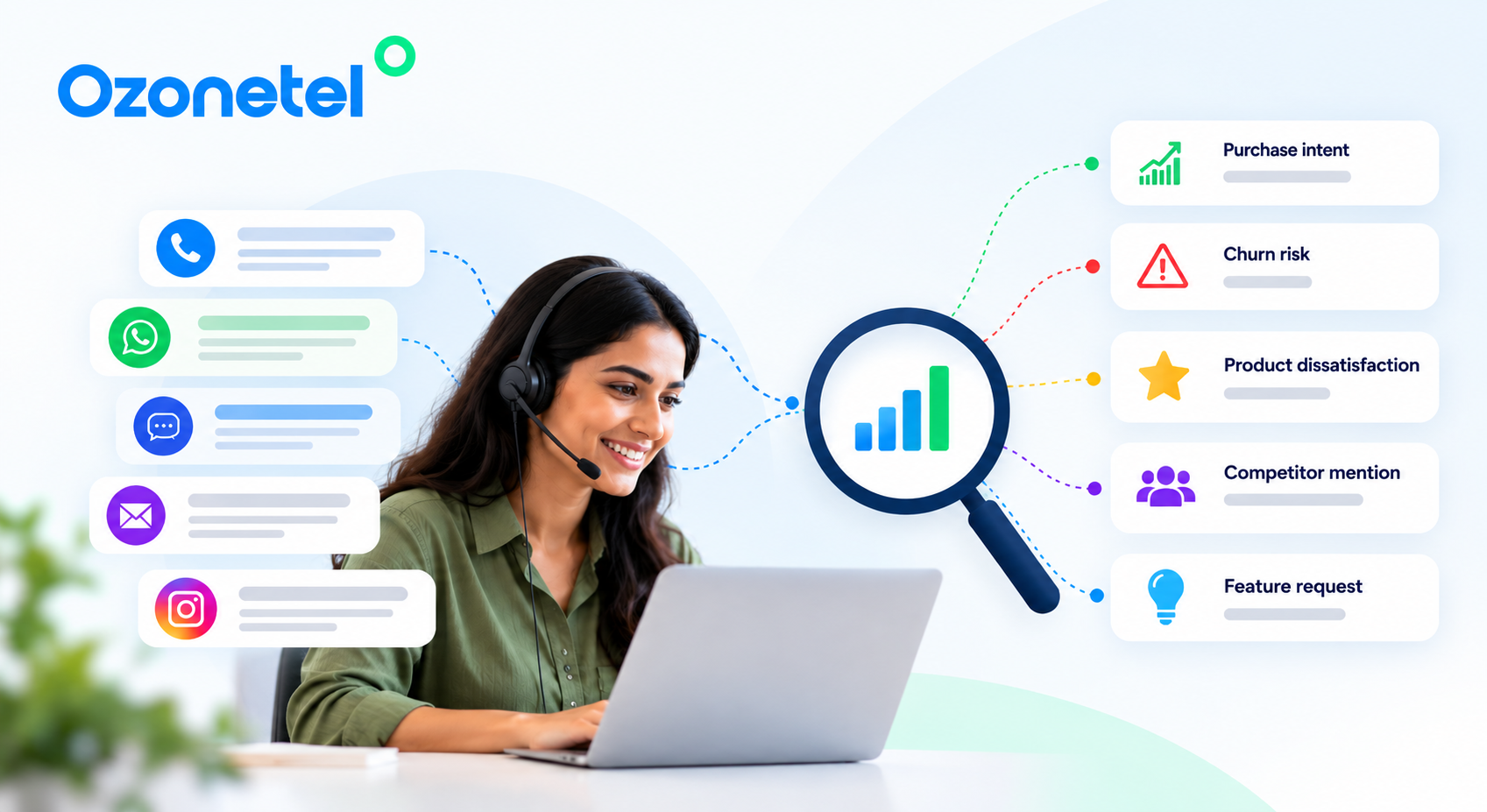
Every customer conversation contains valuable intelligence — buying patterns, churn signals, product feedback, competitive mentions, objection patterns. Traditional QA audits review 2–3% of calls, manually, with a lag that makes the insights close to historical by the time they reach operations.
AI-powered conversational intelligence audits every conversation and makes insights queryable in plain language. A marketing manager can ask ‘What are the top three reasons customers aren’t repurchasing?’ and get a synthesized answer from 10,000 analyzed conversations in seconds — without a custom report request.
Ozonetel in Action: Sunteck Realty — AI-Powered Sales Intelligence
Sunteck Realty leveraged Ozonetel’s AI-first CX platform integrated with their CRM to scale sales operations. AI-powered Voice of Customer analysis surfaces patterns in what prospects are asking, where agents are losing momentum, and what’s actually driving conversions — feeding directly into sales training and outreach strategy.
Result: Higher conversation quality, improved lead outreach TAT, and accelerated business growth.
Conversational AI Beyond Private Enterprise: Government-Scale Deployment
The potential of agentic AI isn’t limited to commercial enterprises. The Telangana state government partnered with Ozonetel to deliver 580+ MeeSeva public services — certificates, payments, registrations — through a WhatsApp-based agentic AI system.
The system understands citizen intent in English and Telugu, validates eligibility and documents in real time, guides citizens through multi-step service journeys end-to-end, and triggers payments and appointment bookings — escalating to a human agent only when genuinely required.
3L+
citizen sessions handled per month via a single WhatsApp number
580+
public services accessible 24/7 through conversational AI
24/7
access with significant reduction in physical center footfall
Industries Leading Conversational AI Adoption
Banking and Financial Services
Banks and NBFCs use conversational AI for account inquiries, fraud alerts, loan assistance, customer onboarding, collections, and cross-sell outreach. AI revenue intelligence now identifies upsell opportunities directly from conversation data.
Healthcare
Healthcare providers use AI assistants for appointment scheduling, patient engagement, symptom assessment, post-visit follow-up, and insurance inquiry resolution — reducing administrative burden while improving patient experience.
Retail and eCommerce
Retailers use conversational AI for personalized shopping assistance, order tracking, return processing, and proactive customer outreach — integrating AI insights directly into merchandising and marketing decisions.
Telecommunications
Telecom companies use AI voice agents to handle billing queries, technical troubleshooting, plan recommendations, and churn prevention — at the scale of millions of subscribers across multiple languages.
Travel and Hospitality
Travel businesses use conversational AI to manage bookings, provide real-time travel updates, handle cancellations, and offer personalized itinerary recommendations — reducing call center load during peak periods.
Government and Public Services
As the Telangana deployment demonstrates, agentic AI can transform citizen service delivery — making complex, multi-step government services accessible 24/7 through channels citizens already use, like WhatsApp.
Ozonetel's AI Monitoring Approach
Ozonetel runs two parallel tracks: AI monitoring AI — evaluating every bot conversation against resolution criteria, hallucination thresholds, and compliance parameters — and AI monitoring humans, scoring agent interactions against quality benchmarks without manual sampling. This is what separates programs that scale from pilots that stall
4. Conversational Intelligence as a Business Asset
The conversation data from CX operations is one of the most underused assets in any enterprise. Modern conversational intelligence goes beyond dashboards — allowing business users to directly query conversation data in natural language and get synthesized answers from thousands of analyzed interactions. Every conversation becomes a strategic input for product, marketing, and growth.
Measurable Benefits of Conversational AI in Customer Experience
| Benefit | What It Means in Practice |
|---|---|
| Improved CSAT | Faster responses and personalized interactions lift satisfaction scores. Ozonetel deployments have delivered up to 15% CSAT improvement within the first phase. |
| Higher Efficiency | Agent assist and automation free agents to focus on complex, high-value tasks. A 15% efficiency gain was demonstrated in a 22,000-agent NBFC deployment. |
| Lower Support Costs | AI automation reduces staffing requirements for repetitive queries while maintaining or improving service quality. |
| Better First-Call Resolution | Intelligent routing and AI-assisted agents resolve issues faster. Ozonetel achieved up to 90% First-Call Resolution (FCR) in NBFC deployments. |
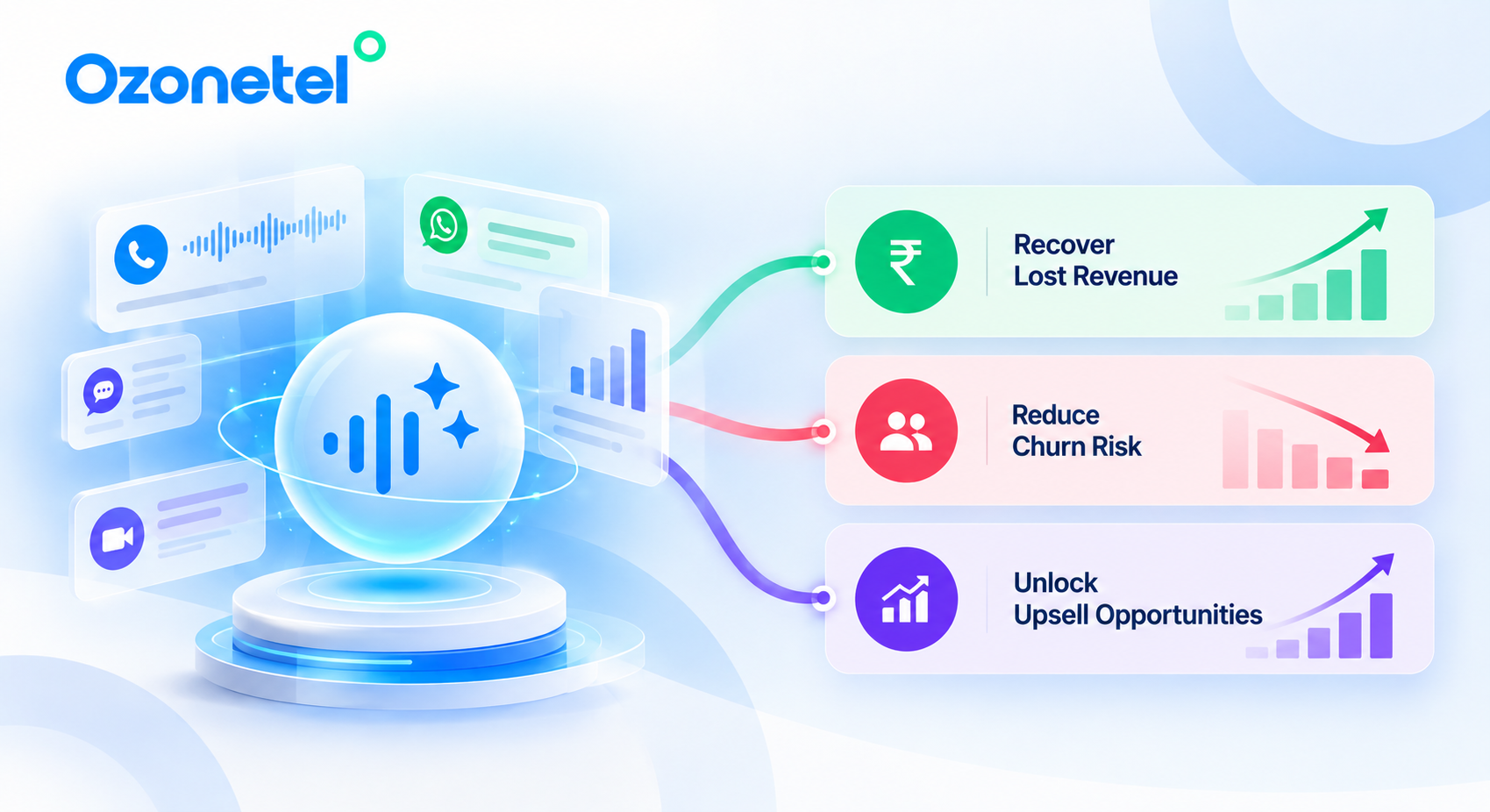
| Revenue Intelligence | Conversation analytics uncover upsell opportunities, churn signals, and buying patterns, directly linking customer experience insights to revenue growth. |
| Scalability | AI handles thousands of simultaneous interactions without quality degradation, making it ideal for peak seasons and rapid business expansion. |
Challenges Enterprises Must Address
Setting the Right Metrics Before Go-Live
If you can’t define what ‘working’ looks like before launch, you won’t know if it’s failing after. AI metrics can’t mirror human benchmarks — an AI resolving 50% of conversations in month one with the rest transferred to agents isn’t underperforming. It’s progressing. Define success in phases, not absolutes.
Data Readiness
Your AI is only as good as the data it can access. CRMs, backend databases, product catalogs, transaction records, and ticketing systems must expose data via API in real time. Without interoperability, even the most capable model is working with an incomplete picture — and incomplete pictures produce wrong answers.
Maintaining Human-Like Conversations
Poorly designed AI systems frustrate customers. Enterprises must train AI models carefully, use domain-specific agents rather than one general-purpose bot, and design escalation as a first-class feature — with full context transferred at every handoff.
Data Privacy and Security
Businesses handling customer data must ensure compliance with privacy regulations and cybersecurity standards. AI guardrails — fatal error criteria, live monitoring dashboards, human escalation on uncertainty, and transparent disclosure of AI interaction — are non-negotiable at enterprise scale.
Balancing Automation and Human Support
Not every customer issue should be automated. Enterprises must create smooth handoff mechanisms between AI systems and human agents. The goal isn’t to contain every conversation within AI — it’s to ensure human intervention, when required, is informed and seamless.
The Future of Conversational AI in Customer Experience
Conversational AI is evolving rapidly. Advances in generative AI, speech synthesis, and emotional intelligence are making AI interactions more human-like than ever. The next frontier is agentic AI that proactively manages customer relationships — not just responding to inbound queries but anticipating needs, preventing churn, and executing complex cross-functional workflows autonomously.
Future systems will deliver more accurate emotional understanding, advanced voice personalization, deeper contextual awareness across sessions, predictive customer support, and hyper-personalized experiences at scale.
Where Enterprises Stand Today (Ozonetel's Framework)
Stage 1 — Cloud complete, AI running: Active agentic deployments, measuring outcomes, scaling what works.
Stage 2 — Cloud complete, AI beginning: Use-case selection and data infrastructure being defined.
Stage 3 — Still in transition: Hybrid on-premise/cloud environments. The path forward for all three: a unified, AI-augmented CX operation that reduces cost, improves resolution, and generates intelligence that benefits the entire business
Conclusion
Customer experience has become one of the biggest differentiators for modern enterprises. Businesses can no longer rely solely on traditional support models to meet rising expectations.
Conversational AI — and specifically agentic AI — helps enterprises deliver faster, smarter, and more personalized customer interactions across every channel. From automating high-volume support to executing complex citizen service journeys, from surfacing revenue intelligence to improving agent performance in real time, AI is transforming how businesses connect with customers.
The enterprises winning with AI today are those that treat deployment as a capability build, not a plug-and-play upgrade. They define success before go-live, start with contained pilots, build in failover, and monitor continuously. Platforms like Ozonetel — with proven deployments across telecoms, financial services, retail, and government — provide the implementation rigor and outcome focus that enterprise AI demands.
Enterprises that invest in AI-driven customer experience today will build stronger customer relationships, drive measurable revenue growth, and establish a competitive advantage that compounds with every conversation.
Switch from SMS OTP to WhatsApp — Ozonetel handles the full setup
Meta verification, template approval, CRM integration, fallback configuration. Our team has migrated fintech, e-commerce, and EdTech platforms to WhatsApp OTP and can give you a realistic timeline and cost estimate for your specific setup.
Frequently Asked Questions
Yes — and structurally more secure than SMS in the ways that matter most. WhatsApp messages are end-to-end encrypted: the OTP is readable only by the sender’s server and the recipient’s device, not by carriers or anyone in between. WhatsApp also doesn’t rely on SS7 carrier routing, removing the primary interception vector that makes SMS OTP vulnerable. And because WhatsApp is tied to an app on a specific device rather than a phone number’s carrier routing, SIM-swap attacks — the most common account takeover method against SMS 2FA — don’t work.
The App is for one person, one phone, manual chats — with a practical ceiling of about 50 conversations per day. The API supports unlimited agents, millions of messages, CRM integrations, chatbots, Agentic AI, and full compliance tooling. See the comparison table in Section 2.
This is the most important operational question to answer before you go live. The answer is straightforward: build SMS fallback in from day one. When a WhatsApp delivery fails — detectable via webhook error callback — your system automatically routes the OTP to SMS instead. The user gets the code; your backend logs the fallback event. Track fallback rate as a regular metric. If it’s consistently above 30% in a given geography, WhatsApp penetration there may be lower than your broader user data suggests, and your channel mix needs adjusting.
Authentication templates are typically the fastest Meta approval category — often a few hours to one business day — because they follow a narrow, well-defined format with little interpretive latitude. Marketing templates, which allow more creative flexibility, take longer. The main cause of delays is template content that strays from the approved structure: promotional language, missing expiry time, or incorrect category selection. A BSP like Ozonetel provides pre-tested templates and submission guidance that removes most revision cycles.
Most CCaaS and CPaaS platforms offer pre-built WhatsApp OTP integrations that connect directly to Meta’s Cloud API — Ozonetel’s oneCXi platform is one example. You need a verified WABA, approved authentication templates, and API credentials. The integration is REST-based: your backend sends a POST request to the /messages endpoint referencing your template and recipient number, and handles delivery status via webhooks. For teams building custom middleware, Meta’s full REST API reference is at developers.facebook.com.
Yes. WhatsApp messages travel over internet data channels, not carrier networks, so they reach any country where WhatsApp is available — including over Wi-Fi and without roaming. The important nuance is pricing: when your sender WABA and the recipient are in different countries, Meta’s authentication-international rate applies rather than the local rate. That can be a 20x cost difference (India local vs India international, for example). For multi-country authentication, work with a BSP that manages localised WABA numbers to keep costs at local rates.
Authentication templates can only be used for identity verification. Repurposing them for account updates, transactional notifications, or anything outside verification violates Meta’s template policies and risks suspension. There’s also a practical limitation: if a meaningful share of your user base doesn’t have WhatsApp — feature phone users, certain rural segments, older demographics — WhatsApp OTP without a well-designed SMS fallback creates friction rather than removing it. Know your users’ device profile before making WhatsApp your primary OTP channel.
Fintech, banking, e-commerce, healthcare, travel, SaaS, and EdTech — any sector where authentication speed, delivery reliability, and security have a direct line to revenue or compliance exposure. Fintech and banking benefit most from SIM-swap resistance and encryption. E-commerce benefits most from delivery rate at checkout. Healthcare values the branded, trustworthy sender for sensitive communications. For any business sending over 100,000 OTPs monthly, the cost argument alone typically makes the business case — and the security improvement is free with it.
Rakesh Kr Jha
Senior Content Writer
Rakesh, a senior writer at Ozonetel, draws on his decade-long journalism career to write about techn...
Rakesh Kr Jha
Senior Content Writer
Rakesh, a senior writer at Ozonetel, draws on his decade-long journalism career to write about technology. His articles delve into the latest advancements in the tech industry and provide valuable insights on improving customer experience.