A customer calls their bank to make a payment. The voice AI greets them warmly. They speak their query. The AI understands. So far, so good.
Then it asks them to verify their 16-digit account number.
They’re on a crowded train. Speaking financial data aloud is not an option. They look for the keypad prompt. There isn’t one. The AI mishears their whispered response twice. The call fails. The payment doesn’t go through.
This isn’t a story about bad AI. The AI worked exactly as designed. The failure was architectural the system was never built to handle what the customer actually needed at that moment: the ability to press a key.
And here’s the uncomfortable truth for most of the voice AI market: fixing this isn’t a software update away. It’s an infrastructure problem. One that traces back to a single question — who actually owns the telephone call?
DTMF stands for Dual-Tone Multi-Frequency. When you press a key on your phone’s keypad, it generates a unique combination of two audio frequencies — one from a low-frequency group and one from a high-frequency group. Each key produces a distinct pair. The system on the other end detects and decodes that tone to understand what was pressed.
DTMF was standardized in the 1960s for the public telephone network and has been a cornerstone of interactive voice response (IVR) systems ever since. “Press 1 for sales. Press 2 for support.” That’s DTMF in action.
Now, with voice AI transforming how businesses handle calls, there’s a temptation to view DTMF as legacy technology — a relic from the pre-AI world. That assumption is a costly mistake.
DTMF is not competing with AI. It complements it. The most effective voice AI deployments use both — and let the customer decide which mode suits their moment.
There’s a temptation in the voice AI industry to frame DTMF as a relic — the old-world IVR model being replaced by conversational intelligence. That framing is wrong, and enterprises that act on it pay for it in containment rates and customer satisfaction scores.
The reasons customers prefer DTMF input at specific moments aren’t about AI quality. They’re about real-world context:
DTMF doesn’t signal that your voice AI is behind. It signals that your voice AI is thoughtful enough to know when to step aside.
Why voice agent startups struggle with DTMF
Most voice AI startups build exclusively at the application layer. They use CPaaS (Communications Platform as a Service) providers like Ozonetel, Twilio, Vonage, or similar platforms as their telephony backbone. This is a fast way to get to market — but it creates an architectural ceiling.
Here’s what they control:
Here’s what they don’t control:
You cannot add DTMF detection from the application layer if the platform beneath you doesn’t expose that functionality. By the time audio reaches the AI application, the telephony layer has already processed — or discarded — the DTMF signal. This isn’t a bug that can be patched. It’s a structural limitation.
Most voice AI companies are software businesses that rent telephony. Ozonetel built the telephony first — and put AI on top of it. That’s not a feature difference. It’s an architectural one.
This is the position Ozonetel occupies — and why it matters in ways that go well beyond DTMF alone.
Platforms that own both the solution and the AI application layer can implement dual-mode support natively — not as a workaround, but as a first-class capability.
In a full-stack architecture:
This is what Ozonetel’s voice agents are built on — a unified stack that has owned the telephony infrastructure from day one, not a CPaaS-dependent application sitting two layers above the problem.
Across industries, the real impact of voice AI emerges when combined with DTMF – balancing conversational ease with reliable, secure input where it matters most.
BFSI: Security Without Friction
A leading private bank deployed voice AI for payment processing and account servicing. In early testing with speech-only input, customers hesitated during account number entry. Some whispered in public spaces, defeating the ASR engine. Others hung up rather than speak financial data aloud.
With dual-mode support, customers used natural speech for general queries (“What’s my balance?”) and switched to DTMF for PIN entry and 16-digit account numbers. The result: payment completion rate improved by drastically compared to the speech-only pilot, with customer satisfaction reaching an all time high.
The key insight: customers felt in control. The AI didn’t force a single interaction mode on them. It offered intelligence where intelligence was needed, and reliability where reliability was needed.
Boosted collections by improving customer reach and recovery outcomes with intelligent voice automation.
A multi-location healthcare provider deployed voice AI for appointment scheduling and prescription refill management. The patient base was diverse: elderly patients, non-native English speakers, and individuals with speech impairments.
The system was designed with intelligent fallback: if speech confidence dropped after two attempts, the bot offered DTMF input proactively — “I’m having trouble understanding. Would you like to use your phone’s keypad instead? Press 1 for yes.”
Containment rate (calls resolved without agent transfer) improved from 52% to 78%. The system adapted to the patient — not the other way around.
In deployments serving diverse or vulnerable populations — including non-native speakers, elderly callers, or communities with low trust in automated systems — DTMF-first design can be the right architecture. When callers don’t need to describe their problem in natural language to get routed correctly, friction drops. Predictable keypad flows reduce anxiety, especially for populations unaccustomed to conversational AI.
A DTMF-only mode, available as a deliberate design choice rather than a fallback, can actually serve these users better than a mixed-mode system. The point is: choice should be in the hands of the designer, not limited by the platform.
The Ozonetel Voicebot: Built for Both
The product block below captures what this architecture delivers in practice — not as a feature list, but as a design philosophy:
For inputs where accuracy is non-negotiable — OTPs, PINs, account numbers, payment authorisations — the voicebot routes to DTMF entry automatically. No ASR ambiguity. No repeated attempts. Clean, secure capture on the first try.
Open-ended queries, intent recognition, empathy-led conversations, complex troubleshooting — the AI engine handles these naturally, the way a skilled agent would. Customers don’t navigate menus. They express what they need.
Customers don’t stay in one mode. Neither does the voicebot. A caller can speak their query, key in their PIN, and continue the conversation — without noticing the transition. The system handles the handoff invisibly.
Where regulations mandate keypad input, the voicebot defaults to DTMF without requiring workflow changes. Where users are elderly, less tech-confident, or in a noisy environment, keypad input is always available as a first-class option — not a reluctant fallback.
Most voice AI demos look identical on the surface. Smooth conversation. Accurate intent recognition. Clean handoffs to agents. The differentiation doesn’t show up in demos — it shows up in production, when a customer is standing on a train platform trying to verify their identity.
The question to ask any voice AI vendor is not just how good is your speech recognition. It’s: can your platform detect DTMF natively — at the media stream level — on the same call as your AI, without any third-party dependency?
If the answer involves a CPaaS workaround, a platform limitation, or a promise to support it in a future release — you already know the ceiling you’re buying into.
Ozonetel has owned the telephony stack since its founding. The AI came after. That order of operations is the advantage — and it’s not something that can be replicated by adding infrastructure on top of an application-layer product.
Inbound calls are initiated by customers seeking help, support, or information. Outbound calls are initiated by your business to reach customers or prospects proactively for sales, renewals, payment reminders, appointment confirmations, or follow-ups. The core inbound and outbound call center difference is who starts the conversation and what the intended outcome is.
The core inbound call center vs. outbound call center difference comes down to who initiates the call. Inbound call centers handle incoming customer queries, focusing on resolution speed, service quality, and customer satisfaction. Outbound call centers make proactive calls to customers or prospects, measured by connect rates, conversions, and revenue impact. That single direction — inbound or outbound — determines everything: the team’s purpose, technology stack, agent skills, and the KPIs that define success.
On average:
Quality Assurance (QA) ensures every call meets your service, compliance, and performance standards. In inbound call centers, QA focuses on resolution accuracy, empathy, first-call resolution, and handle time. In outbound call centers, it covers script adherence, regulatory compliance, persuasion effectiveness, and conversion quality. Modern AI-powered QA tools can automatically audit 100% of calls instead of the 2–5% typically reviewed manually.
A blended call center manages both inbound and outbound calls using the same team and platform. AI-driven routing and real-time workload balancing allow agents to dynamically switch between handling incoming customer queries and making proactive outbound calls. This maximizes agent utilization, reduces idle time, and allows businesses to deliver consistent customer experiences across both service and sales interactions without maintaining two separate teams.
In BPO, inbound processes involve handling customer support, service requests, and inquiries on behalf of clients — measured by FCR, CSAT, and AHT. Outbound processes include lead generation, sales calls, renewals, surveys, payment follow-ups, and collections — measured by connect rates, conversion rates, and revenue per call. Both rely on defined workflows, call center KPIs, and purpose-built contact center technology to meet client performance targets.
A customer calls their bank to make a payment. The voice AI greets them warmly. They speak their query. The AI understands. So far, so good.
Then it asks them to verify their 16-digit account number.
They’re on a crowded train. Speaking financial data aloud is not an option. They look for the keypad prompt. There isn’t one. The AI mishears their whispered response twice. The call fails. The payment doesn’t go through.
This isn’t a story about bad AI. The AI worked exactly as designed. The failure was architectural the system was never built to handle what the customer actually needed at that moment: the ability to press a key.
And here’s the uncomfortable truth for most of the voice AI market: fixing this isn’t a software update away. It’s an infrastructure problem. One that traces back to a single question — who actually owns the telephone call?
DTMF stands for Dual-Tone Multi-Frequency. When you press a key on your phone’s keypad, it generates a unique combination of two audio frequencies — one from a low-frequency group and one from a high-frequency group. Each key produces a distinct pair. The system on the other end detects and decodes that tone to understand what was pressed.
DTMF was standardized in the 1960s for the public telephone network and has been a cornerstone of interactive voice response (IVR) systems ever since. “Press 1 for sales. Press 2 for support.” That’s DTMF in action.
Now, with voice AI transforming how businesses handle calls, there’s a temptation to view DTMF as legacy technology — a relic from the pre-AI world. That assumption is a costly mistake.
DTMF is not competing with AI. It complements it. The most effective voice AI deployments use both — and let the customer decide which mode suits their moment.
There’s a temptation in the voice AI industry to frame DTMF as a relic — the old-world IVR model being replaced by conversational intelligence. That framing is wrong, and enterprises that act on it pay for it in containment rates and customer satisfaction scores.
The reasons customers prefer DTMF input at specific moments aren’t about AI quality. They’re about real-world context:
DTMF doesn’t signal that your voice AI is behind. It signals that your voice AI is thoughtful enough to know when to step aside.
Why voice agent startups struggle with DTMF
Most voice AI startups build exclusively at the application layer. They use CPaaS (Communications Platform as a Service) providers like Ozonetel, Twilio, Vonage, or similar platforms as their telephony backbone. This is a fast way to get to market — but it creates an architectural ceiling.
Here’s what they control:
Here’s what they don’t control:
You cannot add DTMF detection from the application layer if the platform beneath you doesn’t expose that functionality. By the time audio reaches the AI application, the telephony layer has already processed — or discarded — the DTMF signal. This isn’t a bug that can be patched. It’s a structural limitation.
Most voice AI companies are software businesses that rent telephony. Ozonetel built the telephony first — and put AI on top of it. That’s not a feature difference. It’s an architectural one.
This is the position Ozonetel occupies — and why it matters in ways that go well beyond DTMF alone.
Platforms that own both the solution and the AI application layer can implement dual-mode support natively — not as a workaround, but as a first-class capability.
In a full-stack architecture:
This is what Ozonetel’s voice agents are built on — a unified stack that has owned the telephony infrastructure from day one, not a CPaaS-dependent application sitting two layers above the problem.
Across industries, the real impact of voice AI emerges when combined with DTMF – balancing conversational ease with reliable, secure input where it matters most.
BFSI: Security Without Friction
A leading private bank deployed voice AI for payment processing and account servicing. In early testing with speech-only input, customers hesitated during account number entry. Some whispered in public spaces, defeating the ASR engine. Others hung up rather than speak financial data aloud.
With dual-mode support, customers used natural speech for general queries (“What’s my balance?”) and switched to DTMF for PIN entry and 16-digit account numbers. The result: payment completion rate improved by drastically compared to the speech-only pilot, with customer satisfaction reaching an all time high.
The key insight: customers felt in control. The AI didn’t force a single interaction mode on them. It offered intelligence where intelligence was needed, and reliability where reliability was needed.
Boosted collections by improving customer reach and recovery outcomes with intelligent voice automation.
A multi-location healthcare provider deployed voice AI for appointment scheduling and prescription refill management. The patient base was diverse: elderly patients, non-native English speakers, and individuals with speech impairments.
The system was designed with intelligent fallback: if speech confidence dropped after two attempts, the bot offered DTMF input proactively — “I’m having trouble understanding. Would you like to use your phone’s keypad instead? Press 1 for yes.”
Containment rate (calls resolved without agent transfer) improved from 52% to 78%. The system adapted to the patient — not the other way around.
In deployments serving diverse or vulnerable populations — including non-native speakers, elderly callers, or communities with low trust in automated systems — DTMF-first design can be the right architecture. When callers don’t need to describe their problem in natural language to get routed correctly, friction drops. Predictable keypad flows reduce anxiety, especially for populations unaccustomed to conversational AI.
A DTMF-only mode, available as a deliberate design choice rather than a fallback, can actually serve these users better than a mixed-mode system. The point is: choice should be in the hands of the designer, not limited by the platform.
The Ozonetel Voicebot: Built for Both
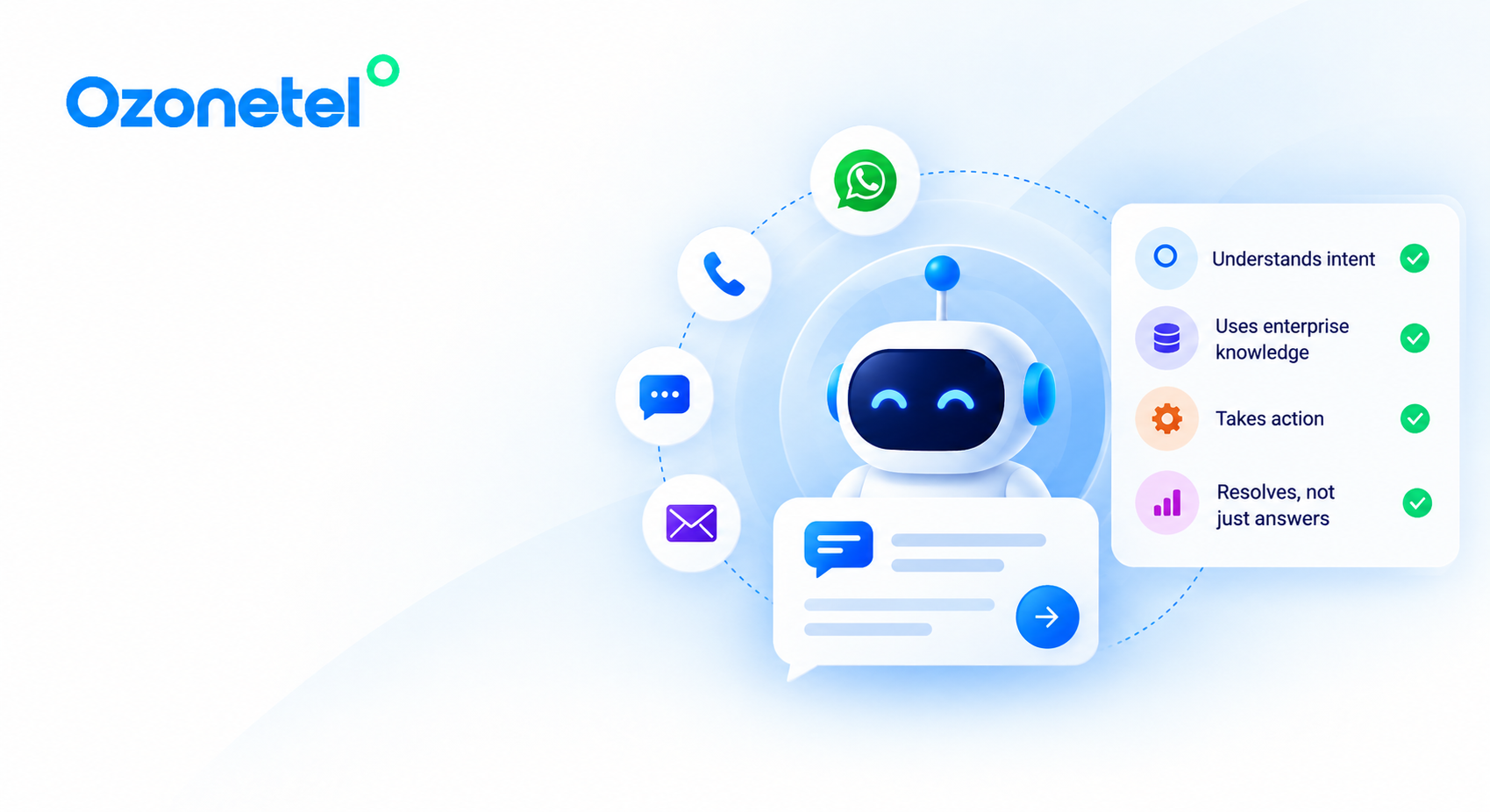
The product block below captures what this architecture delivers in practice — not as a feature list, but as a design philosophy:
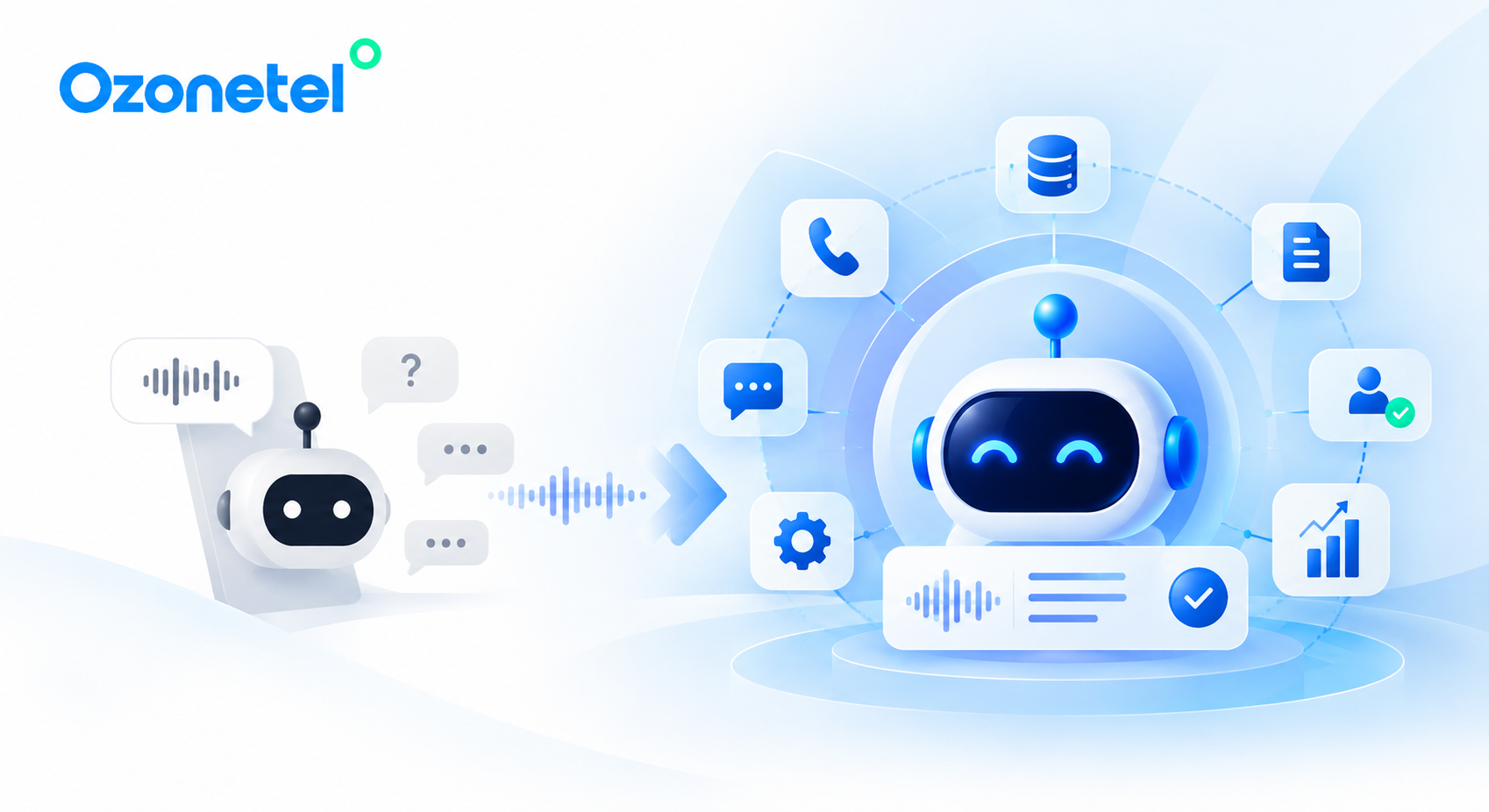
For inputs where accuracy is non-negotiable — OTPs, PINs, account numbers, payment authorisations — the voicebot routes to DTMF entry automatically. No ASR ambiguity. No repeated attempts. Clean, secure capture on the first try.
Open-ended queries, intent recognition, empathy-led conversations, complex troubleshooting — the AI engine handles these naturally, the way a skilled agent would. Customers don’t navigate menus. They express what they need.
Customers don’t stay in one mode. Neither does the voicebot. A caller can speak their query, key in their PIN, and continue the conversation — without noticing the transition. The system handles the handoff invisibly.
Where regulations mandate keypad input, the voicebot defaults to DTMF without requiring workflow changes. Where users are elderly, less tech-confident, or in a noisy environment, keypad input is always available as a first-class option — not a reluctant fallback.
Most voice AI demos look identical on the surface. Smooth conversation. Accurate intent recognition. Clean handoffs to agents. The differentiation doesn’t show up in demos — it shows up in production, when a customer is standing on a train platform trying to verify their identity.
The question to ask any voice AI vendor is not just how good is your speech recognition. It’s: can your platform detect DTMF natively — at the media stream level — on the same call as your AI, without any third-party dependency?
If the answer involves a CPaaS workaround, a platform limitation, or a promise to support it in a future release — you already know the ceiling you’re buying into.
Ozonetel has owned the telephony stack since its founding. The AI came after. That order of operations is the advantage — and it’s not something that can be replicated by adding infrastructure on top of an application-layer product.
Inbound calls are initiated by customers seeking help, support, or information. Outbound calls are initiated by your business to reach customers or prospects proactively for sales, renewals, payment reminders, appointment confirmations, or follow-ups. The core inbound and outbound call center difference is who starts the conversation and what the intended outcome is.
The core inbound call center vs. outbound call center difference comes down to who initiates the call. Inbound call centers handle incoming customer queries, focusing on resolution speed, service quality, and customer satisfaction. Outbound call centers make proactive calls to customers or prospects, measured by connect rates, conversions, and revenue impact. That single direction — inbound or outbound — determines everything: the team’s purpose, technology stack, agent skills, and the KPIs that define success.
On average:
Quality Assurance (QA) ensures every call meets your service, compliance, and performance standards. In inbound call centers, QA focuses on resolution accuracy, empathy, first-call resolution, and handle time. In outbound call centers, it covers script adherence, regulatory compliance, persuasion effectiveness, and conversion quality. Modern AI-powered QA tools can automatically audit 100% of calls instead of the 2–5% typically reviewed manually.
A blended call center manages both inbound and outbound calls using the same team and platform. AI-driven routing and real-time workload balancing allow agents to dynamically switch between handling incoming customer queries and making proactive outbound calls. This maximizes agent utilization, reduces idle time, and allows businesses to deliver consistent customer experiences across both service and sales interactions without maintaining two separate teams.
In BPO, inbound processes involve handling customer support, service requests, and inquiries on behalf of clients — measured by FCR, CSAT, and AHT. Outbound processes include lead generation, sales calls, renewals, surveys, payment follow-ups, and collections — measured by connect rates, conversion rates, and revenue per call. Both rely on defined workflows, call center KPIs, and purpose-built contact center technology to meet client performance targets.
Make it easy for your customers to reach you wherever, whenever, or to help themselves through bots pre-trained to solve retail use cases.
Learn more
Description, experiences: Curating communicative & collaborative customer journeys in Real Estate

Oops! We could not locate your form.