Can a business in India legally put its outbound calling on autopilot? It’s a fair question, especially with TRAI amending its rules again in September 2026 to tighten the net around automated calls. The short answer is yes: businesses can use auto dialers for telemarketing in India, but only within the framework TRAI has built to govern unsolicited commercial communication, customer consent, and calling practices. The technology itself is legal. What matters is how you use it, who you call, and whether you can prove you followed the rules if TRAI or a telecom operator ever asks.
Key Takeaways
The short version, before you get into the comparison table and full provider profiles below:
Cloud telephony replaces on-premise PBX hardware with cloud-hosted calling, IVR, recording, routing, and analytics, helping teams manage business calls without maintaining physical telecom infrastructure.
Ozonetel pairs telephony with AI-powered routing, 50+ CRM integrations, omnichannel engagement, and contact-centre automation. It is built for scale rather than basic call handling, and pricing is custom-quoted rather than publicly listed.
Budget-first options like MyOperator and Acefone can cover basic IVR, virtual numbers, and call tracking, but buyers should compare them carefully against AI depth, CRM workflow maturity, omnichannel capability, and enterprise support needs.
TRAI/DoT compliance, DLT support, DND scrubbing, call recording controls, and data-handling rules are hard requirements for India-facing providers, not optional checkbox features.
G2 scores vary by both rating and review volume. A 4.6 rating from hundreds of reviews carries a different level of confidence than a 5.0 rating from one or two reviews.
Can You Use an Auto Dialer for Telemarketing in India?
An auto dialer is simply software that places outbound calls automatically instead of an agent manually punching in numbers. It covers a range of technologies: power dialers, progressive dialers, preview dialers, and predictive dialers, each pacing calls differently based on agent availability and data quality. Automated outbound calling and telemarketing often get used interchangeably, but they’re not quite the same thing. Automated calling is the method; telemarketing is one purpose it’s put to, alongside collections, appointment reminders, and service updates.
Where this gets regulatory attention is when an auto dialer is used to deliver commercial communication, meaning any call or message that promotes goods, services, or a brand. TRAI doesn’t ban the technology. It regulates the conduct: who gets called, whether they’ve consented, and how the call identifies itself. That distinction (the tool versus the rules around its use) is the one most businesses trip over, usually by treating a contact database as a green light to call everyone on it.
What Are TRAI’s Rules for Commercial Communications?
TRAI’s core framework here is the Telecom Commercial Communications Customer Preference Regulations, 2018, generally called TCCCPR. It defines Unsolicited Commercial Communication (UCC) as any commercial call or message sent to a customer who hasn’t opted in, and sets up the machinery to prevent it: consent, preference registers, and registration requirements for everyone in the calling chain.
Three roles sit inside this chain. The principal entity is the business that wants to communicate (a bank, an insurer, a SaaS company). The telemarketer or aggregator is the registered intermediary that actually places or routes the calls. Both are expected to register on TRAI’s Distributed Ledger Technology (DLT) platform before sending anything, which is how consent and traceability get enforced at scale.
The regulation also cares about appropriate communication channels. A commercial call has to originate from a designated number series so recipients can tell it apart from a personal call, and it has to reach only customers whose stated preferences allow it. Skip either step and the call counts as UCC, regardless of how relevant the offer actually is.
Auto Dialers, UCC, DND & NCPR: What Businesses Need to Know
Four terms come up constantly in this space, and getting them straight makes the rest of compliance much easier.
UCC is any promotional call or message a customer hasn’t asked for or consented to receive. It’s the umbrella violation that most other rules exist to prevent.
DND and NCPR are the customer’s side of the equation. The National Customer Preference Register (NCPR), managed through TRAI’s DND app, lets a subscriber register for full Do Not Disturb or choose specific categories they’re willing to receive (banking, real estate, health, and so on). A number on full DND cannot legally receive promotional calls, auto-dialed or otherwise.
Consent is what separates legitimate outreach from spam. A customer who has an active policy, an open support ticket, or an ongoing transaction with a business has typically consented to service-related contact. That’s different from cold-calling a purchased list of numbers for a new product pitch. Businesses need to be able to tell these two categories apart internally, because they’re treated very differently under TCCCPR.
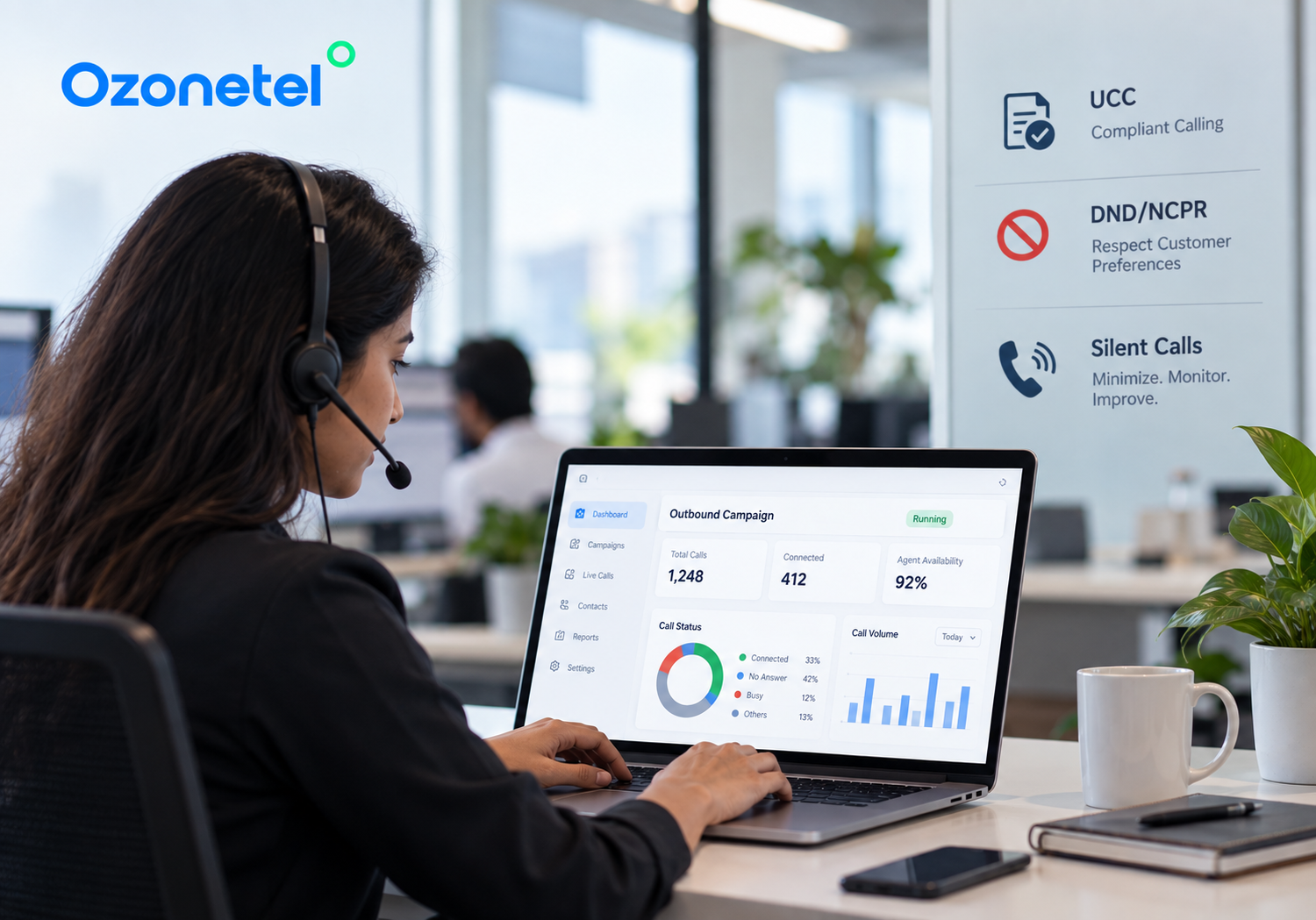
And this is where the auto dialer becomes the risk multiplier. A predictive or power dialer can work through tens of thousands of numbers a day. Simply uploading an entire database and letting it run will inevitably reach NCPR-registered numbers and unconsented contacts at scale, turning a handful of manual mistakes into a systemic UCC problem. Scrubbing lists against DND/NCPR status and consent records before a campaign starts isn’t optional; it’s what separates a compliant outbound engine from a liability.
What Are Silent Calls and Why Do They Matter?
A silent call (also called an abandoned call) happens when a customer picks up the phone and there’s no agent on the other end, just dead air or a click. It’s a familiar complaint, and it’s usually a byproduct of predictive dialing: the system dials ahead of agent availability, betting that a certain percentage of calls won’t connect, so it can keep agents talking back-to-back. When that bet doesn’t pay off (an agent is still wrapping up the previous call, or more people pick up than expected), the customer is left with silence.
India doesn’t currently prescribe a fixed abandoned-call percentage the way some markets do, but that’s not the same as being unregulated. TRAI’s September 2026 amendment now requires that any automated call, including one placed via autodialing or a robo-calling platform, declare upfront that it’s automated, and that pre-recorded or artificial-voice messages carry a pre-declaration too. A call without that declaration is treated as spam. In practice, this pushes the same discipline abandoned-call caps enforce elsewhere: enough agent capacity, sensible pacing ratios, and active monitoring so dialing speed never outruns the people meant to answer. Silent calls are now closer to a compliance metric than just a customer-experience nuisance.
Commercial Communication Numbers and Telemarketers
TRAI requires commercial calls to originate from designated number series rather than regular 10-digit mobile numbers, so recipients can identify them at a glance. Promotional calls use the 140 series, while transactional and service communications (OTPs, delivery updates, account alerts) use 1600-series numbers. Under the 2026 draft amendment, call-management apps are also barred from blocking or tagging calls from these designated series as spam, since that would undermine the system meant to help users tell legitimate business calls apart from nuisance ones.
The registered telemarketer (or aggregator) actually places calls on a business’s behalf, and it’s a separate registration from the principal entity that owns the campaign. This matters in practice: if a telemarketing partner’s dialer generates complaints, the principal entity’s numbers and campaigns can be affected too, even if the fault sits with the vendor.
7 Things to Check Before Launching an Auto Dialer Campaign
Define the purpose of the communication. Promotional, transactional, or service-related? The classification decides which numbers you’re allowed to call.
Check consent and customer preferences. Separate consented leads, existing customers, and cold contacts before a campaign, not after a complaint arrives.
Check DND/NCPR status where applicable. Build preference scrubbing into the campaign workflow, ideally as an automated step, not a manual check.
Use the appropriate calling infrastructure. Match the numbers you dial from, and how they’re registered, to the campaign (140 series for promotional, 1600 for transactional).
Configure dialing and retry rules. Uncontrolled repeat dialing to the same number is a customer-experience problem and a compliance red flag. Cap attempts and set cooling-off periods.
Monitor silent and abandoned calls. Keep pacing ratios tied to actual agent availability so the dialer isn’t outrunning your team’s capacity to pick up.
Maintain records and campaign controls. Consent records, call logs, and campaign configurations should be traceable, since that’s what you’ll need if a complaint or query comes in.
How Can Businesses Use Auto Dialers Without Compromising Customer Experience?
None of this means automation and good customer experience have to be at odds. Businesses that get outbound calling right focus less on raw call volume and more on the variables around it: sensible calling frequency, agent availability matched to dialing pace, structured callback scheduling instead of repeat cold attempts, lead prioritisation, retry controls that respect a customer’s earlier response, live monitoring, and clean call dispositions that feed the next attempt. The goal was never more calls. It’s the right calls, to the right customers, with the right controls.
How Ozonetel Helps Businesses Scale Controlled Outbound Calling
This is the gap a well-configured cloud auto dialer is built to close. Ozonetel’s Auto Dialer supports predictive, progressive, preview, and IVR modes, with campaign management, pacing and retry logic, real-time agent monitoring, and CRM integration, so pacing can be tuned to actual agent availability instead of guesswork. Paired with Ozonetel’s broader cloud call center software, businesses get the reporting and controls needed to run outbound at scale more systematically. Ozonetel doesn’t guarantee TRAI compliance on a business’s behalf; that still depends on how a campaign is set up and run. What the platform provides is the visibility and control that make staying compliant far easier.
Conclusion
Auto dialers can meaningfully increase outbound calling productivity, but scaling automated calling in India takes more than simply dialing faster. Businesses need to work through consent, DND/NCPR preferences, the right calling infrastructure, silent-call rates, and campaign-level controls before a single call goes out. Combine automation with those safeguards, and it’s possible to build outbound campaigns that are both more productive and considerably easier to defend if a regulator ever asks how they were run.
This article reflects TCCCPR, 2018 and amendments notified through September 2026. Regulations change; verify current requirements against TRAI’s official UCC page before publishing.
Yes. The technology isn’t restricted; what’s regulated is how it’s used, specifically whether the calls it places comply with TCCCPR’s rules on consent, DND/NCPR preferences, and registration.
Not for promotional purposes. A number on full DND cannot legally receive commercial calls. Service or transactional calls tied to an existing relationship are generally treated differently, but verify this against current preference categories rather than assuming it.
Calls must come from registered principal entities and telemarketers, respect consent and DND/NCPR preferences, originate from the correct number series, and, since TRAI’s September 2026 amendment, clearly declare when a call is automated.
A silent call, or abandoned call, is one where the customer answers but no agent is available to speak, usually because a predictive dialer paced calls ahead of actual agent capacity
Auto dialer is the umbrella term for any software that automates outbound dialing. Predictive dialer is one mode within it, one that dials ahead of agent availability using predicted answer and talk-time patterns, which is also why it carries the highest risk of silent calls if poorly tuned.