What is IVR ? Complete Guide, Types & Best Practices (2026)

Prashanth Kancherla

Aug 7, 2026 | 13 mins read
An Interactive Voice Response (IVR) system has become the backbone of modern customer service, helping businesses manage incoming calls while delivering faster, more consistent support.

Despite the rapid growth of digital channels, 36% of customers still prefer the phone as their primary customer service channel, according to Gartner. Voice remains a critical touchpoint, making contact center IVR essential for businesses looking to deliver fast, personalized support at scale.

This guide explains what IVR is, how it works, the different types of IVR systems, cloud vs. on-premise deployment, AI-powered IVR, best practices, and how to choose the right solution for your business.

Key Takeaways

  • IVR automates inbound call handling using DTMF and voice recognition to improve self-service and routing.
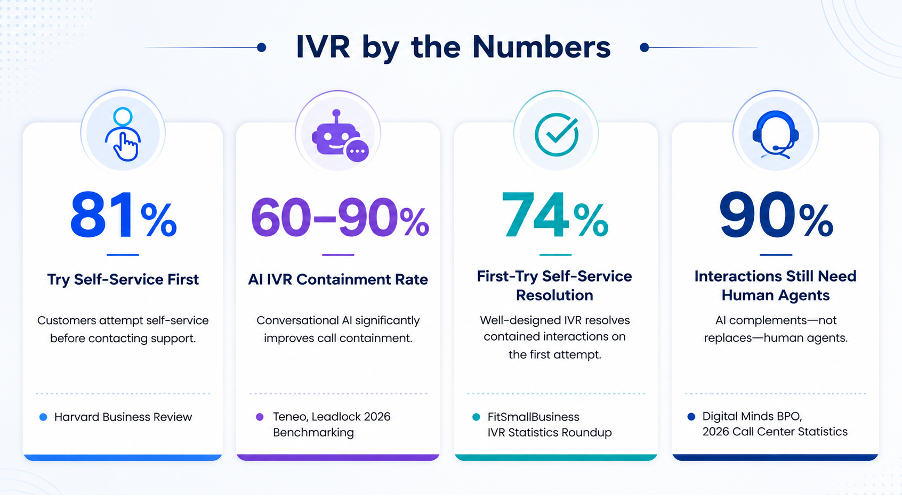
  • 81% of customers try self-service before contacting support, making IVR design critical to customer experience.
  • Cloud IVR offers faster deployment, elastic scalability, lower costs, and seamless CRM integrations.
  • Modern IVR orchestrates customer journeys by connecting AI, CRM, telephony, and business applications.
  • Conversational AI enhances IVR with natural language understanding while DTMF handles routine, high-volume requests.
  • Keep IVR menus to three levels or fewer to reduce abandonment and improve self-service completion.
  • Measure IVR performance using containment rate, FCR, CSAT, call abandonment, and agent productivity.
  • Choose an IVR solution with multilingual support, AI, analytics, CRM integrations, and TRAI compliance

Four Statistics Defining Modern IVR

What is IVR (Interactive Voice Response)?

Interactive Voice Response (IVR) is a telephony technology that enables businesses to interact with callers using automated voice prompts and keypad (DTMF) or voice input. It resolves routine requests through self-service or intelligently routes calls to the right agent without requiring immediate human intervention.

For a business, IVR serves as the first point of interaction for every customer call. It identifies customer intent, authenticates callers when required, and routes interactions to the appropriate team or self-service workflow. Modern AI-powered software integrate with CRM, ERP, and other business applications to personalize self-service and provide agents with complete customer context before the conversation begins.

How Does IVR Work in a Call Center?

Every IVR interaction follows a structured call flow designed to identify customer intent, automate routine requests, and connect callers to the right resource.

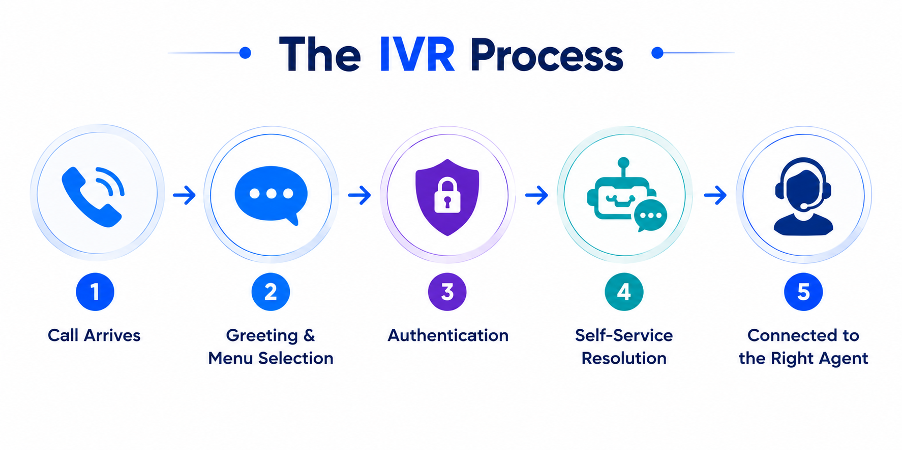
A typical IVR solution processes calls through five key stages:

Call Arrival

An incoming call reaches a business  through the PSTN, mobile network, or SIP trunk and is first handled by the IVR platform before reaching an agent.

Greeting and Menu Selection

The IVR plays a welcome message and presents menu options using keypad (DTMF), voice input, or both. Well-designed IVR menus prioritize the most common customer requests, helping callers reach the right option faster.

Customer Authentication

The IVR captures the caller’s selection and, when required, verifies their identity using a phone number, PIN, OTP, or account details before retrieving customer information.

Self-Service Resolution

For routine requests such as account balances, order tracking, appointment confirmations, or bill payments, the

Intelligent Call Routing

If customer needs human assistance, the IVR routes the call to the most appropriate agent or skill-based queue based on the reason for calling, language preference, customer priority, or business rules. It also transfers the information collected during the interaction, allowing agents to continue the conversation without asking customers to repeat themselves.

Types of IVR Systems

IVR systems come in different types, each designed to support specific business needs, call volumes, and customer journeys. Choosing the right IVR system for your can improve call routing, increase self-service adoption, and deliver a better customer experience.
Type What it does Best suited for
Single-level IVR A simple menu with one level of options and no sub-menus. Small businesses and low call-volume businesses with basic call routing needs.
Multi-level IVR Uses nested menus with multiple sub-options to direct callers based on their needs. Mid-to-large call centers with multiple departments, products, or services.
Outbound IVR Initiates automated outbound calls for reminders, notifications, surveys, or payment collections. Collections, healthcare reminders, appointment confirmations, customer feedback, and payment follow-ups.
Visual IVR Displays interactive menus on a smartphone screen instead of, or alongside, voice prompts. Businesses serving mobile-first customers who prefer tap-based navigation.
Cloud IVR (Hosted IVR) Runs on a cloud platform instead of on-premise hardware, providing flexibility, reliability, and scalability. Businesses looking for faster deployment, lower upfront costs, remote management, and the ability to scale during peak demand.

Cloud-Based vs. On-Premise IVR

An on-premise IVR requires dedicated hardware, PBX servers, telephony cards, and in-house infrastructure, with call capacity limited to what was provisioned during installation. In contrast, a cloud IVR is delivered as a hosted service over the internet, allowing businesses to scale capacity on demand without investing in additional hardware.

Feature Cloud IVR On-Premise IVR
Deployment Time Days Weeks to months
Upfront Cost Low (subscription-based) High (hardware and licensing)
Scalability On-demand and elastic Limited to installed capacity
Multi-location Support Native Requires separate infrastructure
Maintenance Vendor-managed Managed by in-house IT teams

Why Cloud-based IVR is the Preferred Choice for Businesses

Cloud IVR offers several advantages for businesses operating in India:

  • Scales effortlessly during peak demand: Industries such as e-commerce, BFSI, travel, and retail often experience spikes in call volumes during festivals, sales events, EMI due dates, and renewal cycles. Cloud IVR can scale instantly without requiring additional hardware.
  • Supports multi-location and multilingual operations: Businesses can manage multiple locations from a single platform while delivering language-specific IVR experiences in Hindi, Tamil, Telugu, Bengali, and other regional languages.
  • Deploys faster with lower upfront investment: Unlike on-premise systems that may take weeks or months to install, contact center IVR can typically be deployed within days, helping businesses.

How IVR Connects with Your Contact Center Infrastructure
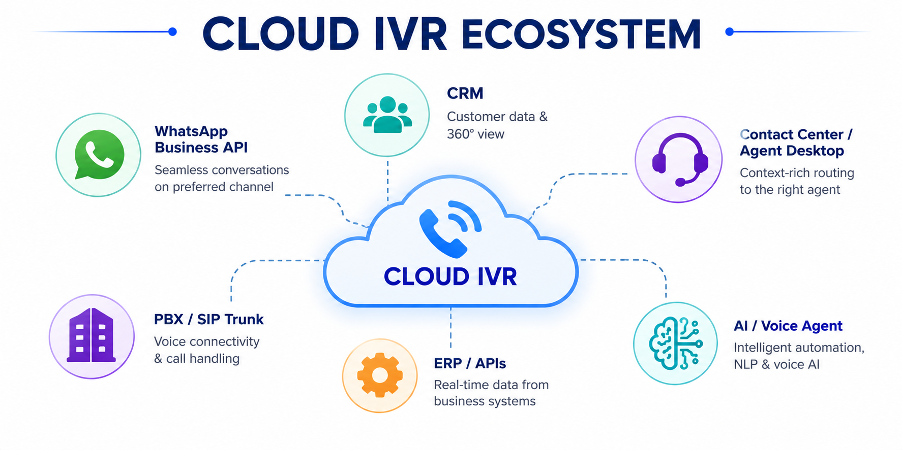
An IVR system doesn’t operate in isolation. It works alongside your   to route calls, manage conversations, and deliver a seamless customer experience. Here’s how IVR integrates with the core technologies behind modern business communications.

IVR and DID (Direct Inward Dialing)

Direct Inward Dialing (DID) assigns dedicated phone numbers to specific departments, teams, or campaigns. While IVR routes callers through menu options, DID allows customers to reach the right destination directly.

Many businesses combine DID with IVR to create personalized customer journeys. For example, a campaign-specific DID can route callers to a dedicated IVR flow, ensuring they reach the right team while providing agents with relevant campaign context.

IVR and PBX (Private Branch Exchange)

A PBX (Private Branch Exchange) manages your organization’s internal phone system by routing calls to extensions, ring groups, and voicemail.

In a call center, IVR handles customer interactions, while the PBX manages call distribution. Modern cloud contact center platforms combine both capabilities into a single solution, simplifying deployment and management.

IVR and VoIP (Voice over IP)

VoIP (Voice over IP) enables voice calls over the internet, while IVR automates and manages those calls. Cloud IVR platforms rely on VoIP to support remote teams, scale call capacity on demand, reduce telephony costs, and integrate with CRM systems and business applications through APIs.

IVR and PSTN (Public Switched Telephone Network)

The Public Switched Telephone Network (PSTN) is the traditional telephone network that still carries many business and mobile calls. Modern cloud IVR platforms connect seamlessly with PSTN through SIP trunking, allowing businesses to receive calls from both traditional phone lines and internet-based networks without disrupting the customer experience.

IVR and Omnichannel Customer Service

An omnichannel IVR connects voice, WhatsApp, and other digital channels to deliver a seamless customer experience. For example, if a customer leaves an IVR call before completing a request, the conversation can automatically continue on WhatsApp with the customer’s context and previous interaction intact.

Traditional IVR vs. Conversational IVR vs. Intelligent Virtual Assistants

Traditional IVR, Conversational IVR, and Intelligent Virtual Assistants these three terms get used almost interchangeably in the market, but they sit at different points on the same spectrum — from rigid, rule-based menus to systems that can carry a full conversation and resolve a request end to end.

 Traditional IVRConversational AI IVRIntelligent Virtual Assistant (IVA)
Interaction ModelKeypad or simple voice commandsNatural language, context-awareFully conversational, agentic
Call RoutingMenu-based, deterministicIntent-based, adaptiveAutonomous — resolves without routing
Self-Service ScopePayment, balance check, status lookupComplex queries, account changesEnd-to-end resolution of multi-step tasks
Context RetentionNone — each interaction is isolatedMaintains context within sessionRetains context across sessions and channels
Best ForHigh-volume structured transactionsMixed call types, moderate complexityReplacing agent interactions for defined use cases
Typical ContainmentLower — routing-only menus rarely resolve much beyond simple lookupsMeaningfully higher, driven more by integration depth than the AI itself

Highest, for narrowly defined use cases with strong backend integration

Should You Rip Out Your Existing IVR?

Probably not — at least not yet. The pragmatic approach for most call centers is a hybrid model: keep DTMF-based IVR for high-volume, low-complexity transactions where it works reliably. Layer conversational AI on top for complex or high-value call types where better self-service meaningfully reduces cost or improves experience. And deploy IVAs only for narrow, well-bounded use cases where the ROI is clearly measurable.

The technology is moving fast, but the fundamentals of good customer service aren’t. A well-designed traditional IVR that respects the caller’s time will outperform a poorly implemented AI system every day of the week.

IVR Best Practices for 2026

Design a smarter IVR that boosts self-service, reduces abandonment, and improves CSAT.

  • Design menus around customer intent, not departments. Use your most common call reasons instead of your internal organizational structure to help customers reach the right destination faster.
  • Keep IVR menus simple. Limit customer-facing menus to three levels or fewer to reduce confusion, call abandonment, and misrouting.
  • Offer an easy path to a live agent. Include options like Press 0″ or “Say Agent”, especially for repeat callers or unresolved issues, to improve customer satisfaction.
  • Prioritize self-service for routine requests. Enable customers to complete tasks such as bill payments, order tracking, appointment confirmations, and balance inquiries without speaking to an agent.
  • Pass customer context to agents. Share authentication details, caller intent, and previous interactions so customers don’t have to repeat information, improving first call resolution (FCR).
  • Support multilingual and regional experiences. Deliver prompts in customers’ preferred language and adapt messaging to regional preferences for a more natural experience.
  • Offer callbacks for long wait times. Give customers the option to receive a callback instead of waiting in a queue, helping reduce abandonment rates.
  • Continuously optimize your IVR. Review call flows, customer feedback, and analytics regularly to remove unnecessary menu options, improve containment rates, and refine routing based on real customer behavior.

IVR Use Cases by Industry

Every industry puts IVR to work differently.  Here’s how real businesses are using it, and the results they’ve seen.

IVR for Banking, NBFCs & Insurance

Banks, NBFCs, and insurance companies use IVR to automate loan servicing, payment reminders, policy enquiries, account verification, and customer support. CRM integration also enables agents to access customer information instantly for faster issue resolution.

Customer success: HDB Financial Services automated 70% of customer queries through self-service IVR for loan servicing and payment reminders while giving agents a real-time 360° customer view.

→ Read the HDB Financial Services case study

IVR for Stock Broking Platforms

Stock broking firms rely on IVR to manage high call volumes, route investors to the right support teams, provide account and trading updates, and reduce wait times during peak market hours.

Customer success: Angel One handles 40,000+ calls daily, automates 40% of customer queries, achieves 80% first-contact resolution, and maintains 60% customer satisfaction (CSAT) with Ozonetel’s IVR.

IVR for Digital Broking & Wealth Management

Wealth management and digital investment platforms use IVR to qualify leads, automate customer onboarding, connect prospects with advisors, and improve campaign performance.

Customer success: HDFC Securities combined self-service IVR with an auto dialer to generate 2.5× more customer conversations, reduce onboarding drop-offs, and improve lead connectivity.

IVR for Healthcare & Diagnostics

Healthcare providers and diagnostic centers use IVR to automate appointment booking, test report updates, prescription reminders, patient follow-ups, and call routing across departments.

Customer success: Healthians increased customer satisfaction by 36% and improved conversions by 54% after implementing omnichannel IVR across phone, WhatsApp, and web.

IVR for E-commerce & Retail

Retailers and e-commerce businesses use IVR to handle order status enquiries, delivery updates, return requests, customer support, and post-purchase communication while reducing call center workloads.

Customer success: Wakefit’s Priority IVR reduced repeat calls by 26%, lowered delivery failures by 10%, improved first-call resolution by 400%, and cut operational costs by 25%.

IVR for BPO & Outsourced Contact Centers

BPOs and contact centers use IVR to automate call routing, capture customer information before agent handoff, reduce average handling time, and improve agent productivity.

Customer success: Kanekt365 reduced average handle time by 35% while increasing customer satisfaction to 50% by passing IVR-collected customer data directly to agents.
IVR for Travel & Hospitality

Hotels, travel companies, and hospitality businesses use IVR to automate booking enquiries, reservation confirmations, cancellations, check-in assistance, and guest support while managing seasonal call spikes.

Customer success: Treebo Hotels automated 60% of customer queries, increased agent productivity by 22%, and gained complete visibility into the customer journey using Ozonetel’s smart IVR.

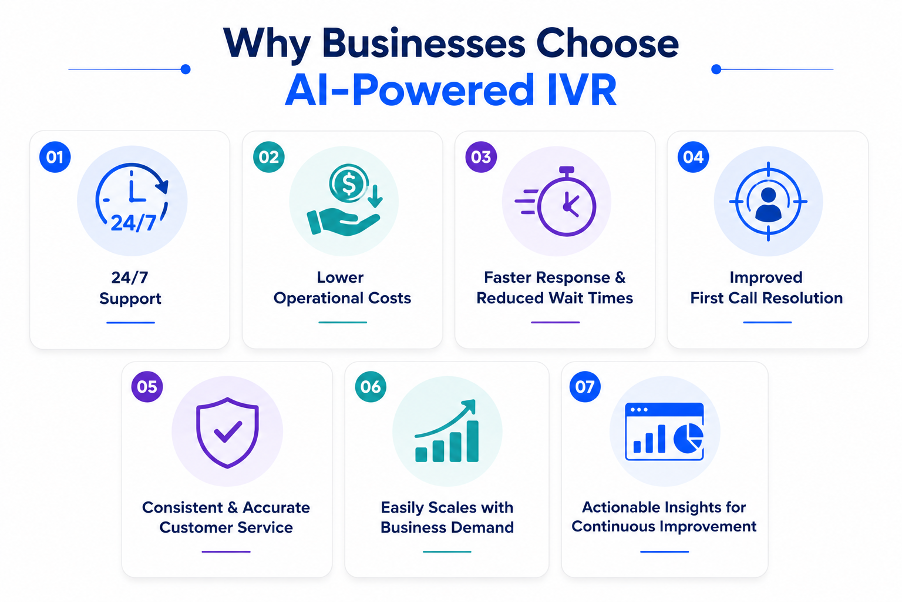
Benefits of AI-powered IVR

Businesses use a smart IVR solution to deliver faster, smarter customer service while reducing operational costs .

24/7 Customer Support

IVR enables customers to access routine services such as order tracking, account balances, appointment confirmations, and bill payments at any time, without waiting for a live agent. This ensures uninterrupted support beyond business hours.

Lower Operational Costs

By automating routine customer queries, IVR reduces agent workload and lowers the cost per interaction. Higher self-service adoption allows businesses to scale support without proportionally increasing staffing costs.

Faster Response and Reduced Wait Times

Instead of placing every caller in a general queue, IVR quickly identifies customer intent and routes calls to the right department or self-service option. This minimizes wait times and improves the overall customer experience.

Improved First Call Resolution (FCR)

By collecting customer intent and authentication details before transferring the call, IVR helps agents start conversations with the right context. This leads to faster resolutions and higher first call resolution rates.

Consistent and Accurate Customer Service

IVR delivers the same information every time, reducing errors caused by manual processes and ensuring customers receive accurate, standardized responses for common requests.

Easily Scales with Business Demand

Cloud-based IVR systems can handle sudden spikes in call volumes during seasonal campaigns, product launches, or festive sales without requiring additional hardware or infrastructure.

Actionable Insights for Continuous Improvement

Every IVR interaction generates valuable data, from menu selections and drop-off points to self-service completion and escalation rates. These insights help businesses optimize call flows, improve containment rates, and continuously enhance the customer experience.

How to Choose the Right IVR System for Your Business In India

Analyze your inbound call data to identify the most common customer queries. Prioritize an IVR system that can automate and efficiently route your highest-volume call types.

Define Your Business Requirements

Decide whether you need an IVR primarily for call routing, self-service automation, or . Choosing the right capabilities upfront helps avoid unnecessary features and implementation costs.

Choose a Cloud-Based IVR Platform

Cloud IVR offers faster deployment, on-demand scalability, lower maintenance costs, and built-in AI capabilities. It also makes it easier to support remote teams and manage multiple locations from a single platform.

Evaluate Integration Capabilities

Ensure the IVR integrates seamlessly with your CRM, helpdesk, ERP, payment systems, and business applications. Native integrations reduce implementation time and enable more personalized customer experiences.

Look for Omnichannel Support

Choose a platform that connects voice, WhatsApp, email, SMS, live chat, and social channels into a unified customer experience. Customers should be able to switch channels without repeating their information.

Test Before You Commit

Run a pilot with real customer interactions before making a final decision. Evaluate call routing accuracy, self-service completion rates, ease of administration, reporting capabilities, and overall customer experience under real-world conditions.

Why Enterprises Trust Ozonetel IVR Solution

The IVR market has no shortage of providers, but the meaningful differences between them show up less in the feature list and more in three practical areas: how well the platform integrates with existing CRM and core business systems, how quickly it scales during volume spikes without service degradation, and how responsive support actually is when a live production issue needs fixing at 11 PM during a festive-season surge.

For Indian businesses in particular, local data residency, native support for Indian languages at the ASR/TTS level, and familiarity with India-specific compliance requirements (TRAI regulations around commercial calling, DLT registration for messaging) matter in ways that global platforms built primarily for US and European markets don’t always handle natively.

Ozonetel’s has been built around exactly this — cloud IVR, WhatsApp, and AI voice agents on one architecture, purpose-built for the compliance and scale realities of the Indian market, with deployment histories across BFSI, insurance, NBFC, and government call centers handling millions of monthly interactions.

Ready to take control of your call transfer
experience for better CX outcomes?

Prashanth Kancherla

Frequently Asked Questions

IVR stands for Interactive Voice Response.

Good IVR improves customer experience by reducing wait times, providing instant self-service for routine queries, routing callers to the right agent on the first attempt, and personalizing interactions based on caller history. Bad IVR does the opposite — which is why design and continuous optimization matter so much.

IVR costs vary dramatically based on deployment model, scale, and feature set. Cloud IVR typically ranges from ₹1–₹9 per minute for basic call routing to ₹9–₹44 per minute for AI-powered conversational IVR with speech recognition. On-premise systems require a significant upfront investment of approximately ₹8.8 lakh–₹88 lakh+, along with ongoing maintenance and infrastructure costs. For most businesses, cloud IVR is the more cost-effective option, particularly as usage scales.

IVR (Interactive Voice Response) is an automated system that interacts with callers through voice prompts and keypad or spoken input, resolving simple requests directly or routing calls to the right agent.

Cloud IVR removes the upfront hardware and in-house maintenance costs of on-premise systems, replaces them with usage-based pricing, and reduces per-call agent cost by resolving a share of calls through self-service before they ever need a live agent.

No. IVR follows fixed, pre-scripted menu paths, while IVA (Intelligent Virtual Assistant) uses conversational AI to understand open-ended, natural-language requests — many call centers now run both together.

 Yes — in an omnichannel setup, the same IVR logic (intent capture, authentication, backend lookups) extends beyond voice to WhatsApp and chat, so a customer can start on a call and finish on WhatsApp, or vice versa, without losing context or repeating themselves.

Cloud IVR runs on shared, elastic infrastructure that adds concurrent call capacity on demand, rather than the fixed capacity of on-premise hardware. This is what lets Indian businesses absorb festive-season or EMI-due-date spikes without pre-provisioning for peak load year-round.

Visual IVR replaces or supplements voice prompts with a tappable menu delivered to the caller’s smartphone screen, letting them navigate options visually instead of listening through a list. It typically resolves requests faster for smartphone-heavy customer bases, since scanning a screen beats listening to five spoken options in sequence.

Skills-based routing sends a call to the agent best equipped to handle it — by language, product expertise, or seniority — rather than the next available agent in a flat queue. The IVR captures the relevant signal (language selection, reason for calling) upfront, and the routing engine matches it to agent skill profiles in real time.

A connected IVR looks up the caller’s number or account ID against the CRM mid-call, pulling details like account status, recent orders, or open tickets, and can use that data to personalize the flow — skipping authentication for recognized numbers or surfacing relevant self-service options first. That same context then travels with the call to the agent, so the customer isn’t asked to repeat information the system already has.

IVR platforms support compliance by logging consent and call recordings for audit purposes, enforcing calling-hour and do-not-disturb rules for outbound IVR campaigns, and — for Indian businesses — supporting TRAI requirements around registered call flows and DLT-compliant messaging on connected channels like WhatsApp.

Tags:

IVR

Share this post: