Voice AI Platform vs Voicebot: What Nobody Tells You in 2026
Voice AI Platform vs Voicebot: What Nobody Tells You in 2026
Prashanth Kancherla
Sep 28, 2026 | 6mins read
Last month, a customer called their bank to make a payment. The bot picked up fast, understood the request, and asked for the 16-digit account number to verify. The customer was on a crowded train platform. They didn’t want to say their account number out loud, and there was no option to key it in instead. Two failed attempts later, the call dropped, unresolved, and they hung up and called back asking for a human.
That’s not a hypothetical — it’s a documented failure pattern across BFSI deployments, and a small example of a much bigger problem. Gartner’s 2024 survey of 5,728 customers found that only 14% of customer service issues get fully resolved through self-service, and 53% of customers say they’d consider switching to a competitor over how a company uses AI in service. The gap isn’t that customers hate automation. It’s that most conversational AI platform deployments are built to sound competent, not to actually finish the job.
Key takeaways
Most voicebots are built to sound competent, not to actually resolve the customer’s issue — that gap is why self-service satisfaction stays low industry-wide.
A voice AI platform is not the same thing as a voicebot — the difference is everything underneath the conversation layer, and most vendors sell the first while calling it the second.
Owning telephony and AI as one stack, rather than renting CPaaS underneath, is what makes real-time grounding, dual-mode input, and context-carrying handoffs possible.
Four design decisions separate a bot that talks from one that closes: domain-specific agents, zero-hallucination answers, dual-mode input, and full-context escalation.
Real-world deployments across telecom, BFSI, and retail show measurable gains in self-service resolution, collections, and contact center automation — proof the difference isn’t theoretical.
What’s the difference between a voicebot and a voice AI platform?
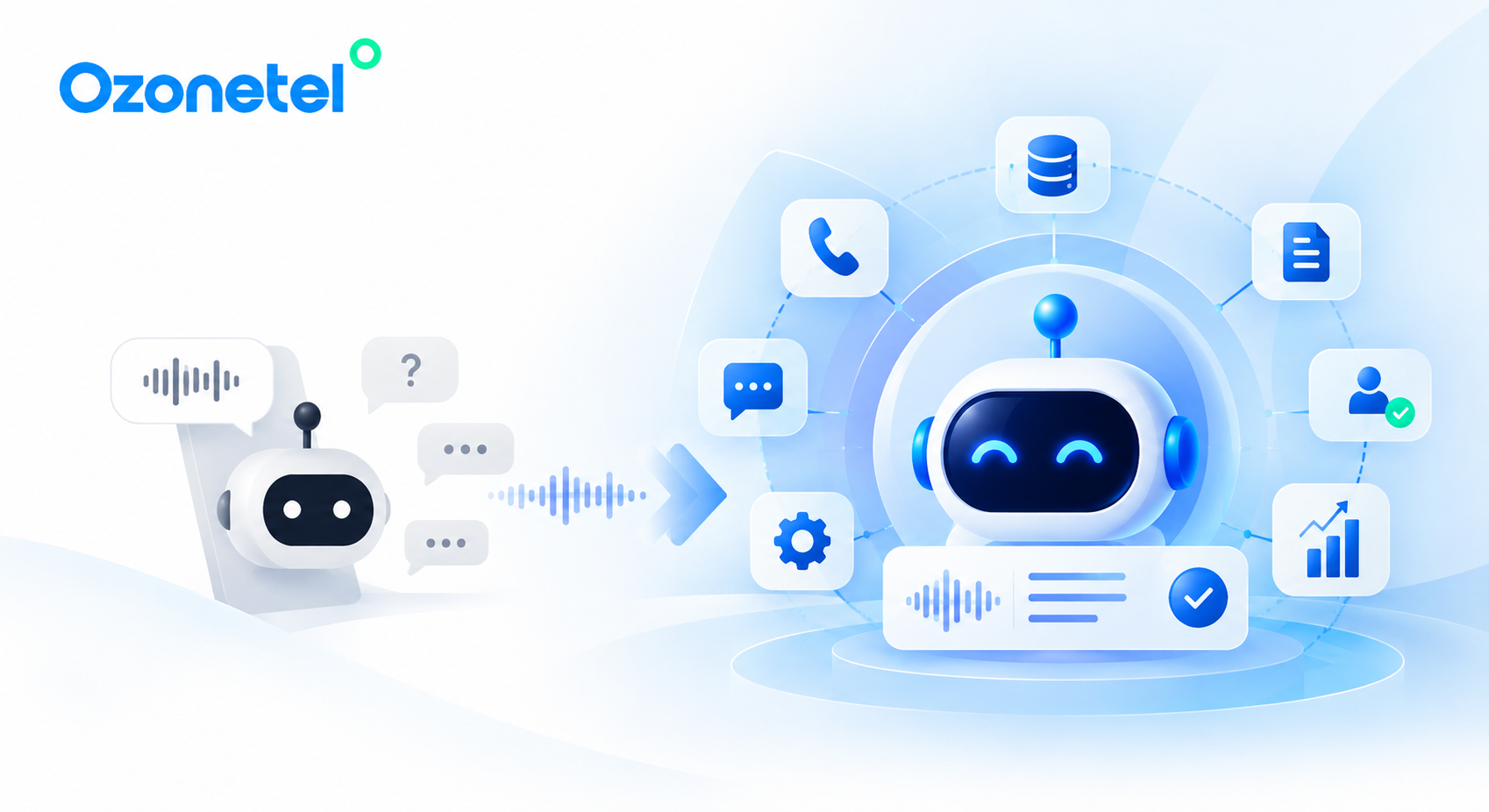
A voicebot is the conversation layer — it recognizes speech, understands intent, and replies. A voice AI platform is everything underneath and around that conversation: the telephony it runs on, the backend systems it pulls live data from, the language and input options it supports, and the handoff logic when it can’t finish the job. Most vendors sell the first and call it the second. The difference only shows up once a bot is handling real call volume, not a demo.
You need a voice AI platform, not a bot
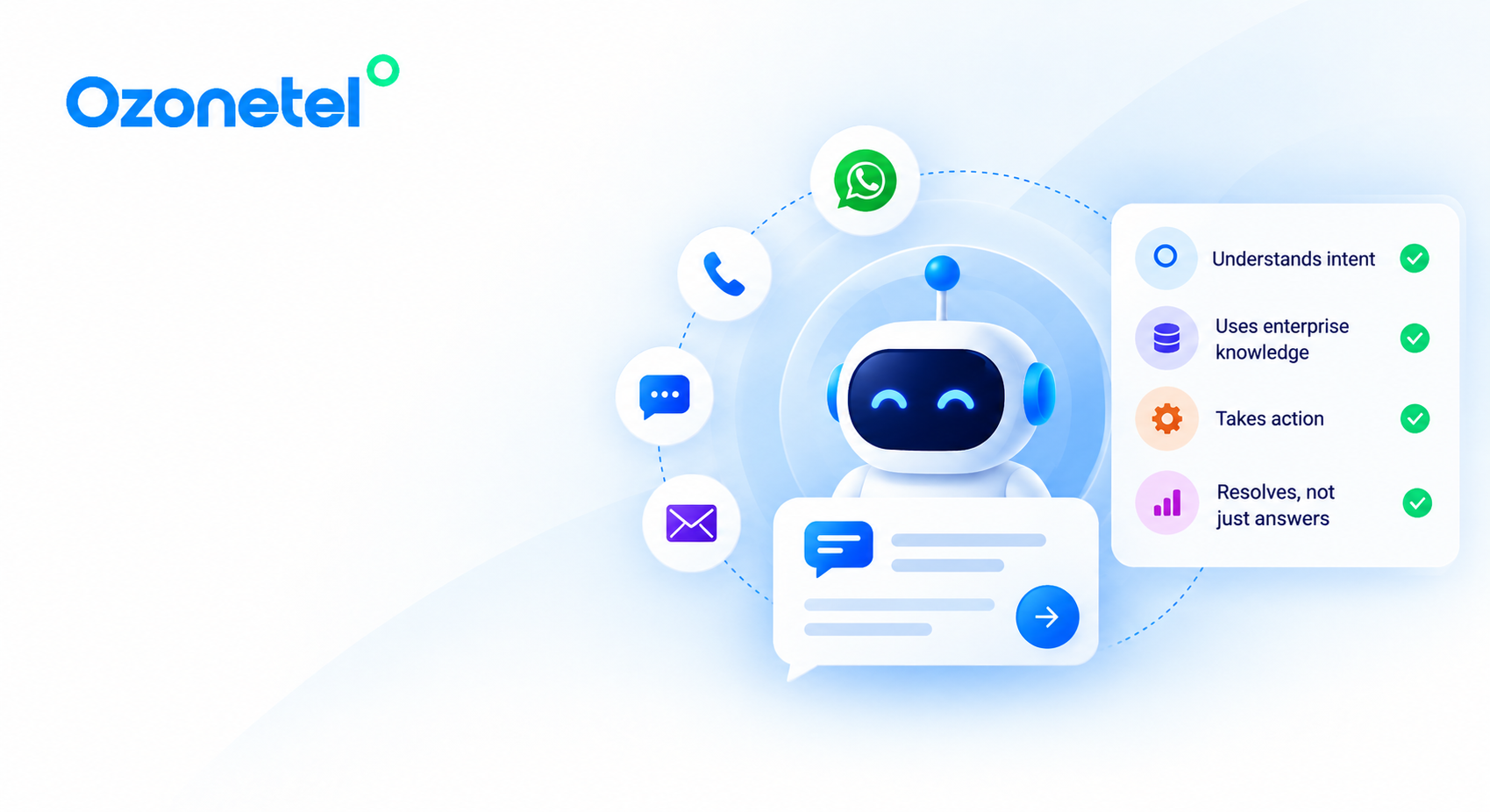
An AI voice agent that can hold a conversation is table stakes now. What separates an enterprise voice AI pilot that stalls from a contact center automation deployment that scales is whether the underlying platform is built to actually resolve the interaction — not just respond to it. That comes down to four specific design decisions, each solving a distinct way voicebots typically break down at scale.
The four things that decide whether it closes the loop
1.Domain-specific agents, not one generalist bot. A single script covering collections, support, and order management ends up mediocre at all three. Specialized agentic AI agents routed by intent are why the same platform can hold a debt-sensitive conversation and a transactional one equally well.
2.Zero-hallucination, backend-grounded answers. A bot that invents a balance or a return date doesn’t just fail once — it creates a support ticket and a trust problem. Every factual answer has to come from a live system call, never the model’s memory.
3.Dual-mode input, not speech-only. Forcing every customer into speech-only interaction is how you lose the ones on a train platform or in a meeting. Letting the bot offer a keypad (DTMF) option keeps those calls from failing outright.
4.Escalation with full context, by design. When a bot hands off, the agent needs the conversation history already in hand — the customer shouldn’t have to repeat
Why the platform underneath is built differently
These four decisions aren’t generic AI best practices — they’re specific engineering choices that come from owning telephony infrastructure rather than integrating with someone else’s. Most voice bots for customer service sit on top of a CPaaS provider — they own the conversation layer but rent the telephony underneath, which quietly limits what they can do, particularly when a customer needs to switch to keypad input mid-call for something like a PIN, or when a conversational IVR flow needs to hand off cleanly to a live agent. Owning the full stack — telephony and AI, natively integrated — is what makes it possible to guarantee real-time backend lookups and clean human handoffs instead of best-effort ones. That’s the structural difference between a CCaaS-native voice AI for call centers solution and one bolted onto rented infrastructure.
Results: three industries, same underlying discipline
The four design decisions above aren’t theoretical — they show up as measurable outcomes across telecom, NBFC collections, and retail, three deployments with almost nothing else in common except the platform underneath them.
Industry
Core Challenge
What Changed
Result
Telecom (DTH)
12M+ subscribers, billing/VAS queries in Hindi + 10 regional languages; legacy IVR could route but not resolve.
Agentic voicebot with live backend API lookups for channel management, VAS, error resolution, smart escalation.
55% self-service resolution
NBFC Collections
EMI follow-ups where tone matters as much as timing — too hard and borrowers disengage.
Automated EMI reminders and payment prompts with empathetic tone, freeing agents for complex cases.
+8% collections lift
Retail
Seasonal spikes in order status, return eligibility, and refund-tracking queries.
Voicebot connects live to loyalty CRM, authenticates callers, hands off complex cases with full context.
45% queries automated
Telecom: a DTH provider’s existing IVR could route menus but couldn’t resolve much beyond that. A custom agentic voicebot now covers channel management, promotional offers, VAS, instant lookup, error resolution, and smart escalation, with factual answers pulled live from the backend through real-time API calls.
NBFC collections: automated EMI reminders and payment prompts with an empathetic tone free human collections agents for the complex cases that need a person on the line — proof a well-built voicebot moves a revenue number, not just a cost-per-call one.
Retail: a voice bot connecting directly to the retailer’s loyalty CRM authenticates callers and pulls live data so answers are accurate without a wait, and hands off anything complex with full conversation context already attached.
What this means for your next deployment
The difference between a voicebot and a voice AI platform isn’t a single feature — it’s whether the whole stack is owned end to end, so nothing is a best-effort integration. The telephony layer, the AI layer, and the backend connections all have to sit under one roof to guarantee real-time data grounding, true dual-mode input, and context-carrying handoffs on every call, not just the ones that go according to script. That’s the gap most vendors don’t volunteer when they’re selling you a conversational AI platform — and it’s the reason a real platform holds up across telecom, BFSI collections, and retail without being re-architected for each one.
If your last voice AI deployment stalled after the pilot, that’s usually the tell — not the model, but what it’s built on top of. See what actually separates a successful enterprise AI deployment from one that stalls.
No — the value scales with complexity of customer journeys, not company size. Smaller teams with high support volume or multi-channel customers often see the gap between chatbot and conversational AI fastest.
It doesn’t have to replace them outright — chatbots still handle simple FAQs well. Conversational AI extends what happens once a conversation needs context, reasoning, or action.
Yes — when it’s integrated with your CRM, ERP, or ticketing systems, it can check order status, initiate refunds, and update records directly, not just describe the process. That integration is what turns an answer into a resolution.
Through resolution-based metrics: first-contact resolution, repeat contact rate, escalation rate, CSAT, and task completion — not raw containment percentage.
A chatbot maps questions to predefined answers. Conversational AI understands intent and context, reasons over enterprise knowledge, and can take action to resolve the request.
Yes — the stronger implementations carry context across channels, so a customer isn’t forced to restart the conversation when they switch from chat to a phone call.
nation charge of up to 5 paise per minute for A2P calls, subject to the exemptions specified in the regulations.
Timelines depend on how many systems it needs to integrate with, but most enterprise deployments go from pilot to production in weeks, not months, especially when the platform sits natively in your existing CX stack rather than being bolted on separately.