Top 15 AI Voicebot Platforms in 2026: The Complete Guide for Indian Enterprises

Prashanth Kancherla
Apr 20, 2026 | 25 mins read

15 Best AI Voicebot Platforms in India
Each platform below is evaluated on features, pros, cons, and India suitability — with ratings sourced from G2 verified reviews.
1. Ozonetel
G2 Rating: 4.6/5 | Best for Indian enterprises across BFSI, D2C, and Real Estate
Ozonetel is one of India’s most widely deployed AI-powered CX platforms, trusted by 3,500+ businesses across BFSI, D2C, real estate, and telecom.
One of its key AI offerings include agentic AI voicebots—voice agents that go beyond scripted responses to autonomously complete multi-step tasks. These include customer authentication, real-time CRM data retrieval, payment resolution, and callback scheduling—all within a single conversation, without human intervention.
The platform supports Hindi, Hinglish, and 10+ Indian languages, integrates natively with tools like LeadSquared, Zoho, SugarCRM, Salesforce, and Freshdesk, and runs on TRAI-compliant telephony infrastructure built for enterprise-scale reliability.
Key Features
- Agentic AI Voice Engine: The AI voice bot autonomously executes multi-step tasks (authentication, data retrieval, resolution, follow-up scheduling) within a single conversation flow without requiring human handoff for routine complexity.
- Speech Recognition and NLP: Precise analysis of speech inputs — handles nuances, accents, context variations, and language switching (Hinglish) across Indian regional dialects.
- Text-to-Speech with Brand Voice: Generates dynamic, natural-sounding voice responses in real time, with customizable tone and prompts aligned to each brand’s communication style.
- Agent Connect with Context Transfer: Seamlessly connects the voice bot to a live human agent for complex queries — with full conversation context transferred, so customers never repeat themselves.
- API Integrations and CRM Sync: Connects with CRM, ERP, OMS, and ticketing systems via REST APIs — enabling the bot to fetch and update live customer data during the call.
- Automated Survey and Feedback: Gathers real-time customer feedback through post-call surveys — enabling CSAT tracking and continuous bot optimization.
Pros
- Handles complex, multi-step interactions end-to-end, not just FAQs
- Native support for Hinglish and regional dialects with purpose-built multilingual telephony
- Pre-built integrations with SugarCRM, LeadSquared, Zoho, and Freshdesk
- Infrastructure scales dynamically with call volume, maintaining performance through seasonal peaks and campaign spikes
- Tracks containment rate, first-call resolution, transfer rate, and intent trends, with call-to-insight times under 10 minutes
Cons
- Initial workflow configuration and CRM integration setup requires dedicated implementation support
- Pricing is enterprise-contract based — no self-serve or publicly listed pricing
India Suitability: Exceptional — the strongest all-around choice for Indian enterprises seeking agentic AI voicebots with proven, attributed outcomes. Purpose-built for Indian contact center complexity, with documented results across BFSI, D2C, and telecom at scale.
CTA – Book Demo
2. Gnani.ai
G2 Rating: Only One review | Best for Indian regional language automation and BFSI collections
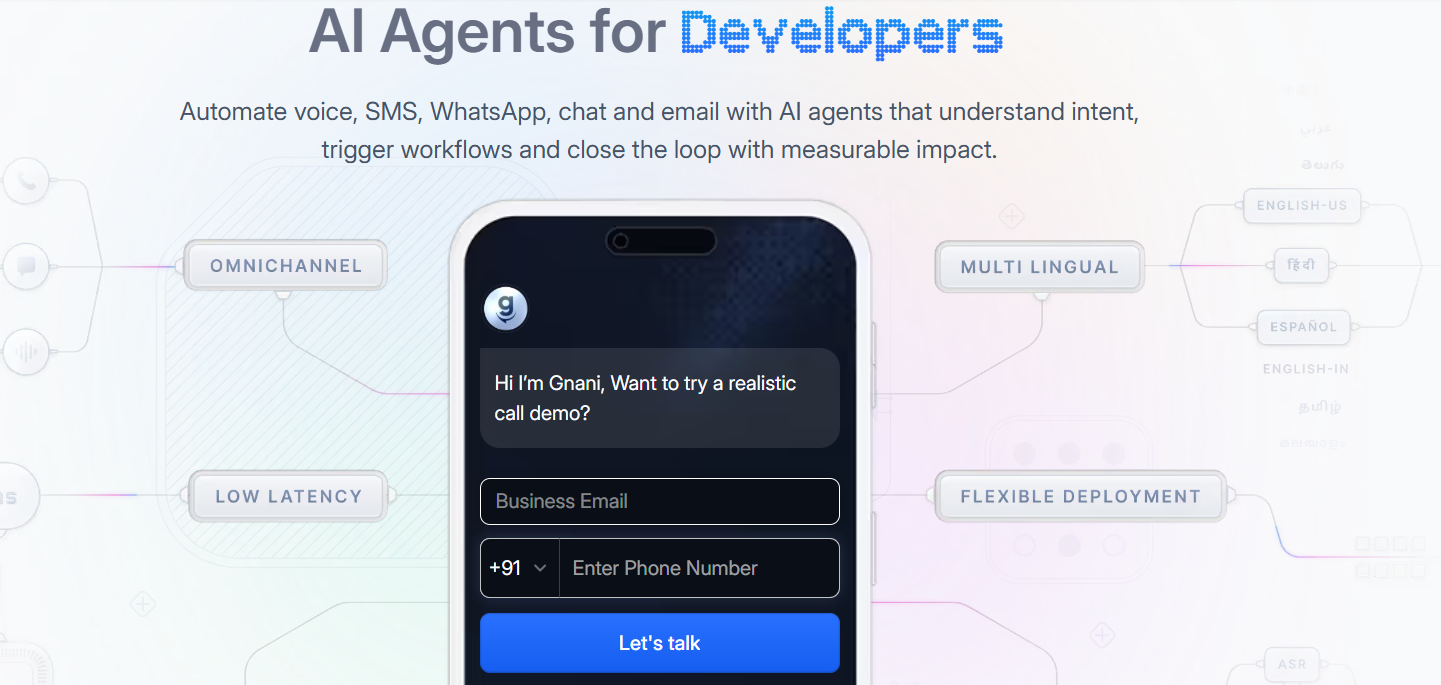
Gnani.ai is an India-native conversational AI company that has carved a strong niche in regional language voice automation. Founded in Bangalore, Gnani serves leading BFSI companies, telecom providers, and collections departments that need to communicate with customers in their native Indian languages — with accuracy that global platforms simply cannot match on Tamil, Telugu, Marathi, Kannada, and Hinglish. Their automatic speech recognition (ASR) models are trained specifically on Indian accent data, making Gnani the go-to choice for businesses serving Tier 2 and Tier 3 India.
Key Features
- 14+ Indian Language Support: Native speech recognition trained on Indian accent data for Hindi, Tamil, Telugu, Marathi, Kannada, Gujarati, Bengali, and more.
- BFSI-Specific Conversation Flows: Pre-built workflows for loan inquiries, EMI collections, KYC verification, fraud alerts, and insurance policy queries.
- Accent-Aware ASR: Speech recognition tuned for Indian regional accents and dialects, dramatically reducing transcription errors vs global platforms.
- Collections Automation: Intelligent outbound calling for payment reminders and collections, with dynamic conversation scripting based on customer profile.
- Compliance and Data Security: RBI-guideline aligned and data localization compliant for BFSI use cases requiring strict data residency.
Pros
- Best-in-class Indic language and accent recognition — proven in production
- Trusted by leading Indian BFSI companies for large-scale collections automation
- Affordable pricing designed for Indian market realities
- Strong compliance posture for regulated BFSI and fintech industries
Cons
- Primarily India-focused; limited support for international languages
- Less comprehensive for non-voice (text/chat) automation use cases
India Suitability: Excellent — the strongest India-native specialist for businesses needing genuine regional language depth. Essential for BFSI, microfinance, telecom, and any sector serving customers across Tier 2 and Tier 3 India.
3. Sarvam AI
G2 Rating: Not Available | Best for Indic language foundational AI models and enterprise voice agents
Key Features
- Native Indic LLMs: Speech and language models trained from scratch on Indian language data for 10+ Indic languages — not translated from English.
- Voice Agent APIs: Flexible, developer-friendly APIs for building custom voice agents with deep Indian language understanding.
- Natural Indic TTS: Text-to-speech synthesis that sounds authentically Indian — not a translated or accented version of English speech.
- Code-Switching Support: Handles Hinglish and other forms of natural code-switching between English and Indian languages seamlessly.
- Government and Enterprise Grade: Deployed for government digitization and Aadhaar-linked services, providing strong compliance credentials.
Pros
- Most technically advanced India-native language AI — genuine Indic LLMs, not translation layers
- Cutting-edge research backing with a world-class AI team
- Strong government and enterprise deployment credentials
- API-first approach for maximum integration flexibility
Cons
- Relatively newer enterprise product — fewer pre-built connectors vs mature platforms
- Requires developer investment to build production-ready voice agents
India Suitability: Excellent — the most technically rigorous choice for enterprises that want genuinely native Indic language AI. Best for organizations willing to invest in building a customized, deeply authentic Indian language voicebot experience.
4. Yellow.ai

G2 Rating: 4.4/5 | Best for omnichannel customer support automation at enterprise scale
Yellow.ai is a Bangalore-headquartered conversational AI unicorn trusted by over 1,100 enterprises globally. Its generative AI platform powers voice bots, chatbots, and digital agents across 35+ channels and 135+ languages. For Indian businesses, Yellow.ai brings strong pre-built templates for BFSI, ecommerce, and retail, backed by an India-native team that understands local market dynamics. Its particular strength is omnichannel coverage — enabling businesses to automate customer interactions across voice, WhatsApp, web, and mobile from a single platform.
Key Features
- Generative AI Conversational Engine: Creates intelligent, contextual responses trained on billions of conversations across industries.
- 135+ Languages and 35+ Channels: Covers all major Indian languages across voice, WhatsApp, web, mobile, and email from one platform.
- Pre-Built Industry Templates: Ready-to-deploy templates for BFSI, ecommerce, healthcare, and retail dramatically reduce time-to-launch.
- Agent Assist Integration: Real-time AI guidance for human agents when calls escalate, improving resolution quality.
- Advanced Analytics and Reporting: Detailed dashboards tracking containment rate, CSAT, intent trends, and conversion metrics.
Pros
- Strong India market presence with 1,100+ enterprise clients
- True omnichannel — voice and digital channels unified in one platform
- Robust analytics and continuous learning capabilities
- Scalable to very high contact center volumes
Cons
- Custom pricing requires direct quotation — no self-serve or transparent pricing
- Platform breadth creates a learning curve for new implementation teams
India Suitability: Very Good — a proven India-native enterprise platform with the broadest omnichannel coverage. Particularly strong for businesses wanting voice + WhatsApp + chat automation from a single vendor.
5. Haptik (Jio)
G2 Rating: 4.5/5 | Best for India-first enterprise conversational AI with Reliance backing
Haptik, acquired by Reliance Jio in 2019, is one of India’s most established conversational AI platforms. With deep roots in the Indian market and the backing of one of India’s largest conglomerates, Haptik brings enterprise-grade voicebot and chatbot capabilities paired with an understanding of Indian consumer behavior that few global platforms can match. The Jio ecosystem connection makes Haptik a natural fit for D2C, retail, and media brands already in the Reliance orbit.
Key Features
- No-Code Visual Bot Builder: Intuitive drag-and-drop interface for designing conversation flows without technical expertise.
- Pre-Built Indian Industry Solutions: Ready-made templates for D2C, BFSI, healthcare, and retail use cases tailored for Indian market nuances.
- Advanced NLP and Intent Recognition: Understands user queries in Hindi, English, and Hinglish with high accuracy.
- Multi-Channel Support: Covers voice, WhatsApp, web, and mobile app channels from a single platform.
- Performance Analytics: Dashboards tracking containment rates, CSAT, fallback rates, and resolution metrics.
Pros
- Deep India market experience and proven enterprise deployments
- Reliance Jio backing provides long-term platform stability
- Pre-built solutions reduce time-to-deploy for common Indian use cases
- Good balance between ease of use and enterprise-grade capability
Cons
- Voice/speech integration is less mature than text-based chatbot capabilities
- Enterprise support response times can vary for non-priority accounts
India Suitability: Very Good — one of the most trusted India-native enterprise AI platforms. Particularly strong for D2C and retail brands already integrated with the Jio-Reliance ecosystem.
6. Skit.ai
G2 Rating: Not available | Best for reaching Tier 2/3 markets with regional language voice automation
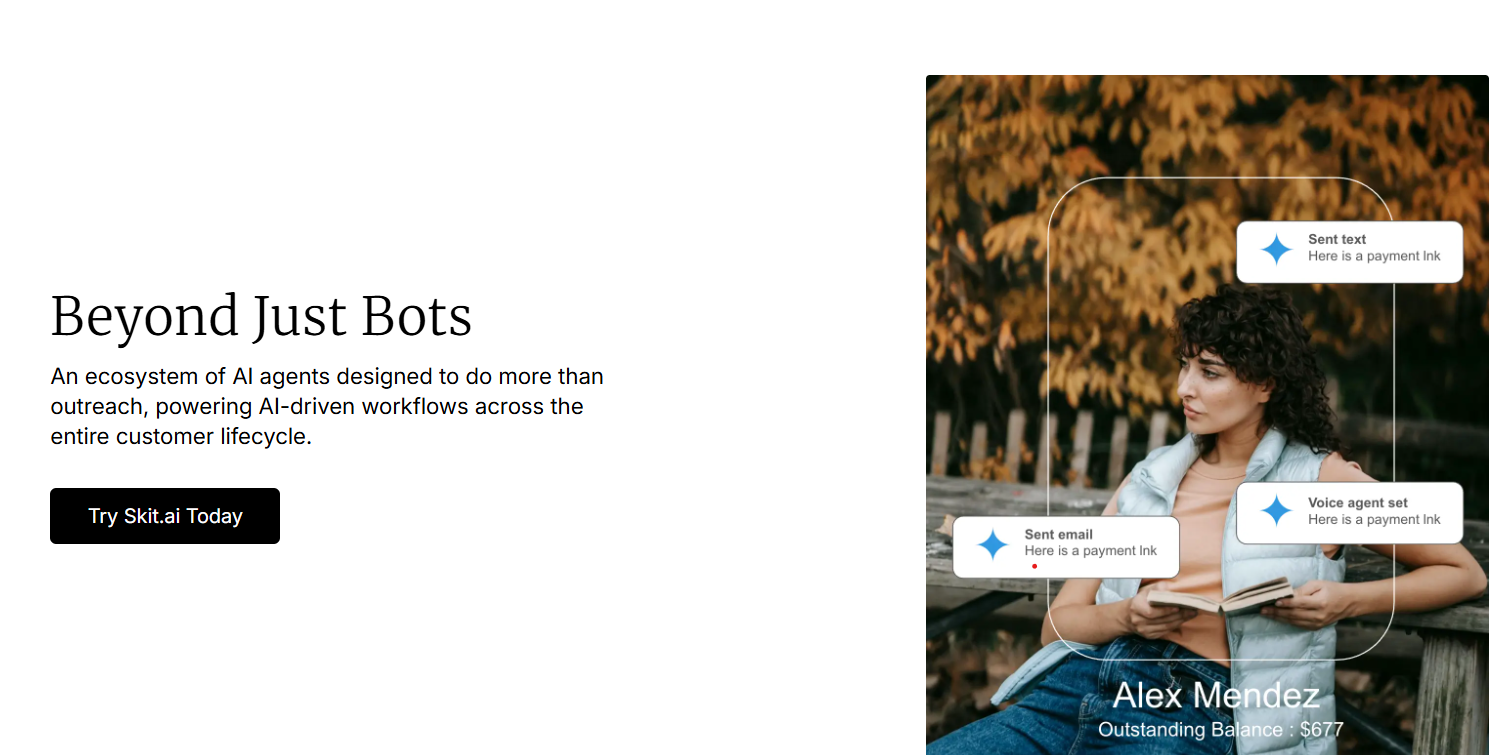
Skit.ai, (formerly Vernacular.ai) is an Indian-origin conversational AI company that has evolved from its regional language roots into a specialized voice AI platform for the accounts receivable and debt collections industry. Founded in 2016 in Bengaluru, the company now operates out of both India and New York, serving enterprise clients across the US market while maintaining its R&D base in India.
Key Features
- Omnichannel AI: Automates customer interactions across voice, SMS, email, and chat — all within a single connected platform.
- Collections-Specific AI: Purpose-built for debt recovery workflows, trained on millions of regulated consumer interactions with built-in knowledge of negotiation patterns, dispute resolution, and payment facilitation.
- Generative AI + RPA: Combines GenAI conversational capability with robotic process automation to handle complex, multi-step collection workflows end to end.
- Compliance Architecture: Natively built to meet FDCPA, TCPA, Reg F, HIPAA, PCI-DSS, SOC 2 Type II, and ISO 27001:2022 standards — compliance is core, not an add-on.
- Deep Integrations: Connects with leading CRMs (Salesforce, Temenos, Finvi), dialers (NICE, Dialpad), and payment processors (Stripe, Repay) via secure APIs or SFTP.
Pros
- Deep domain specialization in collections — not a generic contact center tool
- Strong compliance depth across US regulatory frameworks
- Proven at scale — 1B+ conversations and $1B+ in accounts resolved
- Indian-origin engineering base with enterprise-grade global delivery
Cons
- Heavily US-collections focused — limited relevance for broader CX or Indian market use cases
- Narrowed ICP means limited flexibility for non-collections deployments
- Regional language capability from its Vernacular.ai era is no longer a core offering
India Suitability: Limited for current Indian market needs. While Skit.ai was born in India and built early traction with clients like Axis Bank and Hathway, its product focus has shifted decisively toward the US ARM industry. Businesses looking for regional language voice AI in India would be better served by platforms like Gnani.ai or Mihup.
Excellent for regional reach — the go-to platform for businesses specifically targeting Tier 2/3 markets, agricultural communities, or government-to-citizen communication in regional languages.
7. Exotel
G2 Rating: 4.3/5 | Best for India SMBs and mid-market cloud telephony with voicebot capabilities
Exotel is one of India’s leading cloud communications platforms, trusted by 7,000+ businesses for voice, SMS, and API-driven communication. Its voicebot capabilities are built on top of rock-solid Indian telephony infrastructure, making it a practical and affordable choice for Indian SMBs and mid-market companies looking to automate inbound call handling without the cost or complexity of full enterprise AI platforms. For businesses starting their voicebot journey, Exotel offers a lower-risk, India-native entry point.
Key Features
- Cloud Telephony + Voicebot Bundle: Combines IVR, voicebot, call routing, and recording in one platform — eliminating the need for multiple vendors.
- TRAI Compliant Infrastructure: Fully compliant with Indian telecom regulations including DND, transactional routes, and caller ID norms.
- API-First Architecture: Flexible APIs for building custom voicebot workflows into existing applications and CRM systems.
- Pan-India Network Reliability: Robust Indian telecom infrastructure ensuring high call quality across all geographies including Tier 2/3.
- Transparent Pay-As-You-Go Pricing: Consumption-based pricing suited for SMBs scaling up gradually without upfront commitment.
Pros
- India-first with strong TRAI compliance and regulatory alignment
- Affordable and transparent pricing — ideal for SMB budgets
- Reliable infrastructure with high uptime SLAs
- Easy to integrate with popular Indian business tools
Cons
- Voicebot AI capabilities are less advanced than pure-play AI platforms
- Regional language depth limited compared to Gnani.ai or Sarvam AI
India Suitability: Good — the most practical entry point for Indian SMBs wanting voicebot automation without heavy enterprise complexity. Particularly strong for ecommerce, logistics, and field-service businesses.
8. Sprinklr
G2 Rating: 4.2/5 | Best for Enterprises with global reach
Sprinklr is a publicly listed (NYSE: CXM) enterprise software company that offers conversational voice AI as part of its broader Unified Customer Experience Management (Unified-CXM) platform. Unlike point solutions built exclusively for voice, Sprinklr’s voice bots sit within a full-stack platform that spans 30+ digital and voice channels — making it a strong fit for large enterprises that want voice automation without fragmenting their customer experience stack.
Key Features
- No-Code Voice Bot Builder: Drag-and-drop bot builder lets teams design, test, and deploy voice bots quickly without engineering dependence Sprinklr, with flows built around real contact drivers mined from customer data.
- Unified-CXM Integration: Voice bots share context with chat, email, social, and SMS — so customers never have to repeat themselves across channels.
- Emotion & Intent Detection: Sprinklr’s NLP identifies customer intent and sentiment during interactions in real time, allowing teams to decide which conversations go to virtual agents and which require a human touch. Sprinklr
- Generative AI + Guardrails: Free-form conversational flows eliminate rigid decision-tree workflows, while Sprinklr Guardrails ensure GenAI responses remain brand-compliant and prevent hallucinations. Business Wire
- Multilingual Capability: ASR and intent models retrain continuously from customer data, achieving over 90% accuracy, with new languages deployable in 4–6 weeks at 85% accuracy. Sprinklr
- Outbound Voice Automation: Drives outbound campaigns via voice bots for use cases like bill collections or widespread customer announcements. Sprinklr
Pros
- Enterprise-grade platform with voice as one piece of a unified CX architecture
- Strong GenAI capabilities with built-in brand safety guardrails
- No-code deployment lowers the barrier for non-technical teams
- Backed by a publicly listed company with robust R&D investment
Cons
- Voice AI is not a standalone product — bundled within a broader, expensive enterprise suite
- Can be over-engineered for mid-market businesses that only need voice automation
- Indian regional language support is not a core strength
India Suitability: Sprinklr has a presence in India and serves large Indian enterprises, but its voice AI is optimized for global, English-first deployments. Businesses looking for deep regional language support or Tier 2/3 market reach will find Sprinklr’s voice capabilities insufficient for that purpose.
9. Kore.ai
G2 Rating: 4.6/5 | Best for large enterprise automation with 120+ language support
Kore.ai is a globally recognized enterprise conversational AI platform with a strong presence in Indian BFSI and IT sectors. Its platform combines no-code and low-code bot building tools with sophisticated NLP and enterprise-grade security, making it accessible to business teams while powerful enough for complex enterprise deployments. Kore.ai’s compliance certifications make it a preferred choice for banking, insurance, and healthcare organizations operating in India.
Key Features
- No-Code/Low-Code Builder: Business users can create intelligent virtual assistants with minimal coding through an intuitive visual interface.
- 120+ Language Support: Broad multilingual coverage including Indian languages for both domestic and global deployments.
- Advanced Dialog Management: Sophisticated NLP handles complex, multi-turn conversations accurately — even with context switching.
- Enterprise Compliance: SOC 2, ISO 27001, HIPAA, and GDPR compliant — critical for regulated Indian industries.
- Conversation Analytics: Deep analytics to track performance, identify failure points, and continuously improve conversation quality.
Pros
- Highest G2 rating (4.7) among all platforms evaluated — reflects consistent enterprise satisfaction
- Excellent multilingual and multichannel capabilities
- Flexible development (no-code for business teams; API access for developers)
- Strong in BFSI, insurance, and healthcare compliance for Indian regulated sectors
Cons
- Higher cost that may be prohibitive for Indian SMBs and mid-market businesses
- Initial setup complexity requires dedicated implementation support
India Suitability: Very Good — the strongest choice for large Indian enterprises — particularly BFSI, IT, and healthcare — that require enterprise-grade compliance, 120+ language coverage, and proven global scale.
10. Cognigy.ai
G2 Rating: 4.6/5 | Best for multinational enterprises automating global contact center operations
Cognigy.ai is a leading enterprise conversational AI platform widely adopted by global organizations for contact center automation. With 100+ language support, no-code flow building, and deep enterprise integrations, it is a strong choice for Indian MNCs and large enterprises managing both domestic and international customer operations from a unified platform. Its real-time translation capability is particularly valuable for organizations handling multilingual interactions without maintaining separate bot versions.
Key Features
- No-Code Flow Designer: Drag-and-drop interface for building complex conversational flows — accessible to non-technical business teams.
- 100+ Languages with Real-Time Translation: Handles multilingual conversations including Indian languages with automatic real-time translation.
- Enterprise KPI Dashboards: Advanced performance dashboards tracking all key conversation metrics for continuous improvement.
- REST API Integration: Connects with enterprise CRM, ERP, and ticketing systems for seamless data flow.
- Generative AI Integration: LLM integration for more intelligent and contextual response generation.
Pros
- One of the highest-rated enterprise platforms globally (4.7/5)
- Strong no-code capabilities empower non-technical teams
- Real-time translation reduces complexity of maintaining multilingual bots
Cons
- Pricing requires direct engagement; tends to be on the expensive side for mid-market
- Some advanced features carry a learning curve
India Suitability: Good for MNCs — best suited for Indian subsidiaries of global organizations or large Indian enterprises managing international operations alongside domestic customer service.
11. IBM Watsonx Assistant
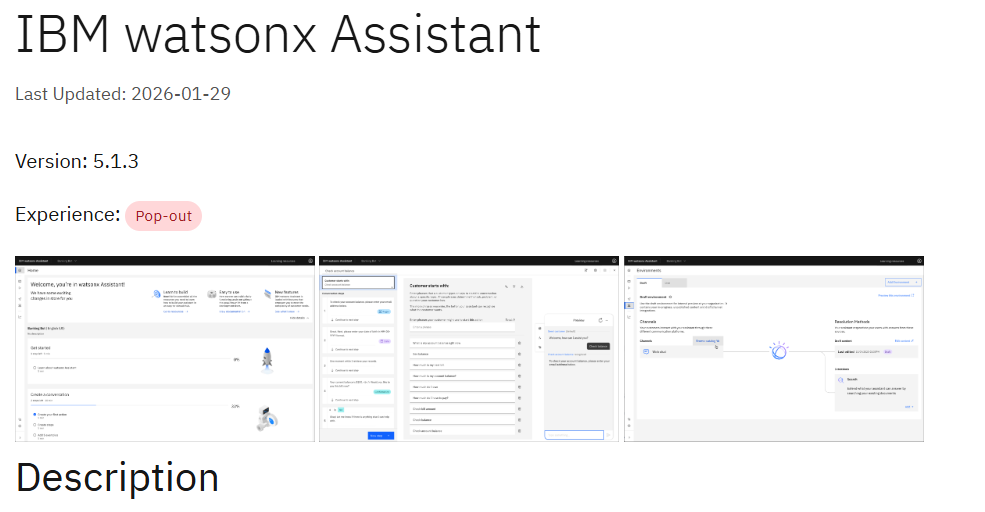
G2 Rating: 4.4/5 | Best for BFSI and regulated enterprise with strict compliance requirements
IBM Watsonx Assistant is a battle-tested enterprise AI platform with deep roots in banking, insurance, and regulated industries globally. It uses advanced NLP and large language models to automate customer support across voice and text, with flexible deployment options including on-premises — a critical requirement for Indian BFSI companies with strict data localization mandates under RBI guidelines. IBM’s presence in India across government, banking, and PSU sectors makes Watsonx a familiar and trusted partner for large Indian organizations.
Key Features
- Advanced LLM Integration: Large language models understand and process complex natural language queries with high accuracy.
- Low-Code Visual Builder: Business-friendly interface for creating and customizing voice and chat assistants without heavy development.
- On-Premises Deployment Option: Available for organizations requiring data to remain within their own infrastructure — critical for Indian RBI compliance.
- Voice and Telephony Support: Supports telephonic integration for call center automation across inbound and outbound channels.
- GDPR and ISO Compliance: Meets major global and RBI-aligned data governance standards for regulated sectors.
Pros
- Trusted by global and Indian banks, insurance companies, and regulated enterprises
- On-premises deployment option is critical differentiator for Indian BFSI data localization
- Strong compliance and enterprise data security posture
Cons
- Complex enterprise pricing requires direct engagement
- Customization and fine-tuning requires technical expertise
India Suitability: Good — particularly strong for large Indian banks, insurance companies, and PSUs that require on-premises deployment, RBI compliance, and enterprise-grade AI capability from a globally trusted vendor.
12. Amazon Lex
G2 Rating: 4.2/5 | Best for AWS-native engineering teams building custom voicebot applications
Amazon Lex, built on the same deep learning technology powering Amazon Alexa, is AWS’s managed conversational AI service. It is the go-to choice for engineering teams already invested in the AWS ecosystem, offering pay-as-you-go pricing and seamless integration with AWS Lambda, DynamoDB, Connect, and CloudWatch. For Indian tech companies and startups on AWS Mumbai or Hyderabad regions, Lex provides low-latency voice AI infrastructure without the overhead of managing model infrastructure.
Key Features
- Native AWS Integration: Seamless connectivity with Lambda, Cognito, Connect, CloudWatch, and the broader AWS service ecosystem.
- Streaming Conversation APIs: Handles interruptions and context switching during conversations for a natural dialogue flow.
- Transparent Pay-As-You-Go Pricing: $0.004 per speech request and $0.00075 per text request — clear, predictable, and scalable.
- Auto-Scaling Infrastructure: Scales automatically to handle demand spikes without manual infrastructure management.
- India Region Deployment: AWS Mumbai and Hyderabad regions ensure low-latency deployment for Indian end users.
Pros
- Transparent consumption-based pricing — ideal for startups and growing businesses
- Seamless AWS ecosystem integration for teams already on AWS
- Scalable infrastructure with no DevOps overhead
Cons
- Struggles with complex multi-turn conversations requiring deep context
- Limited customization vs specialized enterprise AI platforms
- Requires significant development investment to build production-quality flows
India Suitability: Moderate — best for Indian tech teams building custom voicebot applications on AWS. Not suited for out-of-the-box enterprise deployment; requires developer bandwidth to create effective conversation flows.
13. Google Dialogflow
G2 Rating: 4.4/5 | Best for developers building voice and text conversational interfaces on GCP
Dialogflow, Google’s conversational AI platform, leverages Google’s industry-leading NLP and machine learning capabilities. Popular among developers for its visual flow designer and deep Google Cloud integration, Dialogflow is a solid foundation for building custom voicebots. Its support for Hindi and other Indian languages via Google’s NLU models makes it viable for India-facing applications, particularly for organizations already invested in Google Cloud.
Key Features
- Google Cloud NLP: Access to Google’s best-in-class natural language understanding capabilities and continuous model improvements.
- Visual Flow Designer: Intuitive drag-and-drop interface for designing and testing conversation flows.
- 20+ Language Support: Includes Hindi and other major Indian languages through Google’s NLU models.
- Pre-Built Agents: Ready-made conversation templates for common use cases to accelerate development.
- Free Tier + Pay-As-You-Go: Free tier for prototyping; paid tier starts at $0.002 per request — developer-friendly pricing.
Pros
- Deep GCP integration for organizations on Google Cloud
- Developer-friendly with extensive documentation and community support
- Free tier is valuable for prototyping and low-volume use cases
Cons
- Indian regional language depth is significantly less than India-native platforms
- Not purpose-built for Indian enterprise contact center requirements
- Requires substantial development effort for production-quality Indian language bots
India Suitability: Moderate — a strong developer tool for custom voice applications within the Google ecosystem, but requires significant development investment to approach the India-readiness of specialized platforms.
14. LivePerson
G2 Rating: 4.3/5 | Best for digital-first enterprises blending AI automation with human expertise
LivePerson is a veteran in the digital customer service space, known for its intelligent blend of AI automation and human agent capability. Its Conversational Cloud platform powers voice bots and digital agents for large enterprises, with advanced real-time intent detection and conversation analytics. For Indian enterprises managing complex, multi-channel customer service operations where the AI-human blend is a core requirement, LivePerson provides a mature and tested framework.
Key Features
- Real-Time Intent Detection: Analyzes customer intent during live conversations to trigger the right response or escalation in real time.
- AI-Human Hybrid Orchestration: Seamlessly blends AI automation with human agent intervention — including in-conversation agent assistance.
- Customizable Conversation Workflows: Build tailored response and escalation workflows for different customer segments and issue types.
- Advanced Conversation Analytics: Deep insights into customer behavior, resolution rates, intent trends, and agent performance.
- Multi-Channel Coverage: Covers voice, messaging, email, and social channels from a unified platform.
Pros
- Mature platform with proven enterprise deployments globally
- Advanced analytics for continuous CX optimization
- Effective AI-human blend for complex, multi-channel customer service
Cons
- Custom pricing tends to be expensive for mid-market Indian operations
- Reporting interface has a steep learning curve
India Suitability: Moderate — a good fit for large Indian enterprises with digital-first CX ambitions managing complex multi-channel operations, particularly where balancing AI and human service is a strategic requirement.
15. Nurix AI
G2 Rating: 4.5/5 | Best for AI voice agents in sales automation and outbound calling India
Nurix AI is an emerging India-native platform building autonomous AI voice agents specifically for sales, customer success, and collections workflows. Unlike traditional voicebot platforms focused on inbound support, Nurix focuses on agentic AI — voice agents capable of completing multi-step outbound tasks like qualifying a lead, scheduling a demo call, or following up on a missed payment — making it highly relevant for Indian inside sales teams, NBFCs, and collections departments that need intelligent outbound voice automation at scale.
Key Features
- Agentic Voice AI: Voice agents that complete multi-step outbound workflows autonomously — beyond simple scripted responses.
- Outbound Campaign Automation: Automated outbound voice campaigns for lead follow-up, EMI reminders, renewals, and event invitations.
- CRM Integration: Syncs lead status, call outcomes, and next-step actions directly with major Indian and global CRMs.
- Real-Time Conversation Intelligence: Tracks conversation quality, objection patterns, and conversion rates for coaching and optimization.
- Hindi, Hinglish, and English Support: Handles India’s primary business languages with natural conversation quality.
Pros
- Purpose-built for Indian outbound sales and collections workflows
- Agentic AI approach handles multi-step tasks without human intervention
- Strong ROI for high-volume outbound calling operations
Cons
- Newer platform — shorter enterprise track record vs established players
- Regional language depth (beyond Hindi and Hinglish) still evolving
India Suitability: Very Good for outbound — the strongest specialized choice for Indian sales teams, NBFC collections, and inside sales operations needing intelligent, autonomous outbound voice automation.