Toll-Free Numbers for Indian Businesses: The Complete Guide

Prashanth Kancherla

May 18, 2026 | 16 mins read

Every missed call is a missed opportunity. When a potential customer hesitates to dial your number because they’re worried about call charges, you lose more than a conversation — you lose a sale, a support interaction, or a relationship before it even begins.
That’s why toll-free numbers remain one of the most powerful customer communication tools available to Indian businesses. They remove the cost barrier for callers, signal professionalism, and — when paired with modern cloud contact center technology — become far more than just a “free number.”
Their relevance remains strong even among global enterprises. A 2025 analysis by Unitel Voice found that nearly 75% of Fortune 500 companies continue to use toll-free numbers as part of their customer communication strategy.
This guide covers everything you need to know about toll-free numbers in India — from TRAI regulations and pricing to cloud integration, provider comparisons, and setup best practices. Whether you’re a startup evaluating your first business number or an enterprise optimising your existing contact center, you’ll find actionable answers here.

Key Takeaways

  • 1800 numbers are free across Indian mobile networks and landlines; businesses pay incoming call charges.
  • Toll-free numbers activate within 24–72 hours and require no on-premise telephony hardware.
  • Toll-free pricing ranges from ₹0.80/minute to ₹36,000/year, depending on usage and features.
  • Cloud CCaaS adds IVR, AI routing, CRM integration, analytics, and omnichannel customer engagement.
  • Choose providers offering native CCaaS, CRM integrations, transparent pricing, and 99.9% uptime SLAs.
  • Insurance, healthcare, and broking firms improve renewals, CSAT, and scalability using cloud-integrated toll-free systems.
  • TRAI mandates KYC verification, recording disclosures, DND compliance, and grievance redressal mechanisms.

What is a Toll-Free Number?

A toll-free number is a telephone number where the called party (the business) pays all incoming call charges, and the person making the call pays nothing. In India, this is most commonly recognised by the prefix 1800 — a number series explicitly reserved for toll-free services under the National Numbering Plan administered by the Department of Telecommunications (DoT) and regulated by TRAI.

The Indian Context

Toll-free numbers work differently in India than in the United States or the UK. Here’s what Indian businesses need to understand:

  • 1800 numbers are completely free for callers from both mobile phones and landlines. The business bears the full cost of every incoming call — typically on a per-minute basis.
  • These numbers are not tied to a geographic location. A customer in Guwahati and a customer in Mumbai dial the same 1800 number and reach the same business — making toll-free numbers a true pan-India solution.
  • Toll-free numbers in India are inbound-only. You cannot make outbound calls from a toll-free number (unlike virtual numbers, which support two-way calling).

Why the Name “Toll-Free”?

The term originates from the concept of a “toll” — a charge for using a service. Traditional long-distance calls in India used to carry significant charges, and businesses absorbed these costs to encourage customers to call. The first toll-free prefix in the US was 800, which is why you’ll still hear global businesses refer to “800 numbers.” In India, the equivalent is 1800 (and to a lesser extent, 0800).

Toll-Free in the Age of Mobile-First India

India has over 1.1 billion mobile subscribers (Source: TRAI, 2025). The overwhelming majority of your customers will call from a mobile phone, not a landline. A common misconception is that toll-free numbers are only free from landlines — but in India, 1800 numbers are free from all mobile networks as well. This universal accessibility is what makes them so effective as a customer contact channel.

Types of Toll-Free Numbers in India

Not all toll-free numbers are the same. Here’s a breakdown of the four main categories Indian businesses should know:

2.1 1800 Series — The Standard Toll-Free Number

This is the most common and widely recognised toll-free prefix in India.Example: 1800-123-4567

AttributeDetail
Format1800-XXX-XXXX or 1800-XXX-XXX (6–7 digits after prefix)
Caller cost₹0 (completely free from all networks)
Business paysPer-minute incoming call charge
Best forCustomer support, sales inquiries, helplines
Geographic scopePan-India
RecognizabilityVery high — customers instantly know it’s free

2.2 0800 Series — Toll-Free for Landline Callers

Less common but still present in India, the 0800 prefix is sometimes used by legacy telecom operators. 0800 numbers are primarily free from landlines and may incur charges from some mobile networks depending on the operator agreement. For modern businesses, 1800 is almost always the better choice for universal coverage.

2.3 International Toll-Free Numbers

If your business serves customers across multiple countries, you can procure toll-free numbers in each target market. Universal International Freephone Numbers (UIFN) — prefixed with +800 — allow a single number to work across multiple countries, though UIFN adoption in India remains limited.

2.4 Vanity Toll-Free Numbers

A vanity number spells out a word or brand name on a phone keypad (e.g., 1800-BANKING = 1800-2265464). Research by 800response found an 84% improvement in recall rates for vanity numbers over numeric toll-free numbers (Source: 800response Study, 2007). While US-focused, the cognitive principle holds globally. Note: Vanity numbers in India are harder to procure and may carry a premium of ₹5,000–₹15,000 on setup.

Toll-Free vs Regular vs Virtual Numbers

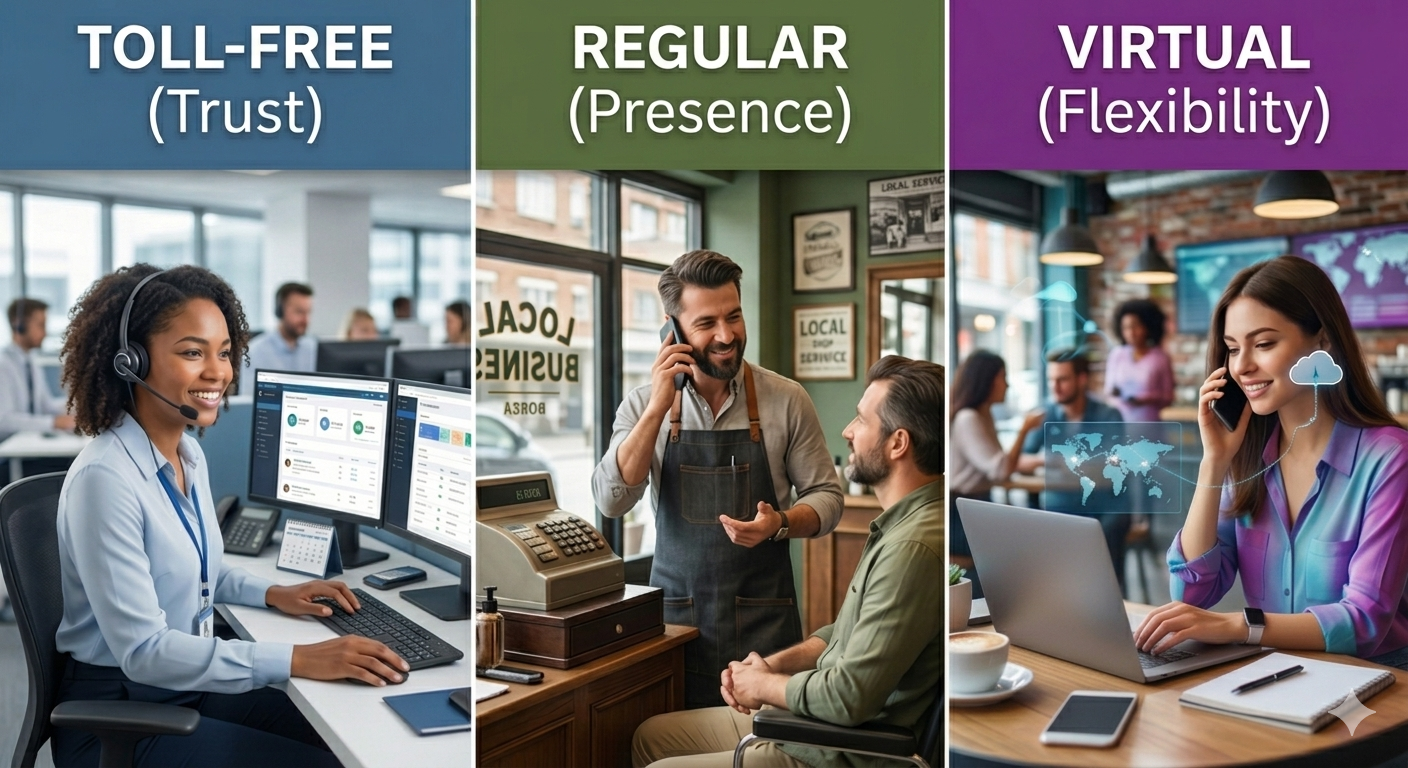
Understanding the differences helps you choose the right number type for each use case. Many businesses use both — a toll-free number for customer-facing touchpoints and virtual numbers for sales and operations.
Feature Toll-Free (1800) Regular Landline Virtual Number (VoIP)
Caller cost Free Standard call rates apply Standard call rates apply
Business pays Per-minute incoming Fixed line rental + call charges Subscription + per-minute
Geographic tie None (pan-India) Tied to city/state None
Outbound calling ❌ Not supported ✅ Supported ✅ Supported
Multi-location routing ✅ With cloud provider ❌ Limited ✅ Native
IVR integration ✅ With cloud CCaaS ❌ Requires hardware ✅ Native
Setup time 24–72 hours (with provider) Days to weeks Minutes to hours
Hardware required None (cloud-based) Physical phone line + PBX optional None
Call recording ✅ With cloud provider ❌ Needs add-on ✅ Native
Portability Can be ported between providers Difficult Can be ported
Best for Customer-facing inbound lines Local presence Sales teams, remote agents, outbound

How to Get a Toll-Free Number in India (Step-by-Step)
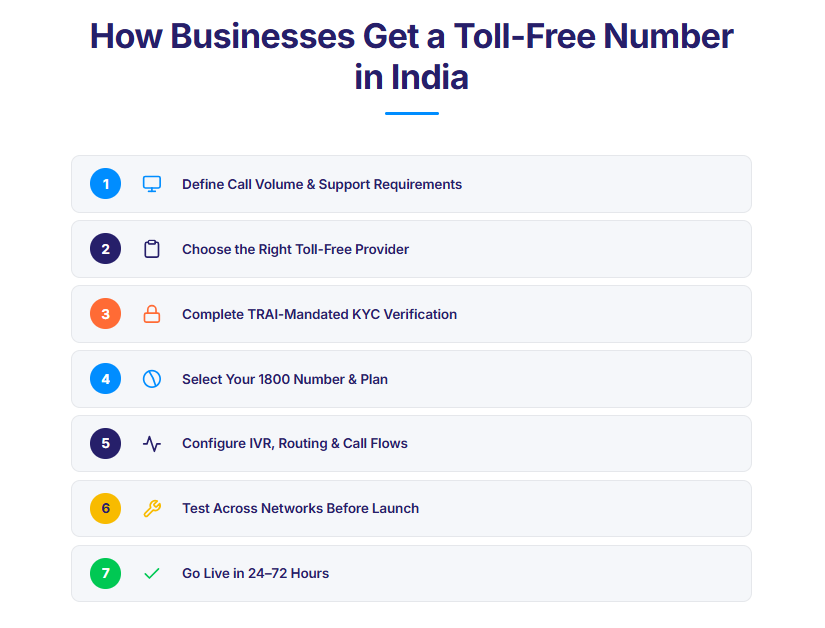
Step 1: Determine Your Requirements

Before approaching a provider, clarify: expected monthly call volume, number of concurrent calls, vanity or random number preference, and features needed (IVR, call recording, CRM integration, analytics).

Step 2: Choose a Provider

Compare providers on pricing, features, reliability (uptime SLA), support quality, and TRAI compliance. See Section 9 for the full provider comparison.

Step 3: Complete KYC Verification

Under TRAI regulations, all applicants must complete KYC. For registered businesses: Certificate of Incorporation, GST registration, PAN, and authorised signatory ID. For proprietorships: PAN, Aadhaar, and business registration proof.

Step 4: Select Your Number and Plan

Choose your plan based on bundle minutes, per-minute overage rate, concurrent calls supported, and included features. Vanity number selection may take longer for provider availability checks.

Step 5: Configure Call Routing and IVR

Using your provider’s dashboard: set up your Smart IVR menu, configure call routing (skill-based, geographic, or time-based), upload greetings, and set up call recording and analytics preferences.

Step 6: Testing and Go-Live

Before announcing your number publicly: test from multiple mobile networks (Jio, Airtel, Vi) and a landline. Test every IVR path, verify call recording, and confirm the analytics dashboard shows test calls. Most providers activate within 24–72 hours of KYC approval.

TRAI Note on Number Allocation

Under the National Numbering Plan, toll-free (1800) numbers are allocated by the DoT to licensed telecom operators, who in turn make them available through cloud telephony providers. Per TRAI’s February 2025 recommendations on the Revision of National Numbering Plan, the 1800 series remains firmly reserved for toll-free services.

Pricing in India — A Transparent Overview

Toll-free pricing in India follows a predictable structure, but providers don’t always make it easy to compare. Here’s what you need to know:

The Two Pricing Models

Model A: Pay-as-you-go

You pay a per-minute rate for every incoming call. No fixed monthly commitment (though a minimum recharge may apply). Best for businesses with unpredictable or seasonal call volumes.

  • Typical range: ₹0.80 – ₹1.80 per minute

Model B: Bundled / Annual Plans

You pay upfront for a year and get a block of included minutes. Overage calls are billed per minute. Best for businesses with consistent, predictable volumes.

  • Typical range: ₹22,000 – ₹36,000 per year (including GST) for 12,000–22,000 minutes
What Pricing Looks Like in Practice (Illustrative)

Here’s a representative snapshot based on publicly available pricing from Indian providers (Zeotel, Tata Tele Business Services, and others as of 2025–2026). Note: These are market-indicative ranges. Actual pricing varies by provider, features, and negotiation.

Plan TierAnnual Cost (approx.)Included MinutesPer-Minute OverageConcurrent Calls
Starter₹22,000–₹25,00012,000–14,500₹1.60–₹1.801–2
Business₹28,000–₹30,00018,000+₹1.40–₹1.603–5
Enterprise₹36,000+22,000+₹1.20–₹1.405–10+


Provider-by-Provider Pricing Breakdown

The table below provides a detailed side-by-side comparison of nine leading Indian toll-free number providers — covering starting prices, plan structures, call rates, and key features.

ProviderStarting PricePlan TypeCall RateFree MinutesKey FeaturesBest For
Acefone₹1,599/seat/mo
Ultra ₹2,299
Per-seat monthlyIncludedUnlimitedIVR, recording, CRM, analyticsSMBs & Teams
CallHippo₹1,900/user/mo
Ultimate ₹4,400
Per-user monthlyUnlimitedUnlimitedWhatsApp, SMS, omnichannelStartups & SMBs
Zeotel₹22,000/year
Advanced ₹36,000
Annual₹1.80/minNot specifiedIVR, extensions, billingSmall businesses
MyOperator₹500/mo add-onAdd-on planPlan-basedPlan-basedTFN, WhatsApp, TruecallerSMBs & Enterprises
Tata Telebusiness₹999/mo AnnualRental + call₹0.60–1.29/min₹9,999 valueDedicated TFN, SLALarge enterprises
KnowlarityCustom pricingVolume-basedVolume pricingDiscountsIVR, CRM, analyticsSMBs & Mid-market
MyOperator TFN₹21,000/year
Premium ₹46,200
Annual₹1.05/min500–5000 minsIVR, routing, allowanceGrowing SMBs
Ozonetel₹999–₹2,500/agentAgent-based₹0.30–1.20/minPlan-basedAI analytics, omnichannelContact centres
Exotel₹9,999 / 5 monthsCredit/customCredit usage₹1,000 creditsIVR, routing, CRMStartups & SMBs

Legend: TFN = Toll-Free Number (1800 series). Pulse rate = billing interval per call. All prices in Indian Rupees (₹) + applicable GST. Pricing is indicative and subject to change. Exotel uses a credit-based model. Ozonetel and Knowlarity pricing require direct contact for exact quotes. Always verify current pricing with providers before purchasing.

What Affects Your Cost

       Call volume: Higher volumes usually mean lower per-minute rates.

       Vanity numbers: Expect a premium — some providers charge ₹5,000–₹15,000 extra for setup.

       IVR levels: Multi-level IVR (more than 2 levels) may cost extra.

       Concurrent calls: Higher concurrency limits increase plan costs.

       Integrations: CRM integrations and API access may be add-ons.

       Number porting: Porting an existing toll-free number may incur a one-time fee.

Hidden Costs to Watch For

       Setup/activation fees: Some providers charge ₹1,000–₹5,000 one-time.

       Short-duration call billing: Check if the provider uses a 15-second or 60-second pulse. A 60-second pulse means a 10-second call is billed as 1 full minute.

       Call recording storage: Some plans limit storage duration (e.g., recordings deleted after 30 days unless you upgrade).

       API call charges: If your integration makes heavy API calls, check if there’s a usage cap.

Key Features of Modern Toll-Free Systems
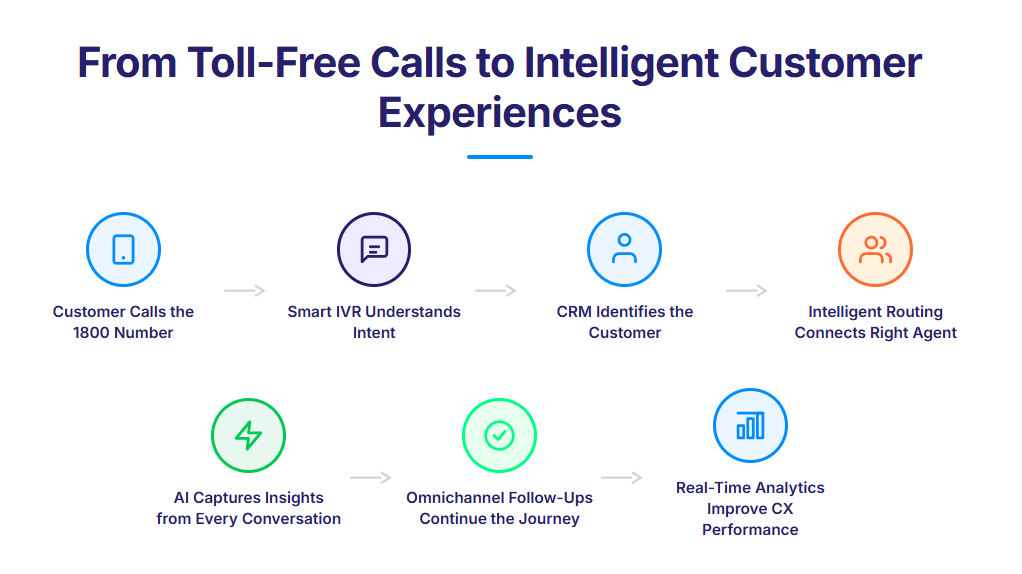
A toll-free number isn’t just a phone line anymore. Modern cloud-based toll-free systems come with a suite of features that transform how you handle customer calls:

Intelligent CX Journey infographics

6.1 Multi-Level IVR

Smart IVR is the automated menu system that greets and routes callers. Modern IVRs support unlimited menu levels (best practice caps at 2–3 to avoid caller frustration), text-to-speech, multi-language support (English, Hindi, and regional languages), and time-based routing.

6.2 Intelligent Call Routing

Beyond basic “press 1 for X,” today’s systems offer: skill-based routing, geographic routing, percentage-based routing, and sticky agent routing — where returning callers connect to the same agent they spoke with previously.

6.3 Call Recording and Transcription

Every call can be automatically recorded, stored securely, and — with AI-powered platforms — transcribed and analysed for sentiment, keywords, and compliance. Call recording is a standard feature on all modern cloud CCaaS platforms.

6.4 Real-Time Analytics and Dashboards

Track total, answered, missed, and abandoned calls; average wait and handle time; peak call hours; agent performance; and call source attribution by campaign or ad.

6.5 CRM Integrations

When a toll-free call comes in, the system can screen-pop the caller’s full CRM profile before the agent answers, auto-log the call in the contact record, and trigger follow-up workflows based on call outcomes.

6.6 Omnichannel Continuity

Increasingly, toll-free numbers are part of a broader omnichannel contact center strategy. A customer might call your toll-free line, then receive a follow-up on WhatsApp Business API, and continue via chat. Modern platforms preserve context across these channel switches.

How Toll-Free Numbers Work with Cloud Contact Centers

A standalone toll-free number is useful but limited. A toll-free number integrated with a cloud contact center platform (CCaaS — Contact Center as a Service) is transformative.

The Standalone Toll-Free Model

Customer calls 1800 → Forwarded to a single number → Answered by whoever picks up. No routing intelligence. No analytics beyond basic call logs. No CRM integration.

The Cloud CCaaS Model

Customer calls 1800 → IVR authenticates and routes → CRM screen-pop → Call reaches the right agent → Call recorded, transcribed, analysed → Post-call workflow triggered.

What This Means in Practice

Scenario: A health-tech company using toll-free + cloud CCaaS

A patient calls the toll-free number to inquire about a diagnostic test. The system recognises the caller, pulls their history, routes to the same advisor via sticky agent routing, the advisor sees the patient profile on-screen as they answer, and after the call, a WhatsApp message is auto-triggered with a booking link.

Real result: One of India’s leading health-tech brands using Ozonetel’s platform achieved 36% higher CSAT and 54% higher conversions by integrating toll-free calling with omnichannel contact center capabilities.

Scenario: An insurance company managing renewals

HDFC ERGO integrated their toll-free lines with Ozonetel’s cloud contact center and their in-house CRM. Result: 85% renewal rate, 50% reduction in renewal processing time, and 5% increase in customer retention — driven by eliminating system-switching for agents and automating data flows.

Key Integrations to Look For

IntegrationWhat It Enables
CRM (Salesforce, Zoho, HubSpot, etc.)Screen-pop, auto-logging, 360° caller view
Helpdesk (Freshdesk, Zendesk, etc.)Auto ticket creation from calls
WhatsApp Business APIPost-call WhatsApp follow-ups
Webhook / APICustom workflows, data sync with internal tools
Analytics (Looker, PowerBI)Consolidated reporting across channels

Benefits by Business Type / Industry

8.1 E-Commerce & Retail

Use case: Order inquiries, returns, delivery tracking, abandoned cart recovery. A toll-free number removes hesitation to call, meaning issues are resolved faster. Key feature: CRM integration that shows the caller’s recent orders before the agent answers.

8.2 Banking, NBFCs & Financial Services

Use case: Loan inquiries, KYC support, account servicing, collections follow-up. In financial services, trust is everything. A toll-free number signals institutional credibility. Number masking is recommended for protecting sensitive caller data in financial interactions.

8.3 Healthcare & Wellness

Use case: Appointment scheduling, test results, doctor referrals, emergency triage. Healthcare providers benefit from IVR-based triage that routes urgent calls immediately.

8.4 EdTech & Coaching

Use case: Admissions inquiries, course counselling, demo class bookings. EdTech depends heavily on high-volume inbound inquiry calls, especially during admissions season.

8.5 Real Estate

Use case: Site visit scheduling, project inquiries, NRI buyer support. Real estate leads are high-value, and a toll-free number paired with a cloud contact center ensures no lead is dropped during peak campaign periods.

8.6 Government & PSUs

Use case: Citizen helplines, grievance redressal, scheme inquiries. Government helplines using 1800 numbers are familiar to Indian citizens and carry an implicit credibility signal.

Provider Comparison

Below is an overview of major Indian toll-free number providers compared on platform type and primary use case:

ProviderToll-Free NumberCCaaS PlatformStrengthBest For
Ozonetel✅✅ oneCXi — full-stack CCaaSToll-free native to CCaaS platform; AI analytics; omnichannelMid-market & enterprises needing integrated CX
Exotel✅✅Large telecom partnerships; strong in SMBStartups & SMBs
MyOperator✅✅User-friendly dashboard; strong SMB focusSmall businesses, first-time buyers
Knowlarity✅✅Wide feature set; good documentationSMBs & mid-market
JustCall✅ via partnerLimitedGlobal numbers; strong international diallingTeams handling international customers
Tata Tele Business Services✅❌ telco-grade, not SaaSLegacy telecom infrastructure; pan-India reachLarge enterprises with dedicated telecom teams
JioBusiness✅❌ telco-gradeJio network reach; bundled with Jio servicesJio-ecosystem businesses
CloudConnect✅✅Transparent pricing; good for first-timersMicro-businesses & startups
Zeotel✅✅Budget plans; basic feature setCost-conscious SMBs

CCaaS = Contact Center as a Service. A true CCaaS platform means the toll-free number is part of a broader customer experience omnichannel platform — with IVR, routing, analytics, and integrations built in. Telco-grade providers offer the number but not the software layer.

How to Choose the Right Provider

Selecting a toll-free provider is a decision that affects your customer experience for years. Here’s a decision framework:

The Five-Question Filter
  1. Do they offer a unified platform or just the number? The most important distinction. Look for providers where the toll-free number is native to their CCaaS platform.
  2. What’s their uptime track record? Ask for their SLA. Enterprise-grade providers commit to 99.9% uptime or higher.
  3. Can they handle your peak volume? Don’t size for average. Size for peak. Ask explicitly: “What’s your maximum supported concurrency?”
  4. What integrations do they support out-of-the-box? “API available” is not the same as “integration built.” Look for native integrations with your CRM and omnichannel tools.
  5. How responsive is their support? Call their support line before you’re a customer.
Red Flags
  • No transparent pricing — if you can’t find a pricing page and must “talk to sales” for basic plans, be cautious.
  • One-size-fits-all plans — can they customise concurrency, features, and billing?
  • No porting support — if you can’t port your toll-free number out, you’re locked in.

TRAI compliance gaps — if they can’t clearly articulate KYC and consumer protection compliance, walk away.

Setup & Best Practices

11.1 IVR Design Principles
  • Smart IVR depth: Limit to 3 levels. Beyond 3 menu levels, abandonment rates spike.
  • State wait times. If hold time exceeds 2 minutes, tell callers and offer a callback.
  • Offer a “speak to agent” path at every level. Don’t trap callers in an IVR maze.
  • Place the most common option first. If 70% of calls are for support, make that option 1.
  • Use professional voice talent for greetings. Text-to-speech is acceptable for dynamic content.
11.2 Routing Configuration
  • Use skill-based routing if you have specialised teams (technical support, billing, sales).
  • Set up overflow routing: when all primary agents are busy, route to a backup team — not voicemail.
  • Configure after-hours routing: even if your office closes at 6 PM, calls shouldn’t go unanswered.
  • Test geographic routing in India: mobile number portability means a caller’s number may not reflect their actual location.
11.3 Analytics Setup
  • Tag calls by source (website, Google Ads, print ad, social media) using different toll-free numbers or dynamic number insertion.
  • Set up real-time alerts for anomalies — spike in abandoned calls, drop in answer rate, agent queue exceeding threshold.
  • Review analytics weekly — not just monthly. Call patterns shift faster than most businesses realise.
11.4 Agent Onboarding
  • Train agents on the CRM + dialer integration. If they’re switching between screens, they’re losing time.
  • Ensure agents understand the full caller journey — not just the call, but what happens before (ad, website) and after (follow-up, ticket creation).
  • Call recording is your best coaching tool — both excellent calls and calls that went wrong.

Common Mistakes to Avoid

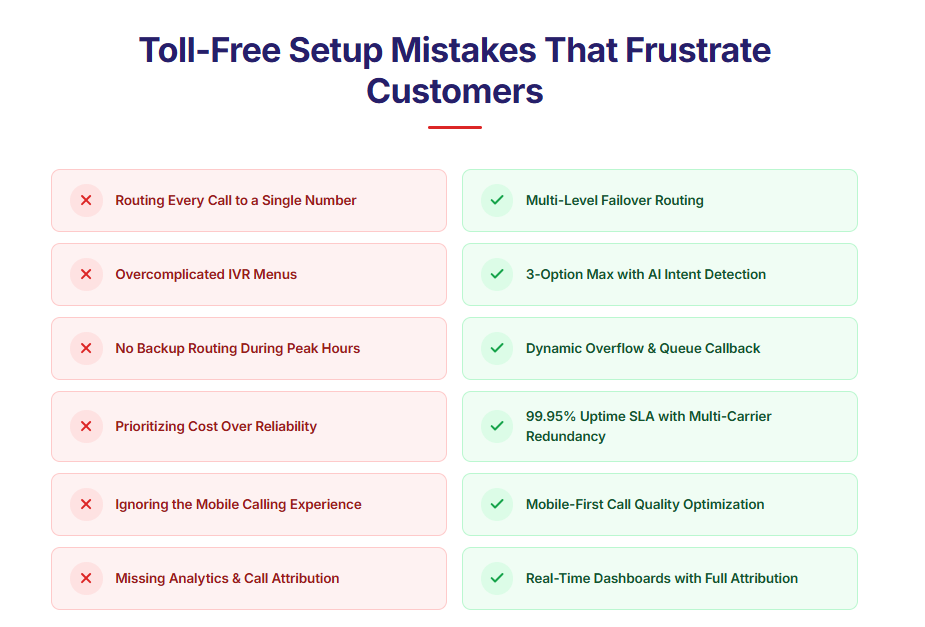
Mistake 1: Buying a Number Without a Routing Strategy

A toll-free number that forwards to a single mobile is not a contact center. Fix: Configure IVR, routing, and agent assignment before going live.

Mistake 2: Ignoring Mobile Caller Experience

95%+ of your toll-free callers are on mobile. Fix: Keep IVR prompts under 15 seconds per menu level. Use short options (“For Sales, press 1” — not “If you would like to speak with our sales team…”).

Mistake 3: Not Measuring Call Source Attribution

If you can’t tell whether calls are coming from Google Ads, your website, or your packaging, you can’t optimise spend. Fix: Use unique toll-free numbers or dynamic number insertion per channel.

Mistake 4: Choosing Price Over Reliability

The cheapest provider often means shared infrastructure, limited concurrency, and no redundancy. Fix: Prioritise uptime SLA, network redundancy, and support responsiveness over small annual savings.

Mistake 5: Overcomplicating the IVR

Group by function, not by product. “Press 1 for Support, Press 2 for Sales, Press 3 for Billing.” Use sub-menus only when absolutely necessary.

Mistake 6: Neglecting TRAI Compliance

India’s telecom regulations are evolving. Work with a provider who proactively communicates regulatory changes. Don’t wait for a compliance notice to update your processes.
TRAI Regulations & Compliance

13.1 Number Allocation Framework

Toll-free numbers (1800 series) are allocated under the National Numbering Plan, administered by DoT. In February 2025, TRAI issued recommendations on the “Revision of National Numbering Plan” to optimise numbering resource utilisation — but the 1800 series’ toll-free status remains unchanged. Source: TRAI NNP Recommendations, February 6, 2025.

13.2 KYC Requirements

Every toll-free number applicant must undergo KYC verification under TRAI mandate. Business entities must provide valid incorporation and tax registration documents. Individual proprietors must provide PAN, Aadhaar, and business proof.

13.3 Consumer Protection Regulations

TRAI’s Telecom Consumers Protection Regulations establish: transparency in billing, a structured grievance redressal mechanism, and DND (Do Not Disturb) compliance for outbound follow-ups. Source: TRAI Consumer Protection.

13.4 Data Privacy and Call Recording

Call recording is permitted but callers must be informed (“this call may be recorded for quality and training purposes”). Recordings containing sensitive personal data must be stored per India’s data protection framework. Number masking is recommended for industries handling sensitive caller information.

13.5 Number Porting

TRAI supports number portability for toll-free numbers. Porting typically takes 7–15 business days and may involve a porting fee.

Compliance Checklist for Indian Businesses

RequirementStatus
KYC completed and documents current
Call recording disclosure played to callers
DND scrubbing for outbound follow-ups
Grievance redressal mechanism documented
Provider TRAI-compliant (ask for confirmation)
Data storage compliant with Indian regulations
Ozonetel’s platform is built India-first — fully TRAI-compliant, with KYC support, secure call recording, and built-in DND scrubbing

Prashanth Kancherla

Share this post:

Frequently Asked Questions

A toll-free number in India is a business phone number — typically starting with 1800 — where the business pays all incoming call charges and the caller pays nothing. It works from both mobile phones and landlines across India.

Yes. Unlike some countries where toll-free numbers are only free from landlines, Indian 1800 numbers are completely free from all mobile networks — including Jio, Airtel, Vi, and BSNL.

Toll-free numbers in India typically cost between ₹22,000 and ₹36,000 per year for bundled plans with 12,000–22,000 included minutes, or ₹0.80–₹1.80 per minute on pay-as-you-go models. Vanity numbers cost extra.

With a cloud telephony provider, activation typically takes 24 to 72 hours after KYC verification is completed.

Yes. TRAI supports toll-free number portability. Porting between providers typically takes 7–15 business days and may involve a porting fee.

1800 numbers are completely free for callers from all networks. 1860 numbers are “shared cost” — callers pay local call rates, and the business subsidises the long-distance portion. 1800 is the preferred choice for customer-facing helplines.

Yes. You need to complete KYC with your PAN, Aadhaar, and business registration documents. Cloud telephony providers serve businesses of all sizes.

No. Modern toll-free numbers are cloud-based. You need no physical PBX, no phone lines, and no on-premise hardware. Calls can be answered on mobile phones, laptops, or IP phones.

Standard 1800 numbers are voice-only. However, when integrated with a cloud contact center platform, you can run WhatsApp Business API alongside your toll-free number — with the same routing and analytics.

Yes — as long as your provider follows TRAI’s KYC, consumer protection, and numbering plan regulations. Always verify your provider’s compliance status before signing up.