- Resources
- How Customer Conversations Reveal Lost Revenue, Churn Risk and Upsell Opportunities
How Customer Conversations Reveal Lost Revenue, Churn Risk and Upsell Opportunities

Prashanth Kancherla
Oct 1, 2026 | 10 mins read
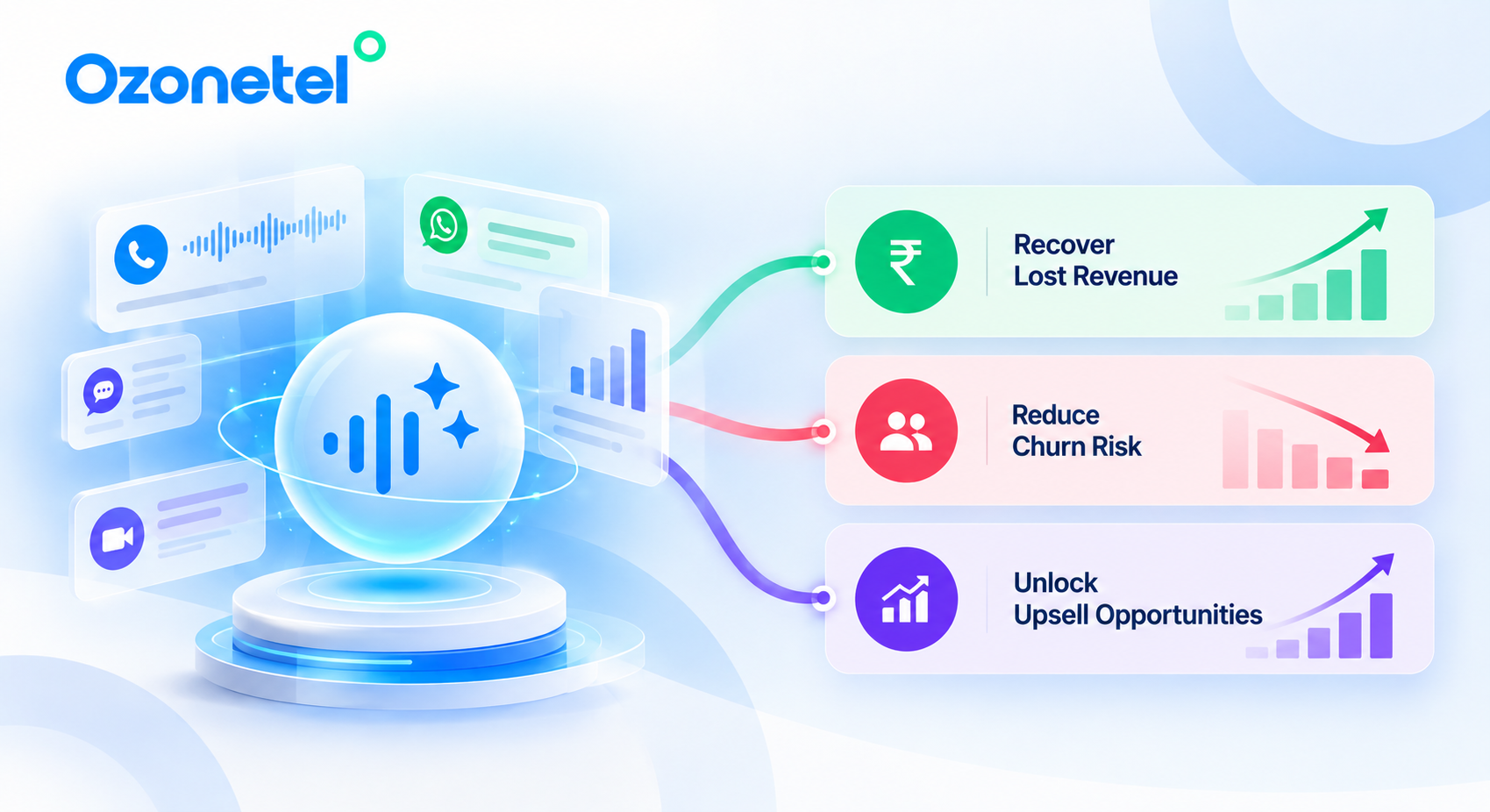
A prospect says, “I’ll think about it.” A customer mentions a competitor. Someone calls support for the third time about the same problem. None of these sounds like a revenue report. Yet each one can tell you something about revenue. The stakes are real. PwC’s 2025 Customer Experience Survey found that 29% of consumers had stopped using or buying from a brand because of a poor customer experience.
In India, ServiceNow’s 2026 CX research found that 44% of consumers are ready to switch brands after a poor service experience. The question isn’t whether customers are giving you signals. It’s whether you’re finding them early enough to act.
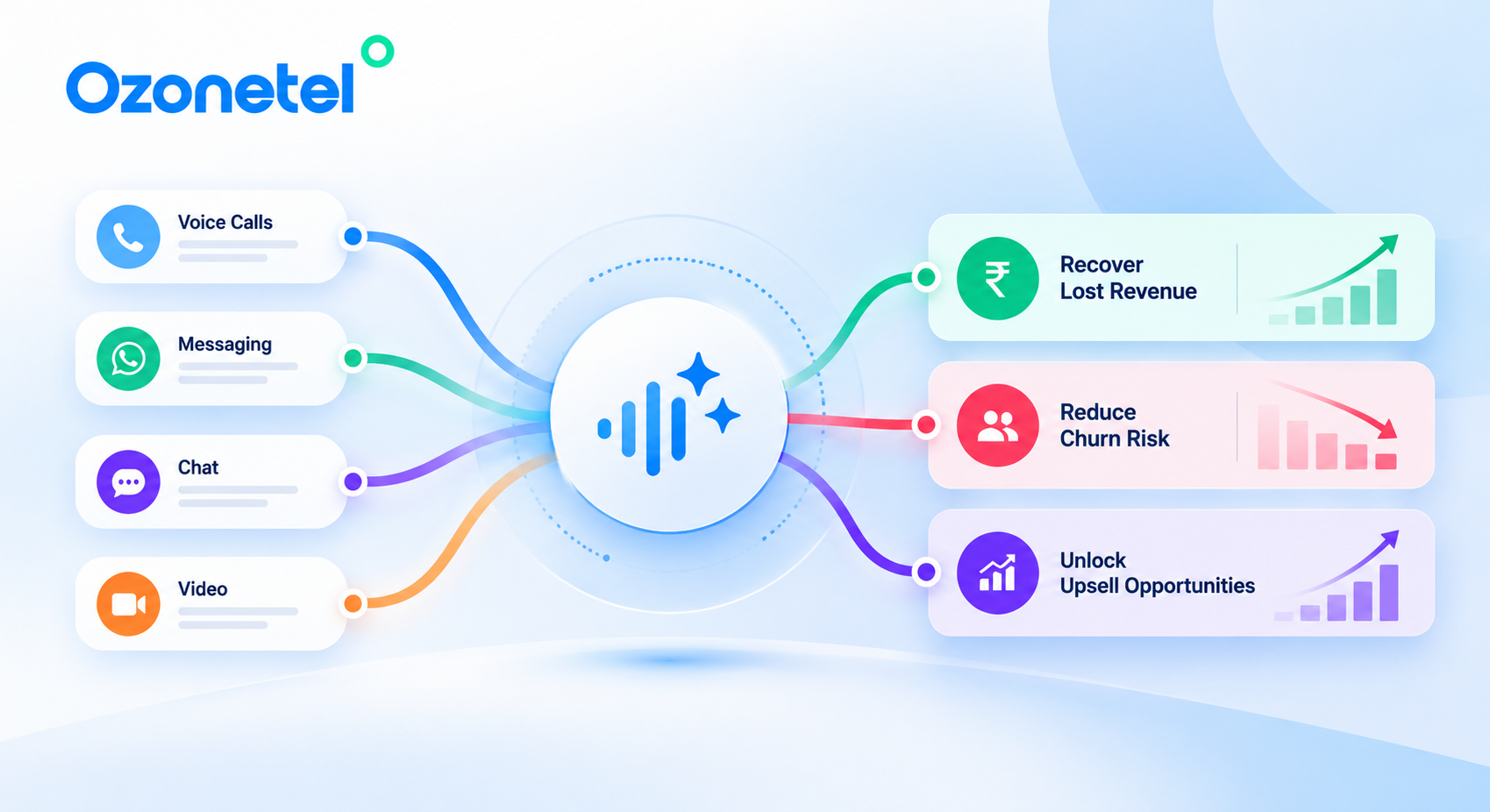
That’s where customer conversation analytics comes in—helping businesses uncover the patterns behind lost revenue, churn risk and new opportunities.
Key Takeaways
- Customer conversations contain early signals of revenue leakage, churn and buying intent.
- Repeated objections, unresolved issues and competitor mentions can reveal where revenue is slipping away.
- Changes in sentiment, intent and conversation patterns can indicate customer churn risk before a customer actually leaves.
- Questions about products, services and new requirements can reveal upsell and cross-sell opportunities.
- AI can analyse thousands of customer interactions to identify patterns that are difficult to spot manually.
- The real value comes when customer insights lead to action across sales, service, retention and operations.
In this article, we will explore:
- 1.What Can Customer Conversations Tell You About Revenue?
- 2. How Do Customer Conversations Reveal Lost Revenue?
- 3. How Do Customer Conversations Reveal Churn Risk?
- 4. How Do Customer Conversations Reveal Upsell and Cross-Sell Opportunities?
- 5.What Does AI Look for Inside Customer Conversations?
- 6. How Does Conversation Analytics Become Customer Intelligence?
- 7. Why Aren’t Surveys Enough to Understand Customers?
- 8. How Do You Turn Customer Signals Into Business Action?
- 9.How Do Speech Analytics, VoC and AI Command Central Work Together?
- 10. Customer Conversation Analytics in Practice: Dish TV, HDB Financial and an ARC
- 11. Your Customers Are Already Telling You What Matters
What Can Customer Conversations Tell You About Revenue?
Customer conversations reveal signals at different points in the customer journey, from the first sales conversation to the moments that determine whether someone stays or leaves. And businesses have a harder time keeping up with those signals than they might think. 70% of executives surveyed by PwC said customer expectations are evolving faster than their company can adapt. That creates a listening problem.
The information is already there, but it is spread across sales calls, support interactions, chats, messages, surveys and reviews. One team sees the complaint. Another sees the sales objection. Someone else sees the cancellation request. Put those conversations together, and a different picture starts to emerge. Three areas are particularly valuable:
- Revenue leakage: Where are customers getting stuck, dropping off or encountering friction that costs the business money?
- Churn risk: Which customers are showing signs that they may leave before they actually say they are leaving?
- Growth opportunities: Which customers are telling you, directly or indirectly, that they need more from you?
The value isn’t in collecting more conversations. It’s in finding the patterns hidden inside them.
How Do Customer Conversations Reveal Lost Revenue?
Revenue leakage often has a voice before it has a number. A customer who has to repeat themselves. A prospect who keeps raising the same objection. A buyer who asks for something your product doesn’t offer. These moments are easy to treat as isolated incidents. But customer effort can have a measurable commercial cost. Gartner found that only 14% of customers who experienced a high-effort service interaction said they were likely to continue doing business with the company.
That makes repeated friction more than a customer-service problem. It can become a revenue problem.
Repeated Sales Objections
If prospects repeatedly raise the same concern about price, implementation, integrations or product capability, the problem may be bigger than one lost deal. Conversation analytics can surface recurring objections across sales calls and show where prospects are consistently getting stuck. That gives sales and marketing something more useful than anecdotal feedback: a pattern they can act on.
Buying Interest That Goes Nowhere
Not every lost opportunity ends with a clear “no.” Sometimes a prospect asks several questions, engages with the product, discusses pricing—and then disappears. Looking across conversations can help identify where these opportunities tend to break down. Was the objection about price? Was a competitor mentioned? Did the prospect need a feature that wasn’t clearly explained? Did the conversation fail to move to the next step? The answers can point to revenue that is being lost quietly.
Repeated Service Problems
A single unresolved complaint may be a service issue. Hundreds of customers describing the same problem is a business signal. If customer feedback analysis identifies repeated complaints around a product, delivery process, billing issue or service workflow, the business can address the underlying problem instead of handling the same symptom conversation after conversation.
Product Gaps Customers Keep Mentioning
Customers often tell you what they want long before they submit a formal feature request. When the same capability, integration or product limitation appears repeatedly in conversations, it can reveal unmet demand—and potentially lost revenue. For product and CX teams, these patterns can provide another source of customer intelligence beyond surveys and formal feedback channels.
How Do Customer Conversations Reveal Churn Risk?
Churn rarely begins with the cancellation request. More often, customers signal dissatisfaction through a series of smaller changes in what they say and how they interact. ServiceNow’s 2026 India CX research found that 44% of consumers are ready to switch brands after a poor service experience. The opportunity is to identify those signals before the customer reaches the exit.
Customers Start Talking About Leaving
Statements such as “I’m considering another provider” or “Maybe we should look at alternatives” are obvious signals. The harder part is finding them consistently across thousands of conversations. AI-powered conversation analysis can identify this kind of churn language and bring high-risk interactions to the attention of retention teams.
The Same Complaint Keeps Coming Back
A customer who raises the same issue repeatedly is telling you something. The issue may not be the complaint itself. It may be that the customer believes nobody is fixing it. Tracking recurring themes across conversations makes that pattern visible.
Competitors Enter the Conversation
Competitor mentions can provide useful context. A customer comparing your pricing with another provider, asking about a competitor’s feature or saying they are evaluating alternatives may indicate a change in purchase intent. Combined with previous interaction history, these signals become more meaningful.
Sentiment Starts Changing
A customer doesn’t always say they are unhappy. Sometimes the change appears in the conversation first: shorter responses, more frustration, repeated escalation or a shift from positive language to dissatisfaction. Analysing these changes over time can help teams distinguish a one-off interaction from a developing relationship problem.
Customers Keep Calling About the Same Thing
Repeated contact is itself a signal. If a customer has contacted support multiple times about the same unresolved issue, the business can prioritize that customer differently from someone making a routine enquiry. That is where conversational intelligence moves from reporting to decision support.
How Do Customer Conversations Reveal Upsell and Cross-Sell Opportunities?
Growth opportunities are often hiding inside conversations that were never classified as sales conversations. A support call can reveal a new business requirement. A service interaction can uncover a product need. A customer asking for a capability may already be telling you what they are willing to buy next.
Customers Ask for More
“Can this also do X?” “Do you have a solution for Y?” “Can we use this for another team?” Questions like these can indicate expansion intent. The opportunity is to connect that intent with the customer’s existing relationship, products and history.
Their Business Has Changed
Customers’ needs change. A growing business may need more users. A new geography may create new communication requirements. A new product launch may create demand for additional services. Conversation analytics can help identify these changes when customers mention them naturally in conversations.
Support Conversations Turn Into Buying Conversations
A customer may contact support with one issue and reveal a completely different requirement during the conversation. Without conversation intelligence, that opportunity may disappear when the interaction ends. With the right analysis, it can become a signal for an account manager or sales team to follow up.
Patterns Matter More Than Individual Opportunities
One customer asking for something is an opportunity. A hundred customers asking for the same thing is a market signal. That distinction is where conversation analytics becomes strategically valuable.
What Does AI Look for Inside Customer Conversations?
AI can analyse customer interactions for signals that are difficult to track manually at scale.
| Customer signal | What it can mean for the business |
|---|---|
| Intent | What the customer is trying to achieve |
| Sentiment | Changes in customer attitude or satisfaction |
| Recurring topics | Issues appearing across customers or segments |
| Sales objections | Reasons prospects hesitate or drop off |
| Competitor mentions | Potential competitive or churn risk |
| Product requests | Unmet needs and potential expansion opportunities |
| Churn language | Possible switching or cancellation intent |
| Buying signals | Interest in additional products or services |
| Repeated contacts | Persistent friction or unresolved issues |
| Escalation language | Customers or accounts requiring intervention |
The important part is what happens after these signals are identified.
How Does Conversation Analytics Become Customer Intelligence?
One conversation gives you context. Thousands of conversations can give you a pattern. That distinction matters. A manager reviewing one call might notice an unhappy customer. An AI system analysing thousands of interactions can reveal that the same issue is appearing across a customer segment, region, product or campaign. That is the shift from conversation analysis to customer intelligence. The business stops asking: “What happened on this call?” It starts asking:
- Is this happening across other customers?
- Is the pattern getting worse?
- Which accounts are affected?
- What revenue is at risk?
- What action should happen next?
That broader view is what makes customer conversation analytics useful beyond the contact center. The signals can inform sales, marketing, product, customer success and business operations.
Why Aren’t Surveys Enough to Understand Customers?
Surveys capture what customers choose to tell you. Conversations capture what comes up naturally while customers are trying to get something done. That difference matters. A survey may tell you that a customer is dissatisfied. A conversation can reveal why. It can expose the specific product issue, the competitor being considered, the repeated service failure or the unmet requirement behind the response. Surveys still have a place. But they are one input into customer intelligence—not the entire picture.
How Do You Turn Customer Signals Into Business Action?
Insight has limited value if it stops at a dashboard. The real opportunity is to connect customer signals to the teams and workflows that can act on them. A churn signal can trigger retention outreach. A recurring product complaint can reach product teams. A buying signal can create a sales opportunity. A repeated process failure can trigger an operational review. The shift is from:
Conversation → Signal → Pattern → Insight → Action
That is where customer conversation analytics starts becoming a business capability rather than another reporting layer.
How Do Speech Analytics, VoC and AI Command Central Work Together?
Different intelligence layers answer different questions. Speech Analytics helps you understand what happened inside individual conversations—what was said, how the interaction went and which topics or behaviours appeared. Voice of Customer analytics brings those signals together to understand what customers collectively think, need, struggle with or respond to.
AI Command Central takes that intelligence further by connecting customer signals with enterprise data and workflows so teams can act on them. Together, they create a progression:
Understand the conversation → Understand the customer → Decide what to do next.
Customer Conversation Analytics in Practice: Dish TV, HDB Financial and an ARC
The value becomes clearer when conversation intelligence is connected to actual business decisions.
Dish TV: Identifying Customers at Risk of Churn
Dish TV analysed more than 9,000 customer conversations to identify signals associated with churn. The analysis found that churn could be identified as early as the second interaction, allowing the business to intervene earlier rather than waiting for a cancellation signal. The result was a 25% reduction in churn, showing how conversation intelligence can help retention teams identify risk earlier.
HDB Financial Services: Finding Growth Opportunities
For HDB Financial Services, conversation intelligence helped identify customer segments and patterns associated with stronger loyalty and business potential. The approach contributed to a 2× increase in the loyal-to-defected ratio and an annual disbursement uplift of ₹1,550 crore. Here, the same underlying customer intelligence served a different purpose: identifying where the business could deepen customer relationships and find growth.
A Leading Asset Reconstruction Company: Deciding Where to Act First
For a leading ARC managing more than ₹8,000 crore, the challenge was different. The business needed to identify where recovery efforts could have the greatest impact and determine which actions should be prioritized. Conversation intelligence helped improve recovery workflows, contributing to a 35% increase in net recovery and a 40% reduction in cost to recover.
Three business questions. Three different outcomes.
- Who is likely to leave? Identify the risk early.
- Where is the growth opportunity? Find the signals inside existing customer interactions.
- Who should the business act on first? Prioritize based on intelligence rather than treating every interaction equally.
The underlying capability is the same: turning customer conversations into intelligence that informs business action.
Your Customers Are Already Telling You What Matters
The challenge isn’t a lack of customer data. It’s that some of the most commercially valuable information is buried inside conversations that traditional dashboards aren’t designed to understand. A prospect’s objection can point to a conversion problem. A repeated complaint can signal a retention risk. A question about a new capability can reveal an expansion opportunity.
And when those signals appear across thousands of conversations, they become more than individual customer interactions. They become business intelligence. That’s the real opportunity with customer conversation analytics: not simply understanding what customers said, but understanding what those conversations mean for revenue, retention and growth. Your customers are already telling you what matters. The question is whether your business can hear the pattern
Explore Ozonetel’s Voice of Customer
Frequently Asked Questions
Customer conversation analytics uses AI to analyse customer interactions across channels such as voice and chat to identify patterns in intent, sentiment, topics, objections, churn signals and buying behaviour.
Repeated objections, unresolved issues, abandoned buying journeys, product gaps and customer friction can reveal where prospects or existing customers are being lost.
It can identify conversation patterns associated with churn risk, such as repeated complaints, competitor mentions, cancellation language and deteriorating sentiment. These signals can help teams prioritize retention efforts.
AI can detect buying signals, new requirements, product requests and changes in customer needs that appear naturally during conversations.
They overlap, but the scope can differ. Speech analytics focuses heavily on analysing individual conversations, while customer conversation analytics can connect signals across interactions to identify broader customer and business patterns.
VoC analytics focuses on understanding customer needs, sentiment, feedback and expectations across interactions and feedback sources. Conversation analytics provides a rich source of those signals.
Yes. Depending on the platform, AI can analyse conversations across voice, chat and other digital channels to create a more complete view of customer interactions.
The next step is to connect the signal to an action—such as a retention intervention, sales follow-up, product change, escalation or workflow automation—and measure the outcome. Talk to an Ozonetel expert to see how this works in practice.