What is Rapport Building? 7 Strategies to Build Good Rapport in Business

Prashanth Kancherla
Mar 24, 2026 | 13 mins read

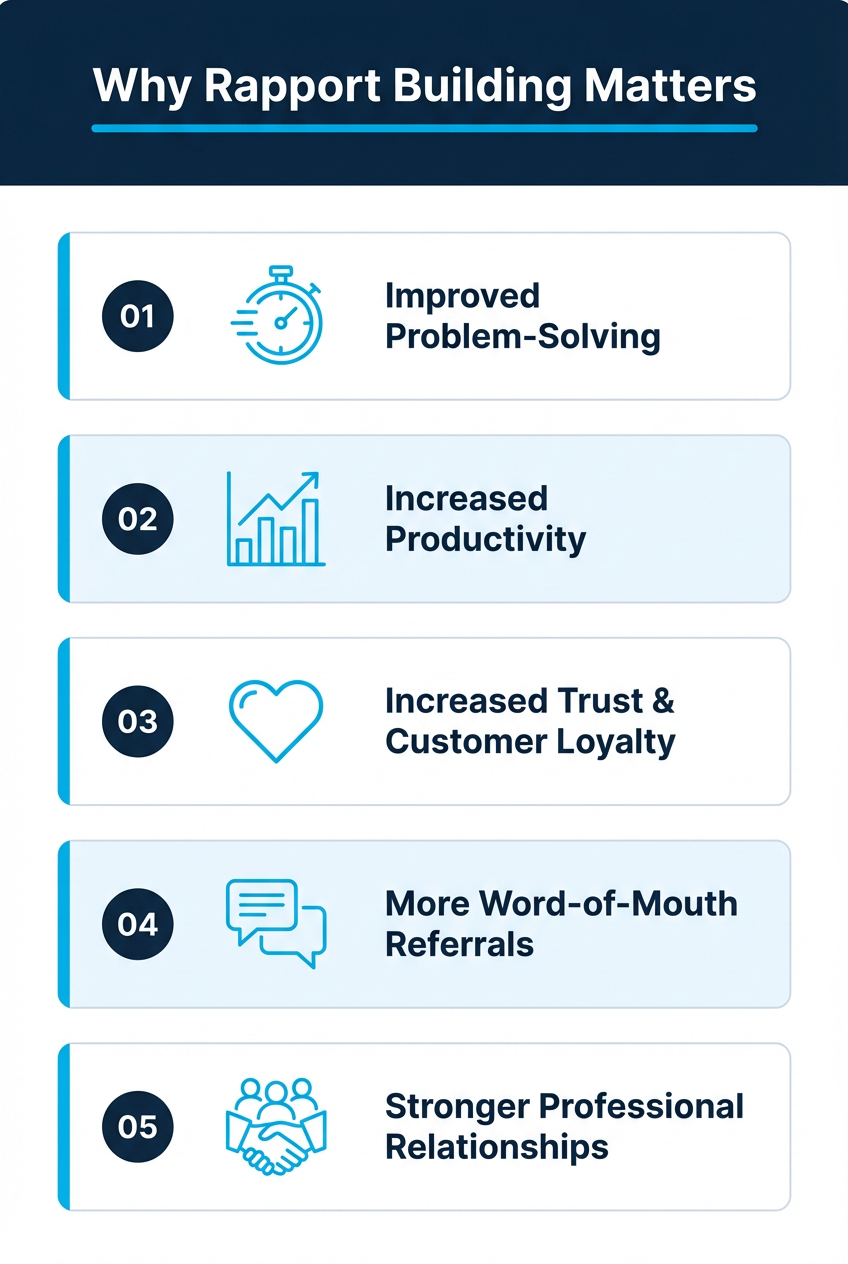
Key Benefits of Rapport Building in Business
Rapport building improves problem-solving, productivity, trust, and customer loyalty. When customers and agents feel genuinely understood, communication becomes more effective, conflict resolution faster, and relationships more durable. For contact centers, these outcomes translate directly into measurable performance gains.
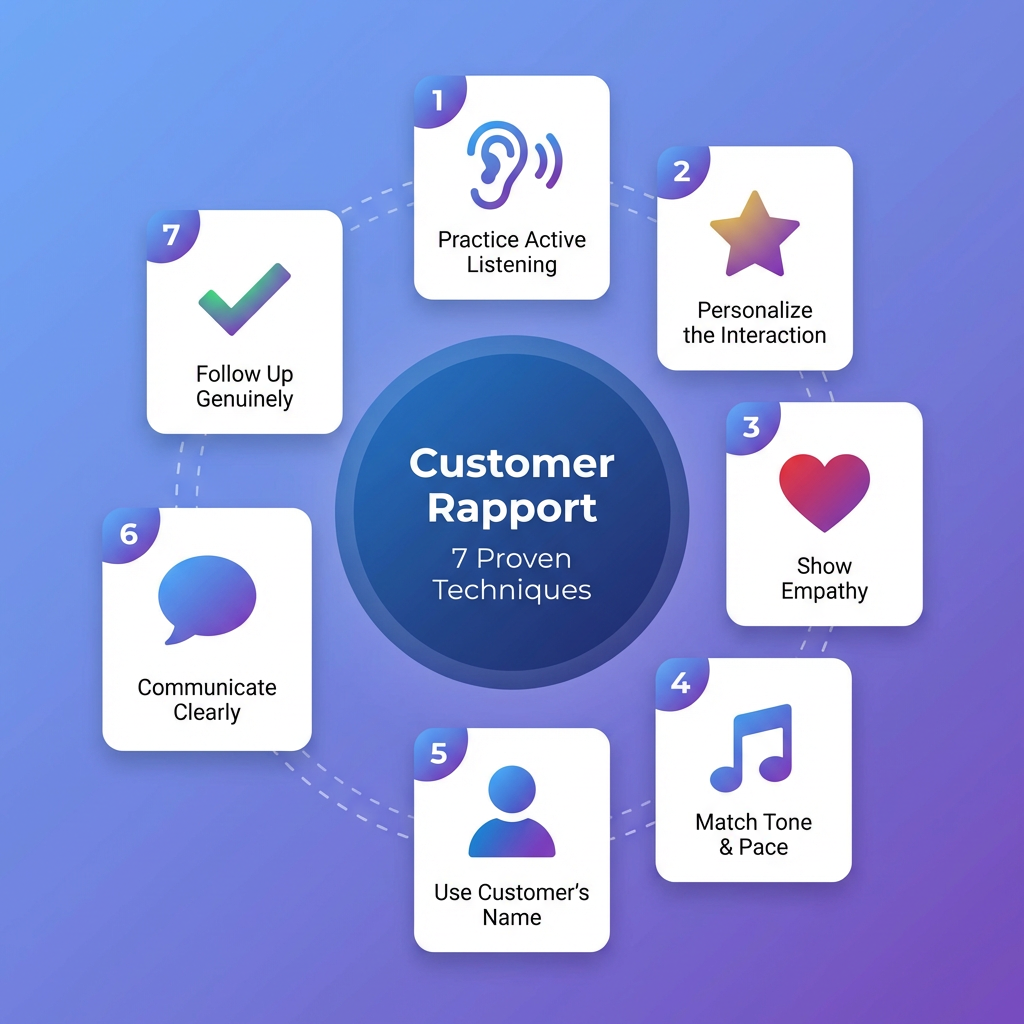
How to Build Rapport With Customers: 7 Proven Techniques
Rapport building isn’t a script — it’s a set of conversational habits that agents can develop and consistently apply. The following techniques are what actually make customers feel heard, valued, and understood in real interactions.
Rapport building isn’t a script — it’s a set of conversational habits that agents can develop and consistently apply. The following techniques are what actually make customers feel heard, valued, and understood in real interactions.
1. Practice Active Listening
Active listening is the single most important rapport building technique. It means giving the customer your full attention — not just waiting for your turn to speak. This involves acknowledging what they’ve said before responding, avoiding interruptions, and reflecting back key points to confirm understanding.
In a call center context, active listening also means picking up on tone and emotional cues. A customer who says “I’ve been waiting three days for this” isn’t just reporting a timeline — they’re expressing frustration that needs to be acknowledged before any solution is offered.
2. Personalize the Interaction
Nothing breaks rapport faster than making a customer feel like a ticket number. Personalizing the interaction — using their name, referencing their account history, remembering previous interactions — signals that they matter as an individual. Even small gestures, like noting a customer’s region or acknowledging a previous purchase, have a measurable impact on satisfaction.
CRM-integrated contact center software makes personalization scalable. Agents can surface relevant customer context before the conversation begins, removing the friction of repetitive questions and enabling more natural, informed dialogue.
3. Show Empathy
Empathy in rapport building means demonstrating that you understand how a customer feels — not just what they need. A simple phrase like “I completely understand how frustrating that must be” can shift the emotional tone of an interaction from adversarial to collaborative. This is especially important when handling complaints or escalations.
Unlike sympathy, empathy doesn’t require agreement or validation of every concern. It requires acknowledgment — making the customer feel that their experience is real and that you take it seriously.
4. Match Tone and Pace
People naturally feel more comfortable with others who communicate similarly to them. Matching a customer’s tone (without mirroring their frustration if they’re upset) and adjusting your pace to theirs helps establish psychological alignment. A customer who speaks slowly and carefully tends to feel rushed or overwhelmed by an agent who talks fast and fires through options. Calibrating your delivery is a subtle but powerful rapport building technique.
5. Use the Customer’s Name
Using a customer’s name — at the start of the call, during the conversation, and at close — is one of the simplest rapport building habits and one of the most effective. It creates a sense of personal acknowledgment and keeps the interaction from feeling generic. Use it naturally, not robotically — two or three times in a typical call is usually right.
6. Communicate Clearly and Honestly
Clear communication builds confidence. Customers who receive clear, honest answers — even when the answer isn’t what they hoped for — trust the agent more than if they receive evasive or overly optimistic responses. Rapport building doesn’t mean always saying yes; it means always being transparent, setting realistic expectations, and following through on what you commit to.
7. Follow Up Genuinely
A follow-up after issue resolution — whether by email, a callback, or a check-in message — is one of the strongest rapport building signals in customer service. It communicates that the interaction didn’t end when the call did. For contact centers, even automated follow-ups (when personalized and well-timed) significantly improve Customer Satisfaction (CSAT) scores and increase the likelihood of repeat engagement.
How to Improve Rapport Building Across Your Call Center
Individual rapport building techniques are only sustainable if the organization supports and reinforces them. This section outlines the management framework for building a culture of rapport in contact centers — from identifying problems to setting measurable goals.
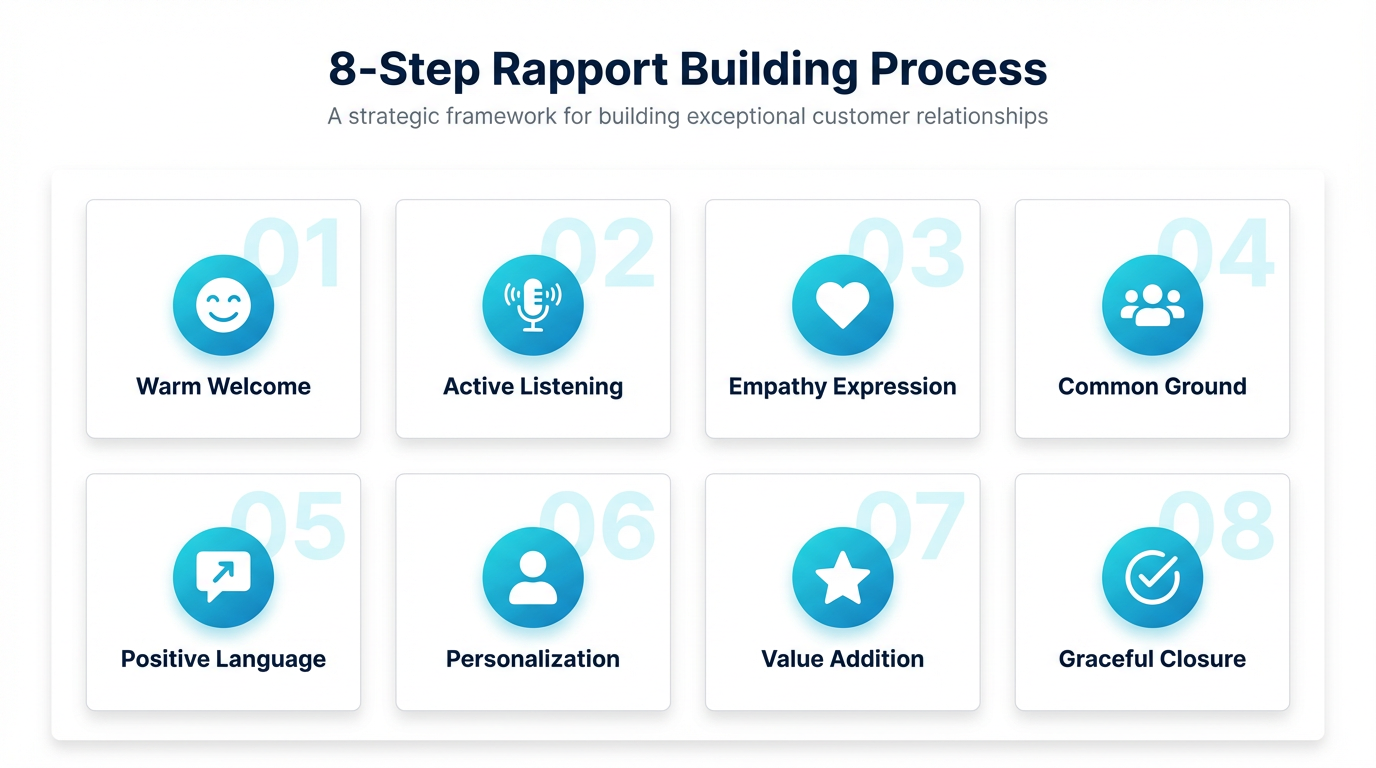
Step 1: Recognize the Problem
The first step in solving any problem is recognizing its existence. You won’t be able to improve your team’s customer service without understanding how they currently perform. Observe agent conversations — listening to both words and tone. Look for patterns across the team, not just individual outliers.
Common symptoms of poor rapport in customer service:
- Unnecessarily long call resolution times
- Unfriendly or impersonal language
- Insincere or scripted tone
- Failure to actively listen or acknowledge customer concerns
- Long silences during conversations
- Frequent escalations or customer frustration
Step 2: Leverage Data
Rapport building is a human skill, but data provides the objective lens to measure it. Start with the metrics you already have — satisfaction surveys, call recordings, resolution times — and look for patterns that reveal where rapport is breaking down. The more sources you combine, the clearer the picture.
Useful data sources for rapport analysis:
- Customer Satisfaction Score (CSAT) surveys
- First Contact Resolution (FCR) rates
- Average Handle Time (AHT)
- Customer Experience (CX) survey responses
- Social media sentiment analysis
- Net Promoter Score (NPS) trends
- Escalation and transfer rates
Step 3: Review for Accuracy
Data is only as valuable as it is accurate. Before drawing conclusions, clean your data — remove duplicates, fix inconsistencies, and verify that your sources are current. Decisions made on flawed data produce flawed strategies. This step is critical and often skipped under pressure.
Data cleaning involves identifying and correcting: duplicate entries, outdated records, incomplete fields, inconsistent formatting, and obvious errors or outliers.
Step 4: Analyze the Data
With clean data in hand, look for correlations between customer satisfaction and specific variables. Are customers whose calls resolve in under four minutes significantly more satisfied? Do certain agents have consistently higher CSAT scores — and if so, what do they do differently? These patterns inform decisions about resource allocation, training priorities, and team structure.
Step 5: Start Planning
With problem areas identified, begin strategic planning. The specifics will vary depending on your findings — there’s no universal template for rapport improvement. Your plan should be tailored to the patterns in your own data, not borrowed from another contact center’s playbook.
Step 6: Make Goals SMART
Goals for rapport improvement should be Specific, Measurable, Attainable, Relevant, and Time-Bound. Avoid vague targets like “be more empathetic” in favor of measurable outcomes like “reduce escalation rate by 15% in Q2” or “increase CSAT by 10 points over 8 weeks.”
- Specific — Define exactly what you’re targeting (e.g., reducing repeat contacts, improving tone scores in QA)
- Measurable — Tie the goal to a metric you can track
- Attainable — Set a realistic target that motivates without demoralizing
- Relevant — Align goals with broader business outcomes (loyalty, retention, NPS)
- Time-Bound — Set a clear deadline to drive urgency and accountability
Step 7: Turn Words Into Action
Goals translate into action through structured training, coaching, and feedback loops. Practical methods include: role-play exercises, call recording reviews with coaching sessions, peer observation, workshops on active listening and empathy, and regular one-on-one feedback conversations. Whatever the method, ensure agents receive specific feedback — not just general praise or critique.
Step 8: Remain Committed
Team transformation takes time. Rapport building is a skill that develops incrementally, and managers should resist the temptation to abandon the process because results aren’t immediate. Sustained commitment from leadership signals to agents that this isn’t a one-time initiative — it’s a fundamental expectation of how they work.











What is Rapport Building? 7 Strategies to Build Good Rapport in Business
Prashanth Kancherla
Mar 24, 2026 | 13 mins read
Key Benefits of Rapport Building in Business
Rapport building improves problem-solving, productivity, trust, and customer loyalty. When customers and agents feel genuinely understood, communication becomes more effective, conflict resolution faster, and relationships more durable. For contact centers, these outcomes translate directly into measurable performance gains.
How to Build Rapport With Customers: 7 Proven Techniques
Rapport building isn’t a script — it’s a set of conversational habits that agents can develop and consistently apply. The following techniques are what actually make customers feel heard, valued, and understood in real interactions.
Rapport building isn’t a script — it’s a set of conversational habits that agents can develop and consistently apply. The following techniques are what actually make customers feel heard, valued, and understood in real interactions.
1. Practice Active Listening
Active listening is the single most important rapport building technique. It means giving the customer your full attention — not just waiting for your turn to speak. This involves acknowledging what they’ve said before responding, avoiding interruptions, and reflecting back key points to confirm understanding.
In a call center context, active listening also means picking up on tone and emotional cues. A customer who says “I’ve been waiting three days for this” isn’t just reporting a timeline — they’re expressing frustration that needs to be acknowledged before any solution is offered.
2. Personalize the Interaction
Nothing breaks rapport faster than making a customer feel like a ticket number. Personalizing the interaction — using their name, referencing their account history, remembering previous interactions — signals that they matter as an individual. Even small gestures, like noting a customer’s region or acknowledging a previous purchase, have a measurable impact on satisfaction.
CRM-integrated contact center software makes personalization scalable. Agents can surface relevant customer context before the conversation begins, removing the friction of repetitive questions and enabling more natural, informed dialogue.
3. Show Empathy
Empathy in rapport building means demonstrating that you understand how a customer feels — not just what they need. A simple phrase like “I completely understand how frustrating that must be” can shift the emotional tone of an interaction from adversarial to collaborative. This is especially important when handling complaints or escalations.
Unlike sympathy, empathy doesn’t require agreement or validation of every concern. It requires acknowledgment — making the customer feel that their experience is real and that you take it seriously.
4. Match Tone and Pace
People naturally feel more comfortable with others who communicate similarly to them. Matching a customer’s tone (without mirroring their frustration if they’re upset) and adjusting your pace to theirs helps establish psychological alignment. A customer who speaks slowly and carefully tends to feel rushed or overwhelmed by an agent who talks fast and fires through options. Calibrating your delivery is a subtle but powerful rapport building technique.
5. Use the Customer’s Name
Using a customer’s name — at the start of the call, during the conversation, and at close — is one of the simplest rapport building habits and one of the most effective. It creates a sense of personal acknowledgment and keeps the interaction from feeling generic. Use it naturally, not robotically — two or three times in a typical call is usually right.
6. Communicate Clearly and Honestly
Clear communication builds confidence. Customers who receive clear, honest answers — even when the answer isn’t what they hoped for — trust the agent more than if they receive evasive or overly optimistic responses. Rapport building doesn’t mean always saying yes; it means always being transparent, setting realistic expectations, and following through on what you commit to.
7. Follow Up Genuinely
A follow-up after issue resolution — whether by email, a callback, or a check-in message — is one of the strongest rapport building signals in customer service. It communicates that the interaction didn’t end when the call did. For contact centers, even automated follow-ups (when personalized and well-timed) significantly improve Customer Satisfaction (CSAT) scores and increase the likelihood of repeat engagement.
How to Improve Rapport Building Across Your Call Center
Individual rapport building techniques are only sustainable if the organization supports and reinforces them. This section outlines the management framework for building a culture of rapport in contact centers — from identifying problems to setting measurable goals.
Step 1: Recognize the Problem
The first step in solving any problem is recognizing its existence. You won’t be able to improve your team’s customer service without understanding how they currently perform. Observe agent conversations — listening to both words and tone. Look for patterns across the team, not just individual outliers.
Common symptoms of poor rapport in customer service:
- Unnecessarily long call resolution times
- Unfriendly or impersonal language
- Insincere or scripted tone
- Failure to actively listen or acknowledge customer concerns
- Long silences during conversations
- Frequent escalations or customer frustration
Step 2: Leverage Data
Rapport building is a human skill, but data provides the objective lens to measure it. Start with the metrics you already have — satisfaction surveys, call recordings, resolution times — and look for patterns that reveal where rapport is breaking down. The more sources you combine, the clearer the picture.
Useful data sources for rapport analysis:
- Customer Satisfaction Score (CSAT) surveys
- First Contact Resolution (FCR) rates
- Average Handle Time (AHT)
- Customer Experience (CX) survey responses
- Social media sentiment analysis
- Net Promoter Score (NPS) trends
- Escalation and transfer rates
Step 3: Review for Accuracy
Data is only as valuable as it is accurate. Before drawing conclusions, clean your data — remove duplicates, fix inconsistencies, and verify that your sources are current. Decisions made on flawed data produce flawed strategies. This step is critical and often skipped under pressure.
Data cleaning involves identifying and correcting: duplicate entries, outdated records, incomplete fields, inconsistent formatting, and obvious errors or outliers.
Step 4: Analyze the Data
With clean data in hand, look for correlations between customer satisfaction and specific variables. Are customers whose calls resolve in under four minutes significantly more satisfied? Do certain agents have consistently higher CSAT scores — and if so, what do they do differently? These patterns inform decisions about resource allocation, training priorities, and team structure.
Step 5: Start Planning
With problem areas identified, begin strategic planning. The specifics will vary depending on your findings — there’s no universal template for rapport improvement. Your plan should be tailored to the patterns in your own data, not borrowed from another contact center’s playbook.
Step 6: Make Goals SMART
Goals for rapport improvement should be Specific, Measurable, Attainable, Relevant, and Time-Bound. Avoid vague targets like “be more empathetic” in favor of measurable outcomes like “reduce escalation rate by 15% in Q2” or “increase CSAT by 10 points over 8 weeks.”
- Specific — Define exactly what you’re targeting (e.g., reducing repeat contacts, improving tone scores in QA)
- Measurable — Tie the goal to a metric you can track
- Attainable — Set a realistic target that motivates without demoralizing
- Relevant — Align goals with broader business outcomes (loyalty, retention, NPS)
- Time-Bound — Set a clear deadline to drive urgency and accountability
Step 7: Turn Words Into Action
Goals translate into action through structured training, coaching, and feedback loops. Practical methods include: role-play exercises, call recording reviews with coaching sessions, peer observation, workshops on active listening and empathy, and regular one-on-one feedback conversations. Whatever the method, ensure agents receive specific feedback — not just general praise or critique.
Step 8: Remain Committed
Team transformation takes time. Rapport building is a skill that develops incrementally, and managers should resist the temptation to abandon the process because results aren’t immediate. Sustained commitment from leadership signals to agents that this isn’t a one-time initiative — it’s a fundamental expectation of how they work.
Ozonetel Live
Upcoming Webinar

Make it easy for your customers to reach you wherever, whenever, or to help themselves through bots pre-trained to solve retail use cases.
Learn more
Description, experiences: Curating communicative & collaborative customer journeys in Real Estate
Description, experiences: Curating communicative & collaborative customer journeys in Real Estate
Description, experiences: Curating communicative & collaborative customer journeys in Real Estate
Description, experiences: Curating communicative & collaborative customer journeys in Real Estate
Description, experiences: Curating communicative & collaborative customer journeys in Real Estate
Description, experiences: Curating communicative & collaborative customer journeys in Real Estate