- Resources
- WhatsApp API vs. WhatsApp App: Which One Does Your Business Actually Need?
WhatsApp API vs. WhatsApp App: Which One Does Your Business Actually Need?

Prashanth Kancherla
May 29, 2026 | 10 mins read
Not every business needs the WhatsApp Business API. But a lot of businesses think they do – and just as many stay on the free WhatsApp Business App far longer than they should, bleeding money through missed conversations every single day.
By the end of this guide, you’ll know exactly which product fits your business right now, what the migration trigger looks like in practice, and why the old ‘you can’t use both’ story is no longer true. Three Ozonetel deployments – Muthoot Gold Bullion Corp, Mahindra Farm Machinery, and MeeSeva Telangana – show what each decision looks like at scale.
In this article, we will explore:
- 1.WhatsApp App vs API – The 30-Second Summary
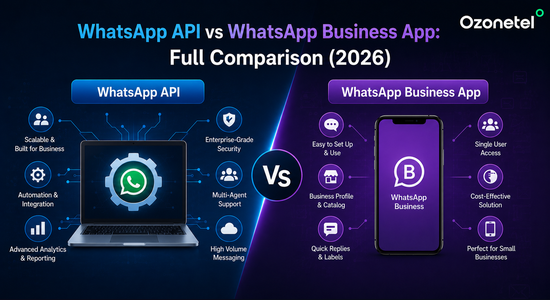
- 2. Full Feature Comparison: WhatsApp Business App vs. API
- 3. Pricing: Free vs. Pay-Per-Message (May 2026)
- 4. Five Things the WhatsApp API Unlocks That the App Can’t
- 5 When to Stay on the WhatsApp Business App
- 6. When to Migrate to the WhatsApp API
- 7. Decision Framework: App or API?
- 8. Can You Use Both at Once? Yes – Here’s How
- 9. The Ozonetel Advantage: One Inbox, Every Channel
WhatsApp App vs API – The 30-Second Summary
Two very different products, built for very different stages of business growth.
The WhatsApp Business App is a free mobile application built for solo operators. One person, one phone, one number. If you handle fewer than 50 customer conversations a day and work alone, the App was built exactly for you.
The WhatsApp Business API (officially the WhatsApp Business Platform) is enterprise-grade messaging infrastructure. Cloud-hosted by Meta, accessed through a Business Solution Provider (BSP), and built for multi-agent teams, chatbots, CRM integration, and broadcast messaging at scale.
If you need multiple agents on the same number, a chatbot answering FAQs overnight, or your CRM logging every conversation automatically – you need the API. The decision framework in Section 7 confirms it in under two minutes.
Full Feature Comparison: WhatsApp Business App vs. API
Every capability that matters, from pricing to compliance, side by side.
| Feature | WhatsApp Business App | WhatsApp Business API |
|---|---|---|
| Price | Free — zero messaging cost | Per-template pricing + BSP platform fees |
| Simultaneous Users | 1 device + up to 4 linked devices | Unlimited agents on any device |
| Message Automation | Quick replies, away messages, greetings | Full workflow automation, AI chatbots, NLP-driven conversations |
| Broadcast Messaging | 256 contacts per broadcast list | Unlimited opted-in contacts via template campaigns |
| CRM / Helpdesk Integration | None (manual CSV export only) | Salesforce, HubSpot, Zoho, Freshdesk, Ozonetel OneCXi and more |
| Chatbot / Conversational AI | Not available | Intent recognition, lead qualification, human handoff |
| Multiple Numbers | One number per device | Multiple numbers, shared inbox, multi-location routing |
| Green Tick Verification | Not available | Available through Meta Business verification |
| Hosting | On-device only | Cloud-hosted by Meta (On-Premises API retired Oct 23, 2025) |
| Analytics | Read receipts and delivery ticks | CSAT, agent performance, funnels, template analytics |
| Click-to-WhatsApp Ads | Not available | Available with 72-hour free messaging window |
| GDPR / Compliance | WhatsApp default controls | SOC 2, SOC 3, GDPR-compliant, consent & data residency controls |
Pricing: Free vs. Pay-Per-Message (May 2026)
Meta overhauled pricing in July 2025 – most guides still cite the old model. Here’s what Indian businesses actually pay today.
WhatsApp Business App – Rs. 0. Always.
No messaging charges, no platform fees. The only cost is the phone and data plan you already have.
WhatsApp Business API – You Pay Only for Template Messages
July 2025 shift: Meta replaced conversation-based billing (one fee per 24-hour window) with per-template-message pricing. Free-form service replies within a customer-initiated 24-hour window remain entirely free – you pay for outbound template delivery, not for conversations.
India rates, effective January 1, 2026 (marketing rates rose ~10% on Jan 1, from Rs.0.7846 to Rs.0.8631):
| Category | Cost per Message (INR) | Covers |
|---|---|---|
| Marketing | ₹0.8631 | Offers, product launches, abandoned cart reminders, promotions, and customer re-engagement campaigns |
| Utility | ~₹0.115 | Order confirmations, shipping updates, appointment reminders, invoices, and transaction notifications |
| Authentication | ~₹0.115 | Login OTPs, two-factor authentication (2FA), account verification, and security validation codes |
| Service Replies (24-hour Window) | Free | Any free-form response sent within 24 hours of a customer-initiated conversation |
The 72-Hour Free Window – The Cost Advantage Most Businesses Miss
When a customer taps a Facebook or Instagram ad and messages your business, all messages – including marketing templates – are free for 72 hours. No per-message charges. You can run complete nurture sequences at zero messaging cost within that window. For businesses running paid Meta acquisition, this changes the economics of the API considerably. Meta’s Click-to-WhatsApp ad documentation has full details.
On-Premises API – Permanently Retired
On October 23, 2025, Meta closed the On-Premises WhatsApp API for good. All businesses now run on the Cloud API – 99.9% uptime, sub-5-second p99 latency, up to 1,000 messages per second (4x the On-Premises cap). Meta’s official sunset notice has the full timeline.
Realistic Monthly Cost: India, 10-Agent Team
5,000 marketing messages + 10,000 utility messages + 2,000 authentication OTPs:
| Cost Item | Approx. Monthly Cost (INR) |
|---|---|
| Meta Marketing Messages (5,000 × ₹0.8631) | ~₹4,316 |
| Meta Utility Messages (10,000 × ₹0.115) | ~₹1,150 |
| Meta Authentication Messages (2,000 × ₹0.115) | ~₹230 |
| BSP Platform Fee (10-Agent Tier) | ₹4,500 – ₹6,500 |
| 18% GST on Platform & Messaging Costs | ~₹1,836 – ₹2,196 |
| Estimated Total Monthly Cost | ₹12,000 – ₹14,400/month |
Five Things the WhatsApp API Unlocks That the App Can’t
These capabilities shift WhatsApp from a messaging app into a customer acquisition and retention engine.
Multi-Agent Shared Inbox
On the App, one number is tied to one phone. On the API, unlimited agents handle the same number simultaneously – with role-based permissions, conversation assignment, queue management, and supervisor oversight. The single biggest operational gap between the two products. Learn how Ozonetel’s OneCXi unified inbox works across voice and WhatsApp together.
AI Chatbots and Workflow Automation
API chatbots go far beyond static auto-replies. They recognise intent, qualify leads, book appointments, pull real-time data from backend systems, and hand off to a human agent precisely when judgment is needed. Ozonetel’s AI agent platform builds this directly into the WhatsApp channel.
CRM and Helpdesk Integration
The API pushes conversations straight into Salesforce, HubSpot, Zoho, Freshdesk, or Ozonetel OneCXi. No CSV exports, no copy-paste. A lead responding to a broadcast auto-creates a CRM record. A support customer gets an agent who sees their full history alongside the chat.
Click-to-WhatsApp Ads with Full Attribution
Ads on Facebook and Instagram open a direct WhatsApp conversation with your business number. Track the full funnel – impression to message to lead to conversion – and unlock the 72-hour free messaging window on every ad-triggered conversation. Meta’s CTWA documentation covers setup. The App cannot receive this traffic.
Broadcast at Scale
The App hard-caps you at 256 contacts per broadcast. The API has no such limit. Send template-based campaigns to unlimited opted-in contacts, segmented by behaviour, lifecycle stage, or campaign, with full delivery, open, and read analytics. See how Ozonetel’s WhatsApp campaign tools work in practice.
When to Stay on the WhatsApp Business App
The App is not a starter version to race past – it is the right tool for a specific stage of business.
Many successful businesses never need to leave it. It’s the right call if:
- You personally handle all conversations – fewer than 50 a day
- You’re a solo operator, freelancer, or local business with no team
- You have no need for chatbots, CRM sync, or outbound campaigns
- You work from one device or a linked laptop via WhatsApp Web
- You’re still building your customer base and the platform costs aren’t justified yet
Local bakeries, boutique salons, independent consultants – many thriving businesses never cross these thresholds, and they shouldn’t pay for infrastructure they won’t use.
When to Migrate to the WhatsApp API
Not a date on a calendar – it’s when these specific pain points become daily friction.
- Three or more agents responding to customers – with messages getting dropped, double-handled, or going unanswered
- Repetitive FAQs consuming hours of agent time daily – the chatbot case writes itself
- CRM sync bottleneck – manually logging WhatsApp conversations is no longer viable at your volume
- Outbound campaigns the App can’t support: abandoned cart, re-engagement broadcasts, post-purchase sequences
- Click-to-WhatsApp attribution – you’re running or planning Meta ads and need full funnel data
The practical threshold: Most businesses cross this line at 100+ daily messages across three or more agents. At that point, staying on the App is costing more in lost conversions and agent burnout than the API ever will.
Three Businesses That Crossed This Threshold – and What They Built
Here’s what the API decision looks like at three very different scales of Indian business.
CASE STUDY 1 – FINANCIAL SERVICES – NBFC
Muthoot Gold Bullion Corp: WhatsApp as a Zero-Inventory Jewellery Sales Channel
increase in average order value
WhatsApp impressions in 9 months
automated EMI calls in 5 months
Challenge: India’s No.1 NBFC group wanted to sell gold jewellery through its 5,000+ branches – without holding inventory or opening boutiques. Gold demands luxury ambiance and continuous engagement; neither is possible at a branch office.
Solution: A phygital GTM model powered by Ozonetel’s CCaaS Platform for WhatsApp. Digital catalogs replaced printed brochures. Customers browsed at home, shared with family, and completed the purchase at the nearest branch. WhatsApp was integrated into the website and synced to Muthoot’s ERP, enabling single-step catalog updates across all centres.
Why the API: Broadcasting to 10M+ customers across 5,000 catchment areas simultaneously, chatbot-driven catalog discovery, ERP integration, and campaign analytics – none of this is possible on the WhatsApp Business App.
Result: Average order value grew from Rs.20,000 to Rs.50,000 (2.5X). WhatsApp drove 150,000+ impressions in nine months. A voice bot added on top handled 43,500 EMI reminder calls in five months, improved collection rates 5-8%, and saved Rs.2,00,000 in agent costs.
“Since we follow a zero inventory, phygital model for the jewellery vertical we are indebted to Ozonetel for quickly deploying these tech for our Go To Market strategy.”
CASE STUDY 2 – AGRI-MACHINERY – RURAL BHARAT
Mahindra Farm Machinery: Reaching Tier-3 Farmers Through #KisanBot
Challenge: Mahindra needed to build product awareness and drive the full customer journey – inquiry to purchase to after-sales – among Tier-3 farmers aged 28-65. WhatsApp was already their preferred channel, but fragmented messaging and no unified platform meant conversations were falling through the cracks.
Solution: #KisanBot – an AI-engineered WhatsApp chatbot on Ozonetel’s platform. It ran bulk awareness campaigns in farmers’ preferred languages, provided product discovery and feature education, surfaced dealer locations, guided purchase decisions, and handled post-purchase service requests and spare part queries. All interactions were end-to-end encrypted.
Why the API: A national Tier-3 broadcast campaign is impossible within the App’s 256-contact limit. The chatbot’s query routing – categorising product, service, dealer, and complaint intents and directing each to the right team – required API-level automation.
Result: Measurable spike in brand visibility and product inquiries in Tier-3 markets. Instant lead response reduced friction across the sales cycle. Dealers and suppliers reported significantly easier customer connections, strengthening the distribution ecosystem at both ends.
CASE STUDY 3 – GOVERNMENT / PUBLIC SERVICES – TELANGANA
MeeSeva Telangana: 580+ Government Services on One WhatsApp Number
government services via one number
WhatsApp impressions in 9 months
live deployment date
Challenge: The Government of Telangana runs 580+ MeeSeva services – certificates, payments, registrations, utility bills – for millions of citizens statewide. Physical MeeSeva centres, manual workflows, and rule-based chatbots couldn’t handle multi-step processes. Citizens were unclear on eligibility, documents, and application status.
Solution: MeeSeva on WhatsApp, live November 18, 2025, with Ozonetel as the technology partner. Multiple autonomous AI agents work in concert – understanding intent in English and Telugu, validating eligibility and documents, guiding users step by step, triggering payments and bookings, fetching real-time application status, and delivering certificates directly on WhatsApp. Human escalation happens only when genuinely needed.
Why the API: Agentic AI orchestrating multi-step government workflows across an entire state – 580 services, multilingual NLP, payment triggering, real-time document delivery – requires full API infrastructure. Citizens reach all 580 services through a single number (8096958096).
Result: Significant footfall reduction at physical MeeSeva centres. Lower cost per transaction through automation. Consistent service quality across all departments – and a repeatable digital governance architecture for future public services.
Decision Framework: App or API?
Answer these seven questions in order – the first ‘Yes’ ends the exercise.
| Question | If Yes | If No |
|---|---|---|
| More than 100 daily customer conversations? | API | Next |
| Three or more agents handling WhatsApp? | API | Next |
| Need CRM or helpdesk integration? | API | Next |
| Running or planning Click-to-WhatsApp Ads? | API | Next |
| Need a chatbot for FAQ or workflow automation? | API | Next |
| Sending promotional broadcasts to 256+ contacts? | API | Next |
| None of the above? | App | API |
Can You Use Both at Once? Yes – Here’s How
Since May 6, 2025, Meta lets you run the App and the API on the same number simultaneously.
Meta launched WhatsApp Coexistence on May 6, 2025. One number, both products running at the same time. Messages are mirrored via a ‘Messaging Echoes’ webhook – App messages appear in the API shared inbox, and vice versa.
In practice:
- Your team starts using the API’s shared inbox for inbound support – same number your customers already have
- You keep using the App for high-touch, personal conversations alongside it
- Existing App chat history stays in the App; new messages from activation sync to both sides
- No number change, no cutover weekend, no disruption to live conversations
One firm constraint: once a number is on the Cloud API (even under Coexistence), you cannot revert it to App-only. The move is one-directional. Plan accordingly.
The Ozonetel Advantage: One Inbox, Every Channel
WhatsApp is powerful. Connected to voice, email, and chat on one platform, it becomes a complete CX engine.
WhatsApp is one channel among many – and the real business value isn’t just in having it. It’s in connecting it to everything else your team already handles.
Ozonetel’s OneCXi platform brings WhatsApp API conversations into the same unified inbox where your agents handle phone calls and digital messages. A customer who calls at 3 PM and messages on WhatsApp at 4 PM is one conversation – not two tickets on two screens.
The platform’s AI-native architecture adds real-time conversation intelligence, agent-assist suggestions, and cross-channel journey analytics. As Muthoot, Mahindra, and MeeSeva Telangana demonstrate, the combination of WhatsApp’s reach and Ozonetel’s orchestration layer works across FS, agriculture, and government – at any scale.
Ready to see it in action?
Frequently Asked Questions
Yes – and with Coexistence, you don’t need to ‘switch’ at all. Your existing number onboards to the Cloud API while the App keeps running. Just note: once on the API, the move is one-directional. See Meta’s migration guide for steps.
Yes. The API requires Facebook Business Manager verification to link your WhatsApp Business Account to Meta’s infrastructure. Most BSPs guide you through this – typical end-to-end turnaround is 5-10 business days.
With a BSP: 24-48 hours for onboarding, plus up to 5-10 business days if Meta’s Business Verification needs extra review. Going direct without a BSP takes 2-6 weeks. The BSP route is faster in almost every case.
No. CTWA ads require the API to open and manage the conversation. The App can’t receive this traffic, can’t attribute the conversion, and can’t unlock the 72-hour free messaging window. See Meta’s CTWA overview for the technical details.
Yes – 18% GST on Meta’s per-message charges (imported services under OIDAR rules) and on your BSP platform fee. Depending on your BSP billing setup, you may need to handle the reverse charge on Meta’s portion. Confirm this with your BSP before you budget.
Yes. Since July 2025, utility template messages sent within a customer-initiated 24-hour service window are free – not just free-form replies. See Meta’s per-message pricing documentation for the full breakdown.
With Coexistence: existing App history stays in the App; new messages from activation sync to both sides. In a full migration without Coexistence, existing App chats don’t carry over – only post-migration conversations are accessible via the API.