How to Get a Toll-Free Number in India: Step-by-Step Guide (2026)

Rampradeep Kumar

May 21, 2026 | 10 mins read

Every business in India eventually faces the same question: what kind of phone number should we put on our website, our ads, and our customer communications?

The answer isn’t one-size-fits-all. A D2C startup running Instagram ads needs something different from a BFSI enterprise handling lakhs of support calls. A regional service business in Tier-2 India has different requirements than a SaaS company selling to global clients.

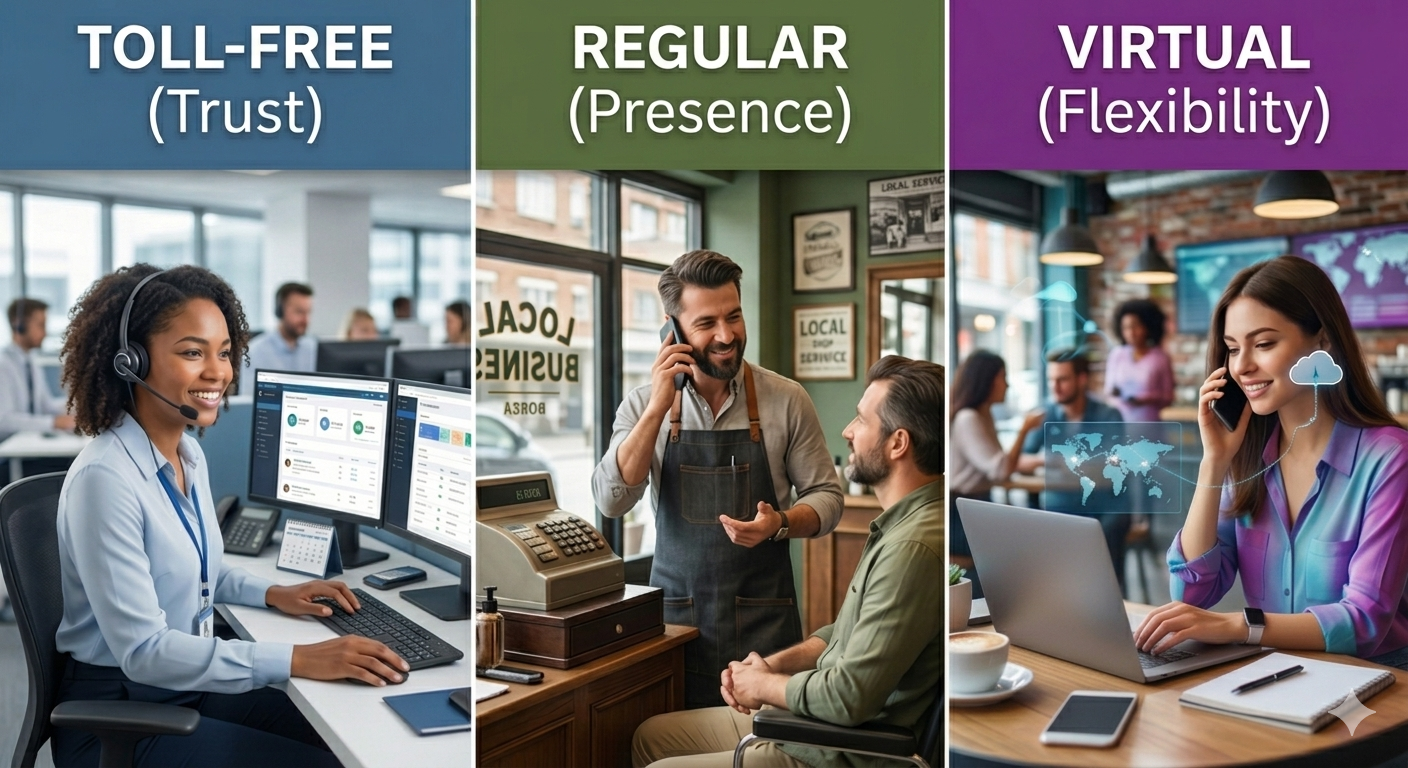
The choice sits between three options: toll-free numbers, regular business numbers, and virtual numbers. Each serves a distinct purpose. Each carries its own cost structure and customer perception. And increasingly, smart businesses don’t pick one — they combine all three as part of a broader cloud communication strategy.

Here’s what each number type actually does, where it shines, and how to choose.

What Is a Toll-Free Number? 

A toll-free number is a business phone line where the business pays for incoming calls, not the caller. In India, these numbers typically start with the prefix 1800, followed by six or seven digits. This makes them instantly recognizable to customers across the country. 

Toll-free numbers are regulated by the Telecom Regulatory Authority of India (TRAI) and the Department of Telecommunications (DoT), and assigned through licensed telecom operators and cloud telephony providers. Unlike a regular landline or mobile number, a toll-free number signals credibility — customers associate it with established, trustworthy businesses willing to invest in their experience. 

Key facts: 

  • Callers pay zero charges from any mobile or landline across India 
  • The business bears the cost, typically on a per-minute or per-call basis 
  • 1800 is the standard domestic toll-free prefix; 1860 is a shared-cost (local-rate) variant; 000800 is used for international toll-free access 
  • A single toll-free number can route calls to multiple locations, agents, or devices 

Types of Toll-Free Numbers in India 

Not all toll-free numbers work the same way. Understanding the variants helps you pick the one that fits your business model. 

TypePrefixWho PaysBest For
Standard Toll-Free1800Business pays all chargesCustomer support, helplines, sales inquiries
Universal Access Number (UAN)1860Caller pays local charges; business pays long-distance legRegional businesses wanting wider reach at lower cost
International Toll-Free (ITFS)000800Business pays; accessible to international callersMNCs and businesses with global customer bases
Shared Toll-Free1800Caller pays nothing; business pays per-call feeStartups and seasonal campaigns with lower call volumes

Cloud-based toll-free numbers add a layer on top of these types. Instead of routing calls to a fixed landline, they connect to a virtual phone system with IVR menus, agent queues, and CRM integrations. This is the modern approach — and the one we’ll focus on in the setup section. 

How to Get a Toll-Free Number in India: Step-by-Step
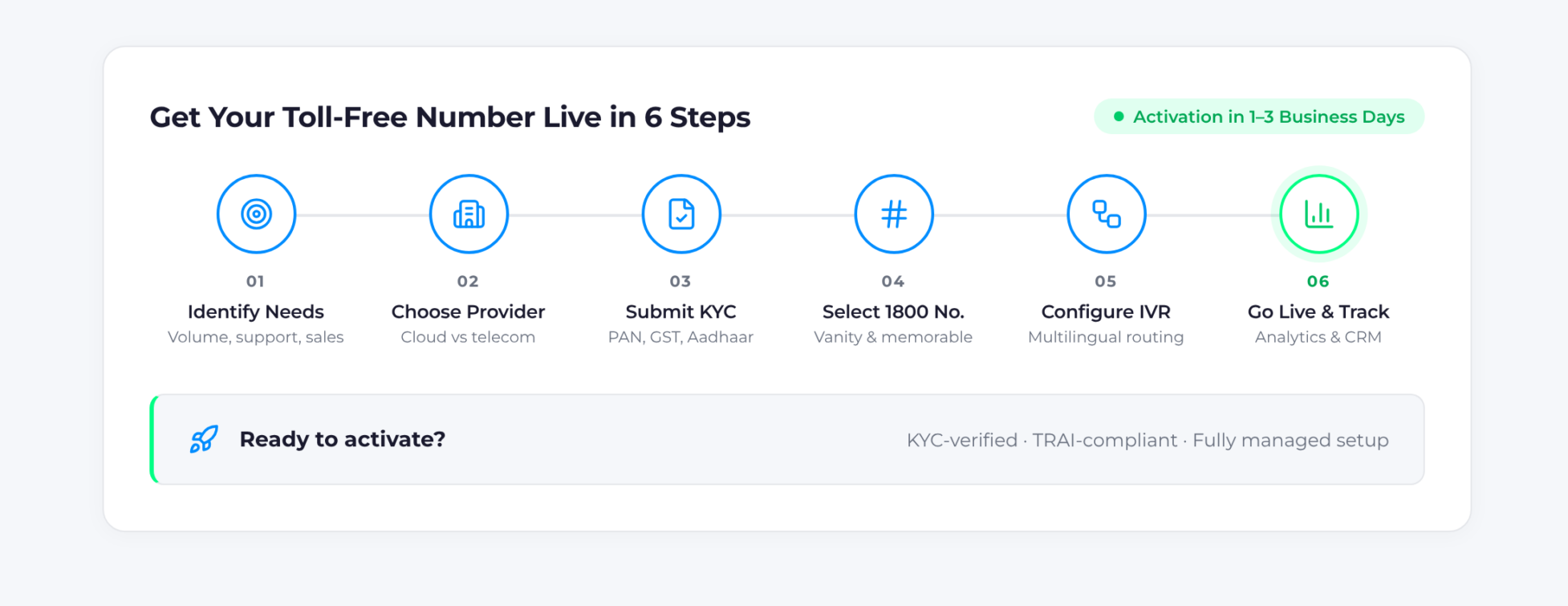
Enable customers across India to reach your business free of cost with a scalable, cloud-based toll-free number solution.

Step 1: Determine Your Business Requirements

Before approaching a provider, get clear on what you need:
• Expected call volume: How many calls per day do you anticipate? This determines your plan tier.
• Caller geography: Will customers call from across India or a specific region? Pan-India coverage costs more but captures more leads.
• Routing needs: Do calls go to one desk, multiple agents, or different departments? This decides whether you need IVR.
• Operating hours: 24/7 support versus business-hours-only affects cost and staffing.
• Compliance: BFSI and healthcare businesses must factor in call recording, data masking, and audit trails. Note: as of January 2026, the RBI has mandated the 1600 series for transactional voice calls (OTPs, fraud alerts, service updates) from banks, NBFCs, and insurance companies — check whether this applies to your outbound communication alongside your inbound toll-free setup.

Pinning these down first prevents overpaying or outgrowing your plan in three months.

Step 2: Choose Between a Telecom Operator and a Cloud Provider

You have two routes:

CategoryTelecom OperatorCloud Telephony Provider
ExamplesJio, Airtel, Tata Tele, BSNLOzonetel, Exotel, MyOperator
Setup time7–15 days1–3 business days
Hardware neededOften yes (PRI lines, EPABX)None — fully virtual
FeaturesBasic forwardingIVR, CRM integration, analytics, AI routing
ScalabilityLimited — hardware-boundInstant — add lines with a click
Best forLarge enterprises with existing infraSMEs, startups, digital-first businesses


Our take:
Cloud providers win on speed, flexibility, and feature depth. With Ozonetel’s platform, you get a toll-free number with IVR, smart routing, and CRM integrations — no hardware, no waiting for telecom engineers. Activation takes 1–3 business days. Plus, as a licensed operator, we handle the telecom side so you don’t have to deal with multiple vendors. Learn more about Ozonetel’s Enterprise CCaaS.

Step 3: Prepare Your KYC Documents

TRAI and DoT mandate KYC verification for every toll-free number application. Learn about Ozonetel’s TRAI compliance process. Have these documents ready:

For registered businesses:

  • Company PAN card
  • GST registration certificate
  • Certificate of Incorporation or Partnership Deed
  • Authorized signatory’s Aadhaar card
  • Address proof of the business (utility bill, rent agreement)

For sole proprietors:

  • Individual PAN card
  • Aadhaar card
  • GST registration (if applicable)
  • Bank account statement or cancelled cheque

For startups without GST:

  • Certificate of Incorporation + PAN + Aadhaar typically suffice
  • Some providers accept Udyam Registration Certificate

Most cloud providers accept scanned copies. The verification process takes 1–2 working days. Having documents ready before applying cuts the timeline significantly.

Step 4: Pick Your Toll-Free Number

Your toll-free number is a brand asset. Consider these factors:

  • Memorability: Simple patterns (e.g., 1800-123-4567) are easier for customers to recall and dial.
  • Vanity numbers: Numbers that spell a recognizable word or code (e.g., 1800-HELPME mapped to the keypad) cost more but can boost recall in above-the-line advertising.
  • Industry relevance: Some providers offer number pools sorted by industry — pick one that aligns.
  • Availability: Popular patterns get snapped up fast. Have 2–3 alternatives ready.

Most cloud providers display available numbers during signup. You can browse and select in real time. Premium or vanity numbers carry a one-time setup fee, typically ₹999–₹5,000.

Step 5: Configure Call Routing and IVR

This is where cloud toll-free solutions pull ahead of traditional telecom setups. Once your number is assigned, configure:

  • IVR (Interactive Voice Response): “Press 1 for Sales, Press 2 for Support.” Well-designed self-service IVR can deflect a significant share of routine queries — Ozonetel deployments at clients like Treebo and Acko have demonstrated meaningful reductions in agent load. Explore the Ozonetel Cloud Contact Center Platform.
  • Call routing rules: Route by time of day, agent skill, caller location, or language preference. Round-robin, sticky agent, or priority-based routing — choose what fits.
  • Fallback options: What happens if all agents are busy? Queue with music? Voicemail? Forward to a mobile? Define these upfront.
  • Business hours: Auto-route after-hours calls to voicemail or an on-call agent.

With Ozonetel, this configuration happens through a web dashboard. No coding. No hardware. The system goes live within minutes of number activation.

Step 6: Test, Integrate, and Go Live

Before announcing your toll-free number to customers:

  • Test from multiple networks: Dial the number from Jio, Airtel, Vi, and BSNL. Confirm connectivity and audio quality from each.
  • Integrate with your CRM: If you use Salesforce, Zoho, Freshdesk, or an in-house CRM, connect it. Screen-pop shows customer data to agents before they answer. Click-to-call lets agents dial from within the CRM. See all Ozonetel CRM integrations.
  • Test IVR flows: Run through every menu path. Does each option route to the correct agent or department?
  • Set up call recording and analytics: Confirm recordings are stored securely. Configure dashboards to track call volume, wait times, abandon rates, and agent performance.

Once testing passes, add the toll-free number to your website, Google Business Profile, ads, invoices, and social media.

Get your 1800 number live in 3 business days.

No hardware. No telecom queues. Just a number that works

Key Business Benefits of a Toll-Free Number
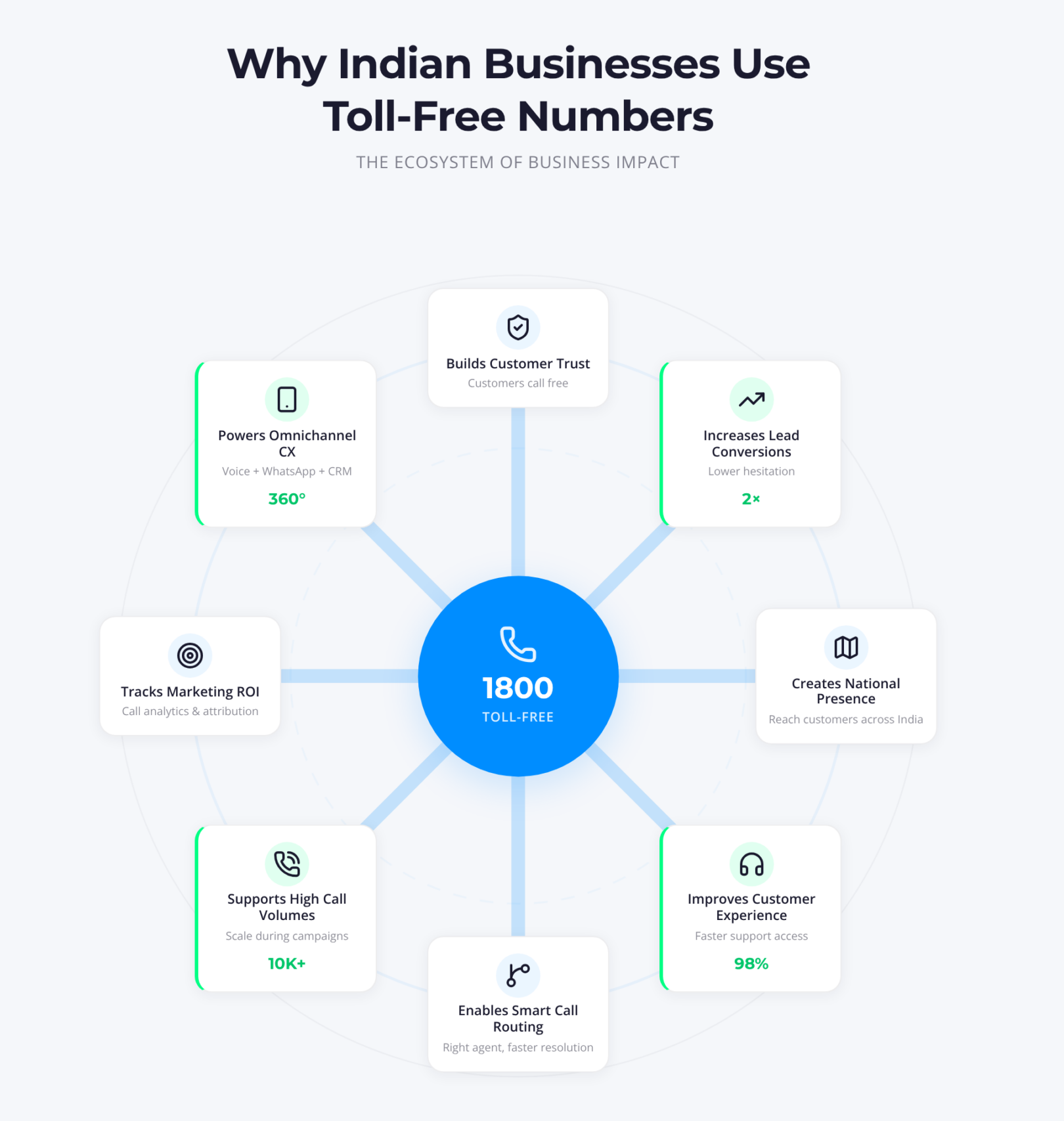
A toll-free number isn’t just a phone line. It’s a signal, a funnel, and a trust marker.
Infographic-Toll-free-benefits wheel

Builds trust instantly. When customers can reach a business at no cost to themselves, the signal is clear: this company has invested in being accessible. That accessibility matters more than ever — an EY report found that 78% of Indian consumers prefer human customer support when shopping online, and the Zendesk CX Trends Report 2026 found that 85% of CX leaders say a single unresolved issue is enough to lose a customer. A toll-free number is one of the lowest-friction ways to ensure customers can reach a real person when it counts.

Increases lead capture. When dialing costs nothing, hesitation drops. According to HealthcareSuccess, vanity toll-free numbers can increase ad response rates by 33% compared to generic numeric strings — and even a standard 1800 number removes the cost barrier that makes prospects abandon an ad without calling. The lead quality case is just as strong: BIA/Kelsey’s Local Commerce Monitor found that 66% of businesses rate phone calls as a good or excellent lead source, ahead of online forms, in-person visits, and email. For D2C brands and real estate firms, where decisions are high-intent and high-value, that matters.

Expands your reach. The next wave of Indian consumers isn’t in Mumbai or Bengaluru — it’s in Indore, Coimbatore, Jodhpur, and hundreds of cities like them. Bain estimates that almost three out of every five new online shoppers since 2020 have come from Tier-3 or smaller towns, and Deloitte notes that over 60% of e-commerce transactions now originate from Tier-2 and Tier-3 markets. These are customers with rising incomes and real purchase intent — who will call if calling costs them nothing. A toll-free number means a business based anywhere can be reachable everywhere, with no geographic signal that gives away its size.

Supports complex purchases. In high-consideration categories — insurance, real estate, loans, healthcare — Indian consumers rarely convert without a conversation first. The stakes are too high and the paperwork too unfamiliar to decide in silence. A toll-free number removes the one remaining reason to delay that call: cost. Whether a prospect is comparing home loan rates in Lucknow or asking about a health plan in Coimbatore, a 1800 number signals that your business is reachable, willing to talk, and absorbing the friction on their behalf.

Enables professional CX at scale. When combined with a cloud contact center like Ozonetel, a toll-free number becomes part of an omnichannel strategy: calls, WhatsApp, chat, and email — all routed, tracked, and analyzed from one platform. HDFC ERGO, using Ozonetel’s platform, achieved an 85% policy renewal rate.
How Ozonetel Powers Your Toll-Free Number

Getting a toll-free number from a telecom operator gives you a line. Getting one through Ozonetel gives you a customer communication platform built around it.

Ozonetel is a licensed cloud telephony provider that combines number provisioning and the contact center stack in one place — so you don’t have to stitch together a telecom vendor, an IVR tool, and a CRM integration independently. When you activate a 1800 number through Ozonetel, you’re simultaneously getting:

  • Multi-level IVR that routes callers to the right agent or department without manual intervention
  • AI-powered smart routing that matches calls by skill, language, time of day, or caller history
  • Native CRM integrations with Salesforce, Zoho, Freshdesk, and more — agents see full caller context before picking up. View all integrations
  • Real-time dashboards showing live queue length, wait times, and agent availability
  • Call recording and analytics with role-based access and secure storage — essential for BFSI, healthcare, and regulated industries

Ozonetel’s platform currently handles 40,000+ calls daily for brands like Angel One, maintaining high uptimes even during peak market hours. Acko achieved 50% faster resolutions using Ozonetel’s self-service IVR. Activation for a standard 1800 number takes 1–3 business days after KYC verification — no hardware installation, no telecom engineer visits.

For businesses that want more than just a forwarding line, Ozonetel is the difference between having a toll-free number and having a toll-free contact center.

Toll-Free Number Pricing in India

Pricing varies by provider type, call volume, and features. Here’s a realistic breakdown. See Ozonetel’s pricing plans:

ComponentTypical Cost
One-time setup fee₹0–₹5,000 (free for standard; premium for vanity)
Monthly rental₹500–₹3,000 (varies by plan and provider)
Per-minute incoming call charge₹0.50–₹1.50/min (lower with volume commitments)
IVR add-on₹500–₹2,000/month
Call recording storage₹200–₹500/month per 1,000 recording hours


Enterprise plans
with dedicated account management, custom integrations, and SLA-backed uptime are priced on a case-by-case basis. Cloud providers like Ozonetel offer bundled plans that include the toll-free number, IVR, CRM integrations, and analytics in a single subscription — no hidden telecom line-item charges.

Cost-saving tips:

  • Commit to annual plans for 15–20% discounts
  • Choose per-minute billing over per-call if your average call duration is under 3 minutes
  • Avoid hardware-based solutions — cloud eliminates PRI line, EPABX, and maintenance costs

Not sure which plan fits your call volume?

Talk to us — we’ll size it right the first time.

Features to Look For in a Toll-Free Solution

A basic toll-free number just forwards calls. A modern cloud-based solution does far more. When evaluating providers, look for:

FeatureWhy It Matters
Multi-level IVRAutomates routine queries, reduces agent load, speeds up resolution
CRM integrationAgents see customer history before answering; no tab-switching
Call recording + analyticsTracks performance, resolves disputes, enables coaching
Smart routingRoutes by skill, time, location, or language — improves FCR
Real-time dashboardLive visibility into queue length, wait times, agent availability
TRAI/DoT complianceBuilt-in DND scrubbing, consent management, data masking
API accessCustom integrations with your existing tech stack
99.95%+ uptime SLAEnterprise-grade reliability during call volume spikes

With Ozonetel, all of the above are included in the platform. The system handles 40,000+ calls daily for customers like Angel One, maintaining high uptimes even during market volatility. Acko achieved 50% faster resolutions using Ozonetel’s self-service IVR.

Conclusion

Getting a toll-free number in India takes three steps: pick a provider, submit KYC documents, and configure your call flows. The entire process can be completed inside a week.

The strategic decision isn’t whether to get one — it’s whether you choose a basic forwarding line or a cloud-based toll-free solution with IVR, smart routing, CRM integration, and AI-powered analytics. The latter doesn’t just make you reachable. It converts calls into customers, tracks what’s working, and scales with your business.

Your competitors are reachable.

Are you? Set up a toll-free number with Ozonetel and start capturing every call.

Rampradeep Kumar

Share this post:

Frequently Asked Questions

With a cloud provider, 1–3 business days after KYC verification. Traditional telecom operators take 7–15 days.

No. Toll-free numbers use reserved prefixes (1800, 1860). You’ll receive a new number. However, you can forward your existing number to the toll-free line or use both in parallel.

Yes. 1800 toll-free numbers in India are accessible from all major mobile networks — Jio, Airtel, Vi, and BSNL — as well as landlines, at no charge to the caller.

Monthly plans are available from most cloud providers. Annual commitments offer better pricing. Ozonetel offers flexible plans with no long-term lock-in for standard numbers.

Yes. Many providers accept alternative documents like a Udyam Registration Certificate, bank statement, or shop establishment license alongside PAN and Aadhaar.

TRAI is working toward greater portability options for business numbers. In practice, policies vary by provider and number type — discuss retention and porting terms with your new provider before cancelling the existing service.

Yes. Ozonetel’s platform includes data masking, encrypted call recording, role-based access controls, and audit trails — all essential for regulatory compliance in banking, insurance, and healthcare.