- Resources
- Toll-Free vs Regular vs Virtual Numbers:Which One Is Right for Your Business?
Toll-Free vs Regular vs Virtual Numbers:Which One Is Right for Your Business?

Prashanth Kancherla
May 19, 2026 | 9 mins read
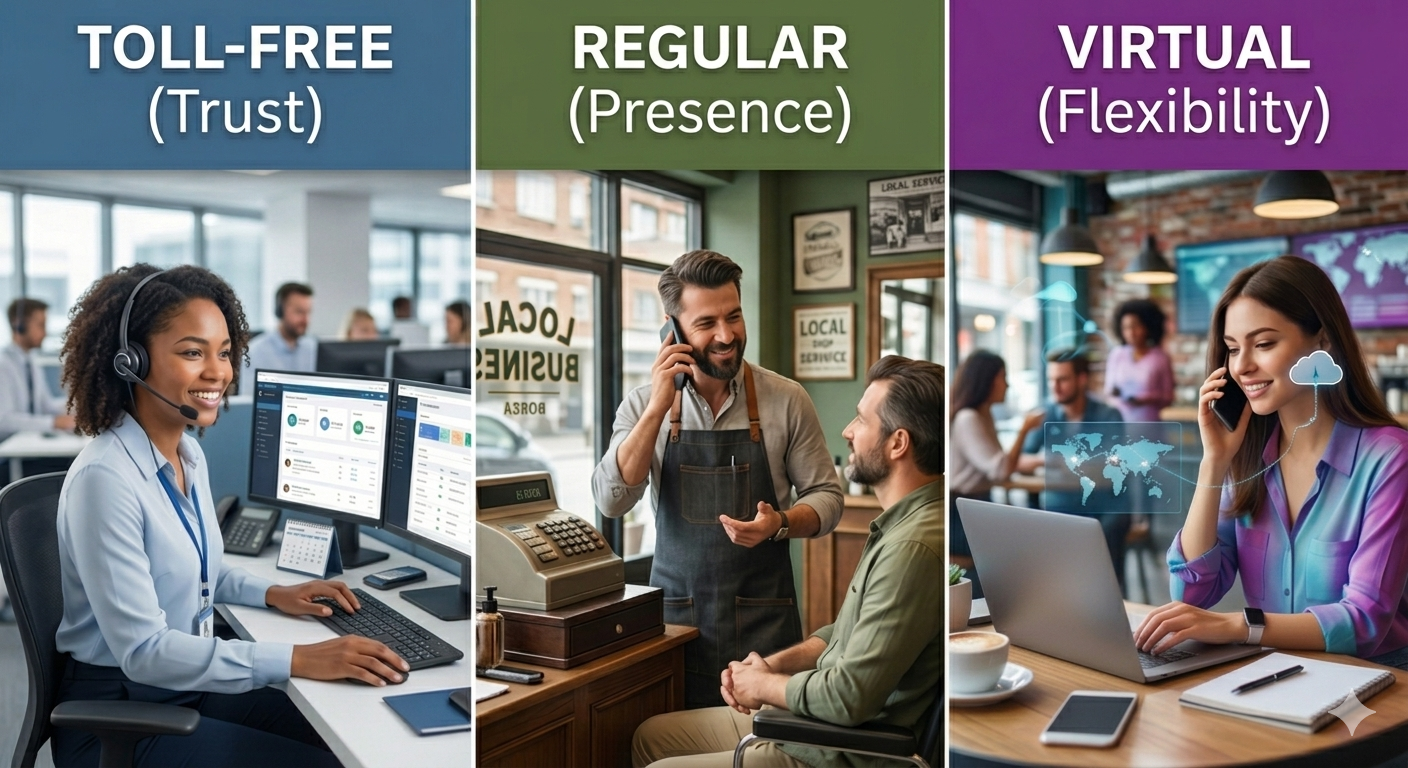
Every business in India eventually faces the same question: what kind of phone number should we put on our website, our ads, and our customer communications?
The answer isn’t one-size-fits-all. A D2C startup running Instagram ads needs something different from a BFSI enterprise handling lakhs of support calls. A regional service business in Tier-2 India has different requirements than a SaaS company selling to global clients.
The choice sits between three options: toll-free numbers, regular business numbers, and virtual numbers. Each serves a distinct purpose. Each carries its own cost structure and customer perception. And increasingly, smart businesses don’t pick one — they combine all three as part of a broader cloud communication strategy.
Here’s what each number type actually does, where it shines, and how to choose.
In this article, we will explore:
- 1.What Is a Toll-Free Number?
- 2.What Is a Regular Business Number?
- 3.Toll-Free vs Regular vs Virtual Numbers: Key Differences
- 4. Which Number Type Is Best for Different Business Use Cases?
- 5.Why Modern Businesses Combine Multiple Number Types
- 6.How Cloud Contact Centers Change the Game
- 7.How Ozonetel Brings All Your Business Numbers Under One Roof
- 8.Factors to Consider Before Choosing a Business Number
- 9.Common Mistakes Businesses Make
- 10.Which One Should You Choose?
What Is a Toll-Free Number?
A toll-free number — the familiar 1800 series in India — lets customers call your business without paying a single rupee. You, the business, absorb the cost of every incoming call.
Think of it as a handshake. You’re telling the customer: “We want to hear from you, and we won’t make you pay for it.”
There are two main variants in India. 1800 numbers are completely free for callers, while 1860 numbers charge callers local rates with the business covering long-distance costs. Most customer-facing brands opt for 1800 — it’s cleaner, simpler, and removes all friction.
Toll-free numbers build trust. They signal that you’re established enough to absorb communication costs, and they make your business look national even if you operate from a single office. That’s why you see them on packaging, billboards, and e-commerce checkout pages.
The trade-off: you pay per minute for every incoming call. For a popular consumer brand or a busy support line, those per-minute costs compound quickly at high call volumes.
What Is a Regular Business Number?
A regular business number is a standard landline or mobile number registered for business use — the most familiar format in India, carrying a city STD code or mobile prefix.
The appeal is simplicity. Setup is straightforward, and local customers recognise the area code instantly. For a neighbourhood clinic, a city-based legal practice, or a regional distributor, a local number often outperforms a toll-free line because familiarity builds faster than prestige.
But regular numbers come with hard limits. They’re tied to a physical line or SIM card. You can’t route calls to a remote team without clunky forwarding setups. There’s no built-in analytics, no call recording, no IVR. Scaling means adding more lines, more hardware, and more maintenance overhead.
For any business handling more than a few dozen calls a day, a regular number alone becomes a ceiling — not a foundation.
Toll-Free vs Regular vs Virtual Numbers: Key Differences
| Dimension | Toll-Free Number | Regular Business Number | Virtual Number |
|---|---|---|---|
| Who pays for calls | Business absorbs all costs | Caller pays standard rates | Configurable — toll-free or caller-paid |
| Location tie | No tie; national presence | Tied to city/region via STD code | No physical location tie at all |
| Hardware needed | Usually needs PBX or PRI line | Requires copper line, SIM, or landline | None — works over internet on any device |
| Setup time | Days to weeks | Days (wireline or SIM procurement) | Minutes to hours |
| Scalability | Moderate — limited by line capacity | Low — each new line needs physical setup | High — add numbers instantly |
| Call analytics | Basic CDRs from provider | Minimal to none | Full recording, tracking, CRM integration |
| Remote-ready | Limited — forwarding required | Bound to physical location | Fully remote-ready |
| Best for | Support lines, national brands | Local businesses, small offices | Growing teams, campaigns, multi-location ops |
| Monthly cost | ₹1,500–5,000 + call charges | ₹500–1,500 + call charges | ₹500–3,000 with cloud features |
Which Number Type Is Best for Different Business Use Cases?
The right choice depends on what you’re trying to accomplish. Here’s how it breaks down across the most common scenarios.
Customer support at scale.
If you’re a consumer brand, an e-commerce platform, or a BFSI company fielding hundreds of inbound queries daily, a toll-free number is non-negotiable. It removes cost anxiety from the caller’s side and positions your brand as accessible. Pair it with a cloud contact center for intelligent routing and real-time visibility.
Local trust and walk-in traffic.
A diagnostic lab, dental clinic, property brokerage, or retail outlet benefits more from a local virtual number or a regular city-coded line. Customers associate the area code with proximity — they’re more likely to call a number that looks like it belongs in their neighbourhood.
Sales and lead generation.
Virtual numbers win here. Assign a unique number to each ad campaign, landing page, or sales region. Track which channel drives calls. Route high-intent callers to senior agents. Record conversations for coaching. No other number type delivers this level of attribution and visibility.
Distributed and remote teams.
Virtual numbers are the only viable architecture. Your sales team in Delhi, support team in Hyderabad, and operations in Mumbai can share the same business number infrastructure — with calls routed intelligently by availability, skill, or time of day.
Why Modern Businesses Combine Multiple Number Types
Here’s what most guides skip: you don’t have to choose one.
A mature communication strategy uses toll-free numbers for inbound customer service, virtual local numbers for regional sales outreach, and — if needed — a regular landline as a fallback line. Cloud platforms make this combination seamless.
Consider a mid-size insurance firm. The 1800 number sits on the website and policy documents — it’s the trust anchor. Regional offices use local virtual numbers to reach policyholders for renewals. The sales team runs outbound campaigns via virtual numbers tied to specific lead sources. All three feed into the same cloud contact center platform, giving leadership a unified dashboard of call volumes, agent performance, and customer satisfaction metrics.
How Cloud Contact Centers Change the Game
A number — whether toll-free, regular, or virtual — is only as powerful as the system behind it. Ozonetel’s oneCXi platform treats every number as a node in a larger customer experience ecosystem.
A toll-free call doesn’t just ring a phone — it hits an intelligent IVR, authenticates the caller, pulls up CRM history via screen-pop, and routes to the best available agent. A virtual number assigned to a Google Ads campaign doesn’t just forward calls — it logs the UTM source, records the conversation, and pushes data into your reporting stack.
This is the real shift: cloud contact centers decouple the number from the infrastructure. You’re no longer buying a phone line. You’re buying a communication capability. The number is the entry point. The platform is what creates value.
For Indian businesses navigating TRAI compliance, remote work, and rising customer expectations, this infrastructure model is fast becoming the default — not because traditional systems stopped working, but because cloud platforms deliver more value per rupee spent.
How Ozonetel Brings All Your Business Numbers Under One Roof
Most providers sell you a number and stop there. Ozonetel takes a different approach — every number becomes an entry point into a unified customer experience platform called oneCXi.
Every Number Type, One Dashboard
Ozonetel provisions 1800 toll-free numbers, local virtual numbers with city STD codes, and international numbers — all from a single provider, managed through one dashboard. No juggling multiple vendors, no reconciling separate bills, no patchwork infrastructure.
Need a Mumbai number for your western region sales team and a Delhi number for NCR outreach? Both provision in minutes after KYC. Need an 1800 line for the national support desk? Same dashboard, same platform, same analytics.
Number Porting Without Disruption
Already have a business number your customers recognise? Ozonetel ports your existing landline or mobile number onto the oneCXi platform. Your customers dial the same digits they always have — but behind the scenes, that number now carries IVR menus, skill-based routing, call recording, and CRM integration, with minimal downtime during transition.
Number Masking for Privacy and Compliance
For businesses handling sensitive interactions — marketplaces, logistics, healthcare — Ozonetel offers number masking. Two parties connect on a call without ever seeing each other’s real phone numbers. Uber UAE uses this capability to facilitate over one million secure conversations daily between riders and drivers, maintaining privacy and preventing off-platform contact.
CRM-Integrated Call Intelligence
Every number on Ozonetel’s platform feeds into a centralised analytics engine. Incoming calls trigger screen-pops with full customer history. Outbound calls log automatically to your CRM — whether that’s Salesforce, Zoho, HubSpot, or an in-house system. Tata 1mg leveraged this integration to achieve 5% higher conversions and 15% business growth by eliminating manual data entry and fragmented workflows.
Built-In Compliance for Regulated Industries
For BFSI, stockbroking, and insurance, Ozonetel bakes in call recording, secure storage, and audit trails by default. A top Indian broking house uses Ozonetel to comply with SEBI’s mandate for legally verifiable records while handling 40,000+ calls daily. HDFC ERGO reduced renewal turnaround time by 50% while ensuring 100% data security across their 1.5 crore customer base.
Factors to Consider Before Choosing a Business Number
Call volume projections. If you expect over 500 inbound calls a month, scrutinise toll-free per-minute costs closely. Below that threshold, the brand value a toll-free number delivers may well outweigh the expense.
Customer demographics. Tier-1 urban audiences are comfortable calling 1800 numbers. Tier-2 and Tier-3 customers often prefer local codes. Match your number to your audience’s mental model.
Team distribution. If your team is spread across cities — or working from home — virtual numbers are the only architecture that makes operational sense.
Growth trajectory. A startup scaling from 5 to 50 agents within a year should not invest in physical landline infrastructure. That locks you into a ceiling.
CRM and tooling needs. Do you need call recording, analytics, lead attribution, and CRM sync? If yes, virtual numbers on a cloud platform are the only option that delivers these natively.
Budget structure. Toll-free numbers carry variable costs. Regular numbers have fixed hardware costs. Virtual numbers offer predictable SaaS-style pricing. Pick the model that matches how your finance team prefers to budget.
Common Mistakes Businesses Make
Using a personal mobile number as the business line. It looks unprofessional, blurs personal and work boundaries, and offers zero analytics, zero scalability, and zero backup if the phone is unreachable.
Buying a toll-free number without a routing strategy. A 1800 number that rings endlessly without intelligent routing creates frustration, not trust. Your toll-free line needs an IVR or skill-based routing behind it.
Treating numbers as standalone assets. A business number without CRM integration, call recording, or a performance dashboard is a missed opportunity. The number itself doesn’t create value — the stack around it does.
Ignoring compliance requirements. For regulated industries — BFSI, healthcare, stockbroking — call recording and data privacy aren’t optional. Cloud platforms bake these in. Regular landlines don’t.
Final Verdict: Which One Should You Choose?
Local businesses relying on walk-ins and neighbourhood trust should start with a local virtual number. It delivers a professional presence without hardware overhead. Upgrade to a toll-free number when your brand outgrows your city.
Consumer-facing brands with national ambitions should lead with a toll-free number for credibility and pair it with a cloud contact center for intelligent call handling.
Sales-driven organisations running campaigns across channels should make virtual numbers their default. Track, measure, optimise — then layer on toll-free numbers for the main support line.
And if you’re scaling — in team size, geography, or ambition — don’t treat this as a single-choice problem. Combine number types. Unify them on a cloud platform like Ozonetel’s oneCXi. Make your phone numbers work as hard as your team does.
Because the goal isn’t just to be reachable. It’s to make every call count.
Frequently Asked Questions
Virtual numbers are generally cheaper at the base subscription level (₹500–3,000/month). Toll-free numbers add per-minute charges on top of the monthly fee, so costs scale with call volume. For low-volume businesses, the difference is modest. For high-volume support operations, virtual numbers with caller-paid routing are significantly more economical.
Yes. Most cloud telephony providers, including Ozonetel, offer virtual toll-free numbers (1800 series) provisioned over the internet. You get the trust and accessibility of a toll-free line combined with the flexibility, analytics, and routing intelligence of a virtual number — without physical hardware.
For most growing businesses, no. A landline makes sense only when internet connectivity is unreliable or when your customer base strongly prefers dialling a local code. Even then, a virtual local number delivers the same trust signal with far more features. The exception is fallback — some enterprises keep one landline as an emergency backup.
Yes. Number porting allows you to migrate an existing landline or mobile number to a cloud telephony provider. Ozonetel ports existing numbers onto the oneCXi platform with minimal downtime. You retain the same number your customers already know, while gaining IVR, call recording, CRM integration, and remote accessibility.
With a cloud provider, virtual numbers activate within minutes to a few hours after KYC verification. Ozonetel provisions toll-free (1800), local, and international virtual numbers through a single dashboard — no carrier paperwork, no hardware installation. For time-sensitive campaigns or urgent scaling needs, the speed advantage over traditional telecom is decisive.
Yes. Ozonetel’s oneCXi platform provisions 1800 toll-free numbers, local virtual numbers with city STD codes, and international numbers — all managed through one dashboard with unified billing and analytics. No need to manage multiple telecom vendors or reconcile separate bills