Speech Analytics: How It Works, Features, Benefits and Use Cases

Prashanth Kancherla

Nov 10, 2026 | 11 mins read
A practical guide to understanding customer conversations and turning them into actionable insights.

Every customer conversation contains information that can help a business improve service, understand customer needs and make better decisions. But when contact centres handle thousands of calls every day, finding useful patterns across those conversations becomes difficult.

Speech analytics helps solve this problem. It uses AI to analyse spoken conversations, identify customer intent, understand sentiment and uncover issues that may otherwise go unnoticed.

From improving call quality to identifying sales opportunities, speech analytics helps businesses turn conversations into actionable insights.

What Is Speech Analytics?

Speech analytics is the use of AI and language-processing technologies to analyse spoken conversations between customers and agents. It converts speech into searchable data and identifies patterns such as customer intent, sentiment, keywords, recurring complaints and compliance gaps.

Instead of relying only on manual call reviews, businesses can analyse large volumes of conversations to understand what customers are saying and how interactions are being handled.

For example, a bank can identify repeated complaints about loan processing. A healthcare provider can detect conversations that mention medication concerns. A real estate company can understand why prospective buyers hesitate before scheduling a site visit.

The goal is not simply to transcribe calls. It is to extract information that helps businesses improve customer experience, agent performance and business outcomes.

How Does Speech Analytics Work?

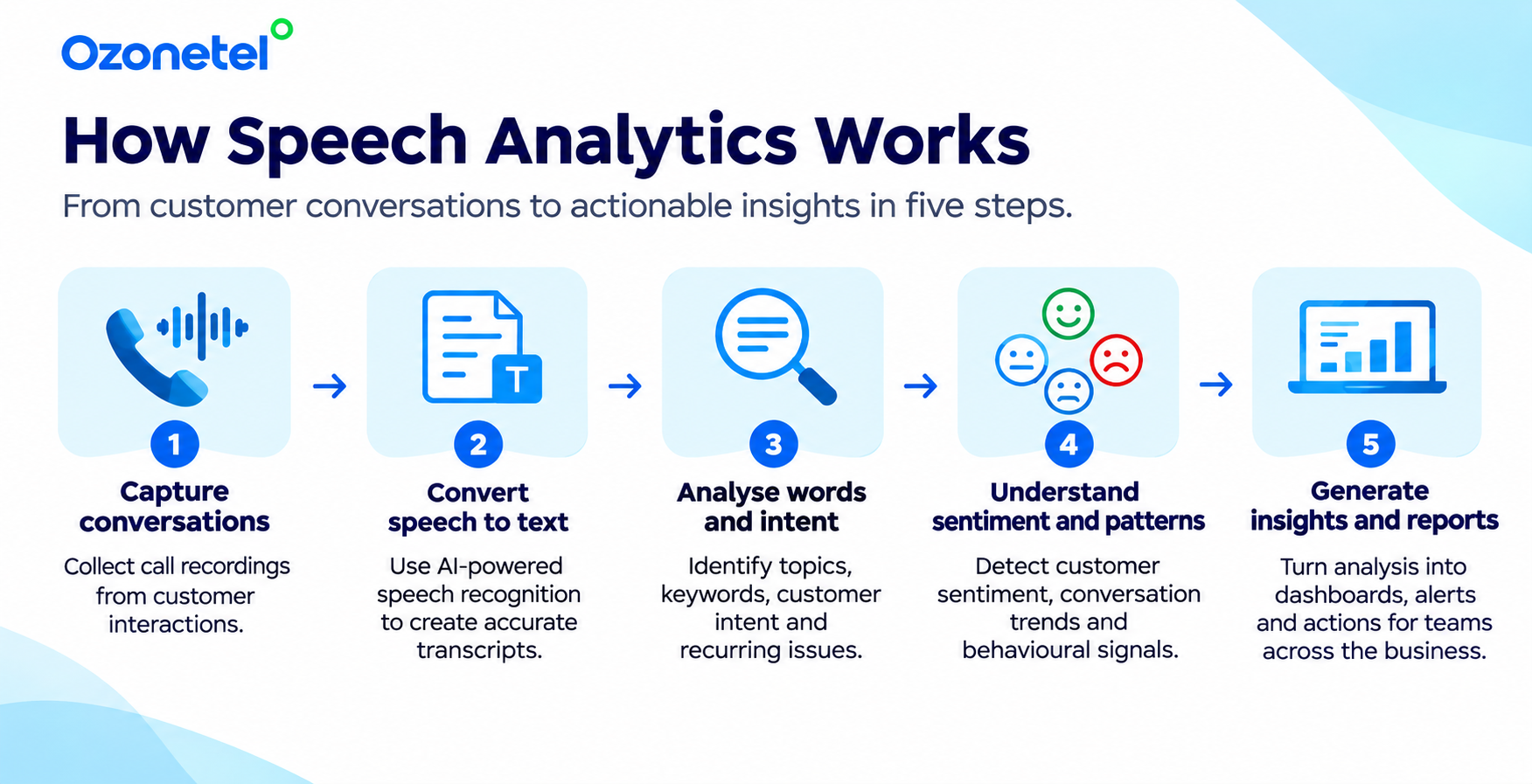
Speech analytics combines speech recognition and AI to turn audio conversations into structured, searchable insights. The process typically involves five steps.

1. Capturing conversations

The system collects audio recordings from customer interactions, including inbound and outbound calls. These recordings become the input for analysis.

2. Converting speech into text

Automatic Speech Recognition (ASR) converts spoken words into text. This makes conversations searchable and helps the system identify specific words, phrases and topics.

Transcription quality can depend on factors such as language, accents, background noise and audio quality.

3. Identifying intent and context

Natural Language Processing (NLP) helps the system understand what customers and agents are discussing. It can identify keywords, topics, questions, objections and recurring issues.

For example, a conversation containing phrases such as “payment failed”, “amount deducted” and “refund pending” may be classified under payment-related complaints.

4. Analysing sentiment and conversation patterns

AI models can analyse language and conversational context to identify positive, negative or neutral sentiment. Depending on the platform, analysis may also consider interruptions, speaking patterns and changes in tone.

This helps businesses understand not just what customers say, but also how conversations are progressing.

5. Generating insights and reports

The system organises findings into dashboards, alerts and reports. Supervisors can identify recurring customer concerns, monitor agent performance, spot compliance risks and prioritise conversations that need attention.

Some platforms also support real-time alerts, allowing supervisors to intervene while a conversation is still in progress.

Key Features of Speech Analytics Software

Speech analytics software offers several capabilities that help businesses understand and act on customer conversations.

FeatureWhat it does
Speech-to-text transcriptionConverts spoken conversations into searchable text.
Keyword and topic detectionIdentifies frequently discussed subjects, phrases and customer concerns.
Sentiment analysisHelps identify positive, negative and neutral customer sentiment.
Intent detectionRecognises why customers are contacting the business.
Automated quality monitoringEvaluates conversations against defined quality and compliance parameters.
Conversation alertsFlags important events, customer concerns or potential risks.
Performance analyticsIdentifies agent strengths, recurring gaps and coaching opportunities.

These capabilities work together. For example, a business can identify calls where customers express dissatisfaction, determine the most common reasons and review how agents handled those interactions.

Automated quality monitoring is particularly useful when manual reviews cover only a small sample of calls. AI can help extend evaluation across a much larger share of customer conversations. Learn more about AI-powered quality audits.

Discover How Leading Brands Scale with Ozonetel.

Benefits of Speech Analytics

Speech analytics helps businesses move beyond individual call reviews and understand patterns across customer interactions. Its value extends across customer experience, operations, sales and compliance.

1. Understand customer concerns

Speech analytics identifies recurring complaints, questions and sources of dissatisfaction. Businesses can use these insights to address service gaps, improve processes and reduce repeat contacts.

2. Improve agent performance

By analysing conversations at scale, supervisors can identify where agents need support. They can use specific interactions to guide coaching on communication, product knowledge, objection handling and compliance.

3. Improve quality monitoring

Manual quality checks can be time-consuming and may cover only a limited number of calls. Automated analysis helps businesses evaluate more conversations and identify interactions that require closer review.

4. Identify sales opportunities

Customer conversations often reveal buying intent, objections and unmet needs. Speech analytics can help sales teams identify patterns in successful conversations and understand why potential customers do not move forward.

5. Support compliance and risk monitoring

Businesses in regulated industries need to ensure that agents follow prescribed processes and communicate important information. Speech analytics can flag missing disclosures, risky statements and other potential compliance issues for review.

6. Make better business decisions

Conversation data can reveal issues that extend beyond the contact centre. Product, sales, marketing and service teams can use these insights to improve customer journeys and business processes.

This is where Voice of Customer analysis becomes valuable. It connects customer feedback and conversation patterns with wider business decisions.

Explore how AI-powered quality audits help businesses monitor customer conversations at scale.

Types of Speech Analytics

Speech analytics is commonly used in two ways, depending on when conversations are analysed.

**Real-time speech analytics** analyses conversations as they happen. It can identify specific keywords, customer frustration or potential compliance issues and alert supervisors when intervention may be needed.

**Post-call speech analytics** analyses recorded conversations after they end. It helps businesses evaluate call quality, identify recurring topics, track customer sentiment and understand performance trends over time.

Some platforms also use different analytical approaches. Phonetic analysis identifies specific sounds and word patterns, while linguistic analysis focuses on the meaning and context of spoken language.

Speech Analytics vs. Voice Analytics vs. Conversation Analytics
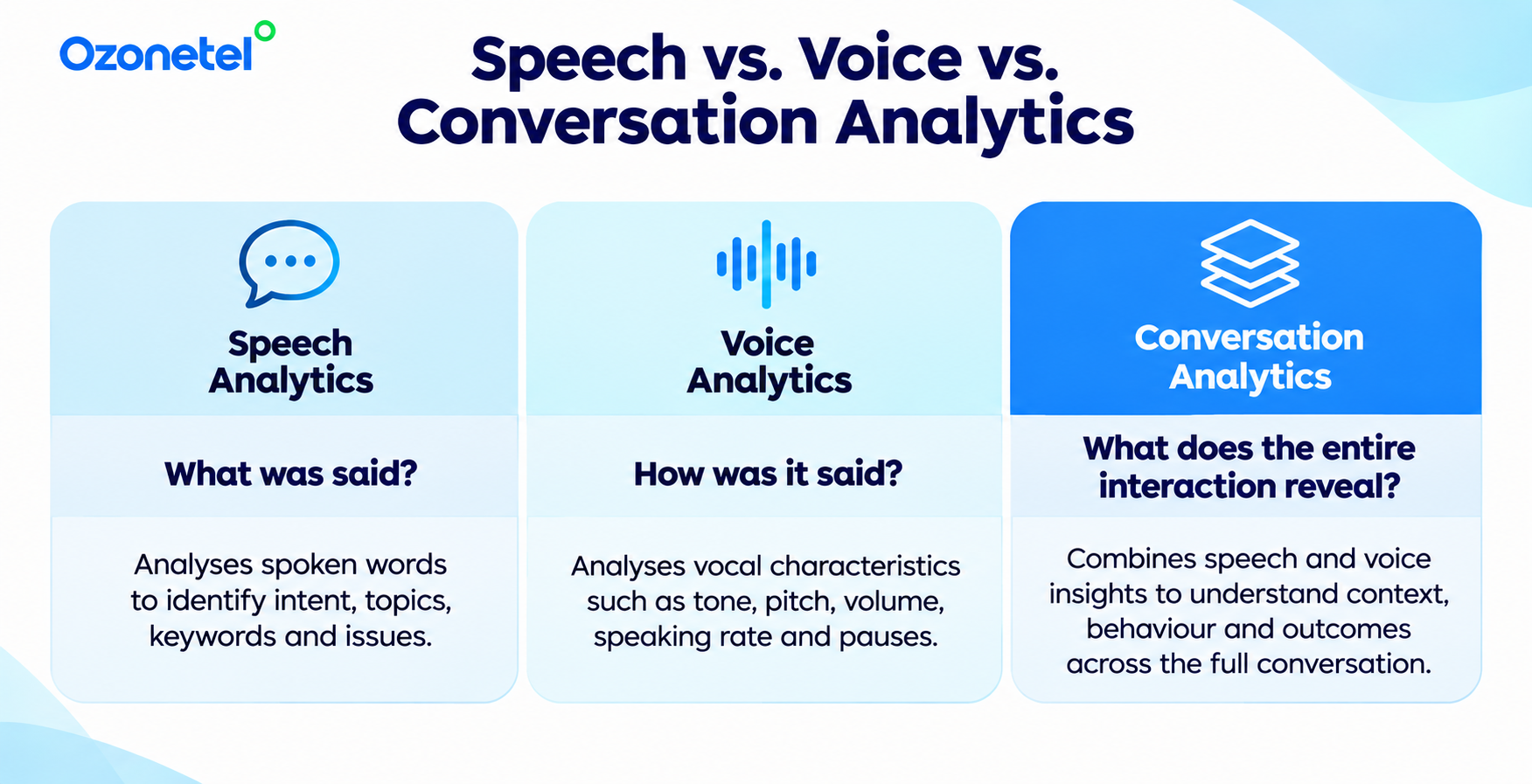
These terms are related, but they do not mean exactly the same thing.

TechnologyWhat it analysesTypical application
Speech analyticsSpoken words, topics, intent and language patterns.Understanding customer conversations and identifying recurring issues.
Voice analyticsAcoustic characteristics such as pitch, tone, pauses and speaking patterns.Studying vocal cues and conversational behaviour.
Conversation analyticsBroader interaction data, which may include speech, text, context and customer journey information.

Understanding customer interactions across channels and touchpoints.

Speech analytics focuses primarily on what is being said. Voice analytics examines how something is being said. Conversation analytics takes a broader view of customer interactions and may combine multiple sources of information.

The capabilities can overlap, and some platforms bring them together to provide a more complete understanding of customer experience. Explore conversational intelligence to understand how these insights can support a wider view of customer interactions.

What Affects Speech Analytics Accuracy?
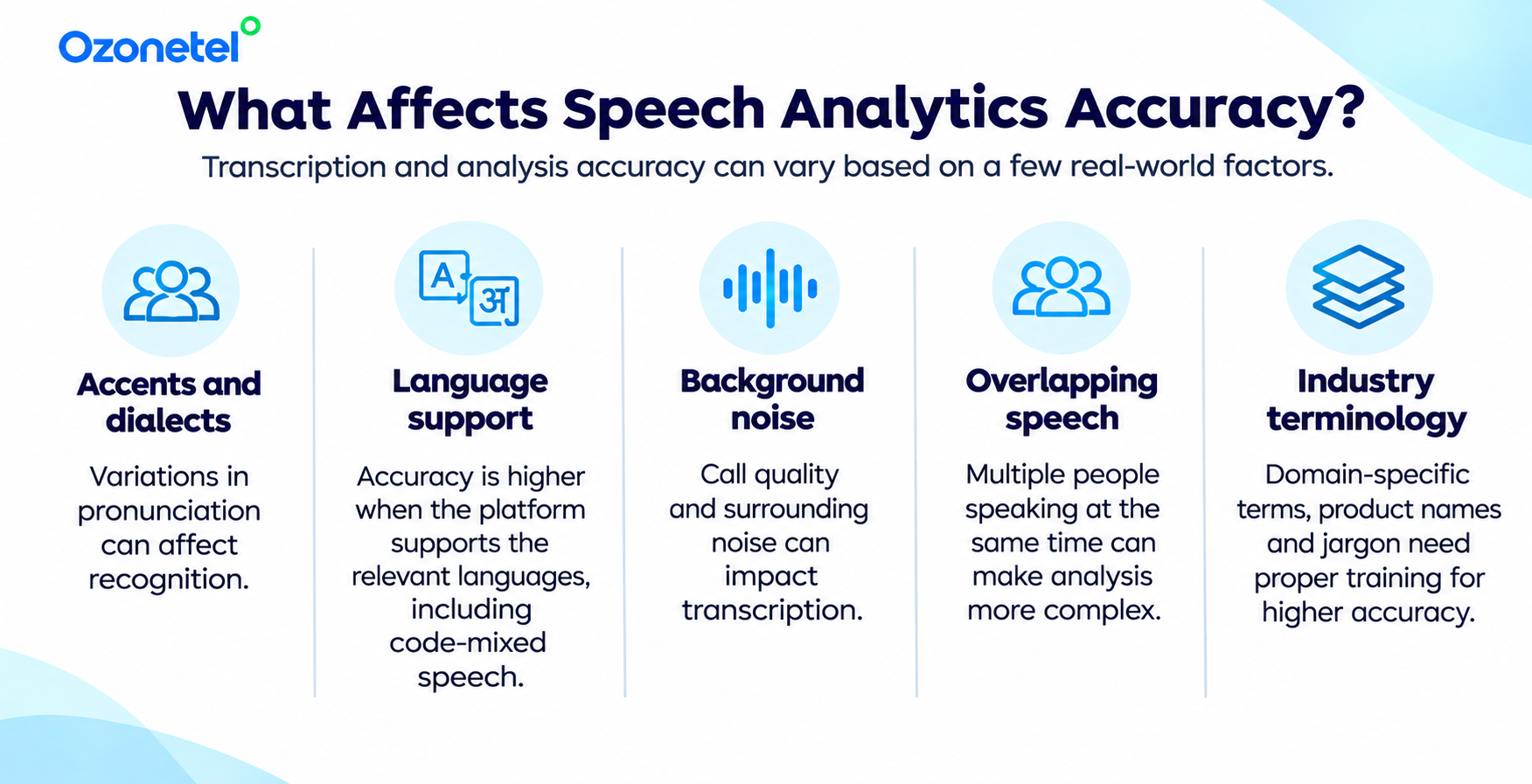
Speech analytics accuracy depends on more than the AI model. Audio quality, background noise, accents, language variations and overlapping conversations can affect transcription and analysis.

The system must also understand context to distinguish between similar words and correctly interpret customer intent.

Businesses should evaluate transcription and analysis quality using actual call recordings, particularly when they handle regional languages or industry-specific terminology.

It is also important to distinguish transcription accuracy from analytical accuracy. A system may transcribe a conversation correctly but still misinterpret the customer’s intent or sentiment. Both should be tested before deployment.
Speech Analytics Use Cases Across Industries

Speech analytics can support different business functions depending on the nature of customer interactions.

IndustryHow businesses use it
Banking and NBFCsIdentify compliance gaps, loan-related concerns, customer objections and service issues.
HealthcareUnderstand patient concerns, detect potential adverse events and monitor service quality.
Real estateIdentify buyer intent, common objections and opportunities to improve sales conversations.
E-commerceTrack recurring delivery, payment, refund and order-related complaints.
InsuranceMonitor claims conversations, identify customer concerns and review compliance-related interactions.

For businesses handling large volumes of calls, multilingual speech analytics can be especially valuable. It helps teams analyse conversations across different languages instead of limiting insights to a single language or a small sample of calls.

How Businesses Use Speech Analytics: Five Customer Examples

The following examples show how speech analytics, conversation intelligence and AI-powered quality audits can address different business challenges. The specific capabilities used vary by implementation.

Brigade Group: Expanding quality audit coverage

Manually reviewing every customer conversation can be difficult for large sales and service teams. Brigade Group used Ozonetel’s AI-powered quality audits to move from manually reviewing a limited sample of calls to automated coverage of 100% of customer conversations.

Its published case study also reports quality scores of 85–90%. This example demonstrates how AI can expand quality monitoring beyond the limits of manual sampling.

Read the Brigade Group customer story.

HDB Financial Services: Finding customer and business patterns

Customer conversations can reveal patterns that are difficult to identify through individual call reviews. HDB Financial Services used conversation intelligence to identify customer segments and patterns associated with loyalty and business potential.

The insights helped the business understand differences in customer behaviour and identify opportunities to improve engagement and retention.

This example shows how conversation intelligence can help businesses move from individual call observations to a broader understanding of customer segments.

Explore the customer conversation insights.

Tata 1mg: Monitoring quality and identifying adverse events

In healthcare, customer conversations can contain important information about medication, service and patient concerns. Tata 1mg used AI-powered quality audits and conversation analysis to evaluate agent interactions.

The implementation enabled 100% of agent conversations to be audited against defined quality parameters. Ozonetel’s published case study also reports that the system identified 73% of adverse events.

This illustrates how conversation analysis can help healthcare businesses monitor interactions and flag issues for further review.

Read the Tata 1mg customer story.

Sobha Realty: Understanding sales conversations

In real estate, sales conversations can reveal why prospective buyers show interest, raise objections or hesitate to schedule a site visit.

Sobha Realty used conversation intelligence to analyse sales interactions and identify factors such as agent interruptions, pricing discussions, speech clarity, empathy and objection handling.

These insights helped identify strong sales practices and areas where agents needed coaching. Ozonetel’s published materials report a 3X increase in site visits.

This example shows how sales conversation insights can help teams improve customer engagement and follow-up.

National Health Authority: Analysing multilingual conversations at scale

Large public-facing programmes need to monitor service quality across diverse populations and languages. For the National Health Authority’s PM-JAY programme, Ozonetel analysed more than 122,000 hours of conversations across 11 vernacular languages.

The analysis covered a sample of 1.2 million calls and included parameters such as advisor and beneficiary sentiment, information retrieval time and interruption frequency.

This demonstrates how speech analytics can help organisations evaluate large volumes of multilingual conversations and identify areas for service improvement.

Read the PM-JAY customer story.

How to Choose Speech Analytics Software

Choosing speech analytics software requires more than comparing feature lists. Businesses should evaluate whether the platform can handle their conversation volumes, languages, workflows and business requirements.

Consider these five factors:

  • **Language and transcription support:** Check whether the platform supports the languages, accents and regional variations used by your customers. Ask for accuracy benchmarks based on relevant call conditions.
  • **Analytical capabilities:** Evaluate its ability to identify topics, intent, sentiment, keywords and compliance-related patterns.
  • **Real-time and post-call analysis:** Determine whether you need live alerts, retrospective analysis or both.
  • **Integration and scalability:** Check whether the software integrates with your contact centre, CRM and existing business systems. It should also support your expected conversation volumes.
  • **Actionable reporting:** Look beyond dashboards. The platform should help teams identify issues, assign follow-up actions, coach agents and track improvements.

A good solution should connect conversation insights to the decisions and workflows that improve customer experience. Integration with your contact centre platform can also help teams connect call data with customer and agent workflows.

How Do You Measure the ROI of Speech Analytics?

The return on investment from speech analytics should be measured through operational improvements and business outcomes, not just the number of calls analysed.

Useful metrics include:

  • Quality audit coverage and time spent on manual reviews.
  • First Call Resolution (FCR) and repeat contact rates.
  • Average handling time and escalation rates.
  • Agent quality scores and coaching outcomes.
  • Customer retention, satisfaction and sales conversion.

The right metrics depend on the business objective. A service team may focus on FCR and repeat calls, while a sales team may track lead conversion and scheduled appointments.

What Makes Ozonetel Speech Analytics Different?

Speech analytics solutions can transcribe calls and identify customer sentiment. But businesses need more than transcripts and dashboards. They need comprehensive monitoring, context-aware evaluation and insights that help teams take action.

Ozonetel combines speech analytics with AI-powered quality audits and Voice of Customer capabilities to help businesses understand conversations and improve customer interactions.

1. A proprietary speech analytics algorithm

Ozonetel’s product documentation describes a patented algorithm designed to achieve deep-learning-model accuracy while using less data, training time and computing power than conventional GPU-based models.

2. Faster deployment

Ozonetel states that its speech and sentiment analytics technology can be deployed in 3–4 days, compared with the 30–45-day implementation cycles associated with conventional GPU-based models.

3. Comprehensive quality monitoring

Ozonetel’s speech analytics product supports monitoring every call and chat against 30+ parameters. This helps businesses move beyond small manual samples and gain a broader view of conversation quality.

4. Context-aware quality assessment

Ozonetel’s AI Quality Audits evaluate factors such as listening behaviour, interruptions, sentiment and conversational flow. The platform supports 40+ configurable quality parameters, including fatal and non-fatal errors, contextual scoring and resolution validation.

5. Multilingual quality audits

Ozonetel’s AI Quality Audits support assessments across 13+ Indian languages. This helps organisations evaluate interactions across diverse customer groups and regional markets.

6. Insights that support agent coaching

Managers can review transcripts, recordings and performance reports to identify agent strengths and improvement areas. They can also track indicators such as repeat calls, escalations and average handling time to understand where processes need attention.

The value lies in connecting conversation analysis with quality improvement and business action. Instead of simply knowing what happened during a call, businesses can understand why it happened and what needs to change.

Explore Ozonetel’s speech analytics software to learn how it can support your contact centre.

Ready to get more value from your customer conversations?

Explore how Ozonetel can help your team analyse conversations and improve customer experience.

Prashanth Kancherla

Frequently Asked Questions

The main purpose of speech analytics is to extract useful information from spoken conversations. It helps businesses understand customer needs, identify recurring issues, monitor service quality and improve agent performance.

AI speech analytics uses technologies such as Automatic Speech Recognition and Natural Language Processing to convert speech into text, identify topics and intent, analyse sentiment and generate insights from conversations.

Call analytics generally focuses on call-level data such as call volume, duration, wait time and handling time. Speech analytics examines the spoken content of conversations to identify customer intent, sentiment, topics and quality-related patterns.

Yes. Some speech analytics platforms support multiple languages and can analyse conversations in regional languages. However, language coverage and transcription accuracy vary by platform, language and audio conditions. Businesses should validate performance using their own call samples.

Yes. Speech analytics helps businesses identify customer complaints, recurring service issues and sources of dissatisfaction. Teams can use these insights to improve processes, coach agents and address problems that affect customer experience.

Businesses should evaluate language support, transcription quality, AI capabilities, real-time analysis, integration options, scalability and reporting. Most importantly, the software should turn conversation data into insights that teams can act on.

Speech analytics helps businesses analyse spoken customer conversations to identify intent, sentiment, recurring issues, compliance risks and opportunities to improve service or sales.

It typically captures call recordings, converts speech into text using Automatic Speech Recognition (ASR), analyses language and context with AI, identifies sentiment and patterns, and presents findings through reports or alerts.

Speech analytics focuses on the words and meaning of a conversation. Voice analytics examines acoustic characteristics such as tone, pitch, volume, speaking rate and pauses.

Yes, depending on the platform. Language coverage, accents, dialects and code-mixed speech support vary, so businesses should test the system using representative recordings.

Some platforms analyse conversations while they are happening and can alert supervisors to specific keywords, customer frustration or potential compliance issues. Others analyse recordings after the call ends.

Businesses can track improvements in quality audit coverage, manual review effort, First Call Resolution, repeat contacts, average handling time, escalations, agent performance, customer retention and sales conversion.

Share this post: