- Resources
- Voice Bots for Contact Centers

Voice Bots for Contact Centers
Most customers don’t hang up because their problem is too complicated. They hang up because they’ve been on hold for six minutes, pressed three menu options, reached the wrong department, and started over.
That’s the real contact center problem—not volume, not complexity. It’s the gap between what the customer needs right now and how long it takes to get there. Voice bots, when built and deployed well, close that gap faster than any other intervention a contact center can make.
But the term gets used loosely. So before we get into what Ozonetel’s platform does specifically, it helps to understand what a voice bot actually is—and more importantly, what separates a good one from the kind customers route around the moment they find the option.
What Are Voice Bots?
A voice bot is an AI-powered virtual agent that holds spoken conversations with customers—understanding what they say, interpreting what they mean, and responding in natural language. Unlike traditional phone systems that force callers through rigid menus, a voice bot can handle free-form speech, follow a conversation across multiple turns, and resolve queries end-to-end without transferring to a human agent.
The technology runs on four components working in concert:
- Automatic Speech Recognition (ASR) — converts spoken words into text, accurately, across accents, noise levels, and phrasing variations
- Natural Language Processing (NLP) — interprets the intent behind what was said, not just the literal words
- Text-to-Speech (TTS) — generates responses in a natural-sounding voice rather than robotic pre-recorded audio
- Machine Learning — improves continuously with every interaction, so accuracy and resolution rates go up over time
Together, these capabilities enable a voice bot to do something traditional phone systems fundamentally can’t: hold a real conversation.
Voice Bots vs. IVR: What’s Actually Different
People often describe voice bots as “better IVR,” which is technically true but practically misleading. IVR systems were built to route calls. They do one thing: get a caller to the right queue. The experience of getting there—the menu trees, the “please listen carefully as our options have changed,” the hard stops when you say something unexpected—was always a friction tax, not a feature.
Voice bots are resolution tools, not routing tools. The goal isn’t to get the caller to an agent faster. It’s to resolve the query entirely, without an agent being involved at all.
| Feature | Traditional IVR | AI Voice Bot |
|---|---|---|
| Interaction style | Menu-driven (“Press 1 for…”) | Natural spoken conversation |
| Intent recognition | Keyword matching on fixed options | Context-aware NLP across free-form speech |
| Multi-turn handling | Resets with each input | Tracks context across the full conversation |
| Flexibility | Rigid, predefined paths only | Dynamic responses based on real-time data |
| Learning | Static — changes require manual updates | Continuously improves through ML |
| Resolution rate | Routes to agent in most cases | Resolves 60–80% of queries autonomously |
| Customer experience | Frustrating, often leads to hang-ups | Intuitive, fast — resolves without waiting |
When a customer says “I need to know when my package is arriving” and then follows up with “actually, can I change the address?”—a voice bot tracks both requests in the same conversation. IVR would have made that caller start over.
How Ozonetel Voice Bots Work (Platform Overview)
Ozonetel’s AI voice bot platform is built on three core capabilities working together: Automatic Speech Recognition that converts voice to text accurately across accents and noise conditions, Natural Language Processing that interprets what the customer actually wants, and Text-to-Speech that delivers responses in a natural-sounding voice—not the robotic pre-recorded audio customers learned to dread.
On top of that foundation, the platform connects to whatever systems your contact center already uses—CRM, ticketing, payment gateways, knowledge bases. A voice bot that can pull up a customer’s account history, check order delivery status in real time, and process a return request end-to-end is functionally different from one that just collects information and transfers the call.
Beyond the core stack, the platform includes capabilities that matter at enterprise scale:
- Agent Connect — seamlessly hands off a voice bot interaction to a live agent when the conversation requires it, with full context transferred
- Date Detection — recognizes and extracts dates from conversations for scheduling and appointment use cases
- Automated Callback — schedules a follow-up call to the customer at a specified time, rather than making them hold
- Customizable Prompts — tailor the bot’s language, tone, and messaging to fit your brand
- Automated Survey & Feedback — gathers customer opinions at the end of interactions through built-in survey flows
- Auto Scaling & Load Balancing — scales resources on demand and distributes incoming traffic efficiently during peak periods
- API Integrations — connects to external systems so the voice bot can retrieve data and take real-time actions
- Sentiment Analysis — detects customer emotion and flags frustrated callers for priority human handoff
The platform supports 22 Indian regional languages and multiple dialects, with the ability to switch between languages mid-conversation in the same voice and tone. For enterprise deployments, Ozonetel offers a visual drag-and-drop dialog designer that non-technical teams can use to configure conversation flows without touching code.
Voice Bot Use Cases by Industry
The use cases that work best share a common characteristic: high-volume, predictable queries where the customer needs a fast, accurate answer more than they need a conversation. Across banking, retail, real estate, and telecom, the pattern is the same—identify the queries consuming disproportionate agent time without requiring human judgment.
Banking & Financial Services
Account balance inquiries, EMI reminders, transaction verification, loan status checks, and appointment scheduling for branch visits or advisor consultations. Frequent, formulaic, and fully resolvable without an agent. PCI-DSS compliant for payment-related use cases.
Explore how NBFCs improve collections & engagement
Healthcare
Appointment booking, rescheduling, cancellation, insurance eligibility checks, and prescription refill coordination—workflows that consume significant staff time at most providers without requiring clinical judgment.
Telecom & DTH
Proactive outbound automation—service outage alerts, recharge reminders, plan upgrade recommendations, billing notifications—alongside inbound account management, plan details, and troubleshooting.
Direct-to Customer
During peak periods, call volume spikes on order status, return eligibility, and refund tracking—queries that don’t need a human agent. Automation handles the spike; agents handle the complexity.
Voice Bot in Action: Three Customer Stories
Sometimes the clearest way to understand what a technology actually does is to look at where it’s already running. Here are three deployments from Ozonetel—different industries, different problems, similar outcome.
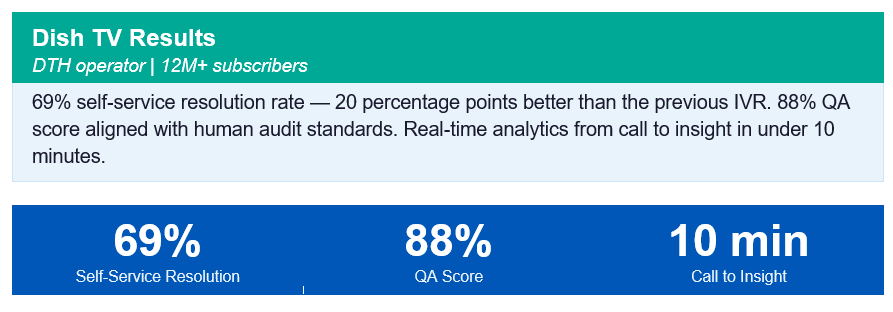
Voice Bot for Telecom: How Dish TV Achieved 69% Self-Service Resolution
India’s competitive DTH market has a specific challenge: customers call about billing issues, channel activation, and value-added services—at volume, in multiple languages, and with no tolerance for IVR loops that don’t resolve anything. For a provider serving 12+ million subscribers, that’s a meaningful operational pressure point.
Dish TV’s existing IVR could handle basic menu navigation but couldn’t manage the diversity of customer intent, the regional language variation, or the escalation rates. Ozonetel built a custom Agentic AI platform—engineered specifically for enterprise telephony, not adapted from a generic framework—that handles six core interaction types: channel management, promotional offers, value-added services, instant channel lookup, error resolution, and smart escalation.
The architecture uses a zero-hallucination design for factual queries like channel availability, with real-time API integration to backend systems and a visual designer for non-technical configuration.
Voice Bot for Retail: How Bata Automated 45% of Contact Center Queries
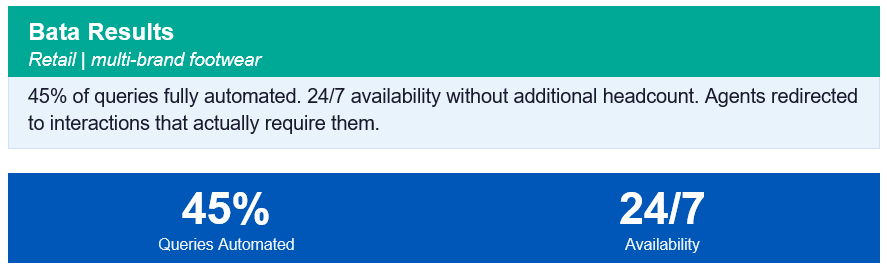
Retail contact centers have a seasonality problem. During peak periods—sales, new collections, holiday campaigns—call volume spikes on exactly the queries that don’t need human agents: order status, return eligibility, refund tracking, voucher support.
Bata’s AI voice bot integrated directly with their Easy Rewards CRM, enabling real-time authentication and data retrieval so callers get accurate, personalized answers without queuing. The bot handles six core use cases—order status, returns and exchanges, refunds, promo support, invoice requests, and payment failure resolution—with an intelligent escalation layer that transfers complex queries to a human agent with full conversation context already passed over.
Voice AI for Real Estate: How Piramal Realty Converted More Site Visits
Real estate is a high-consideration category with a short engagement window. When a prospective homebuyer calls, the time between first contact and disengagement is measured in minutes—and traditional IVR systems, with their hold times and menu friction, close that window before a meaningful conversation even starts.
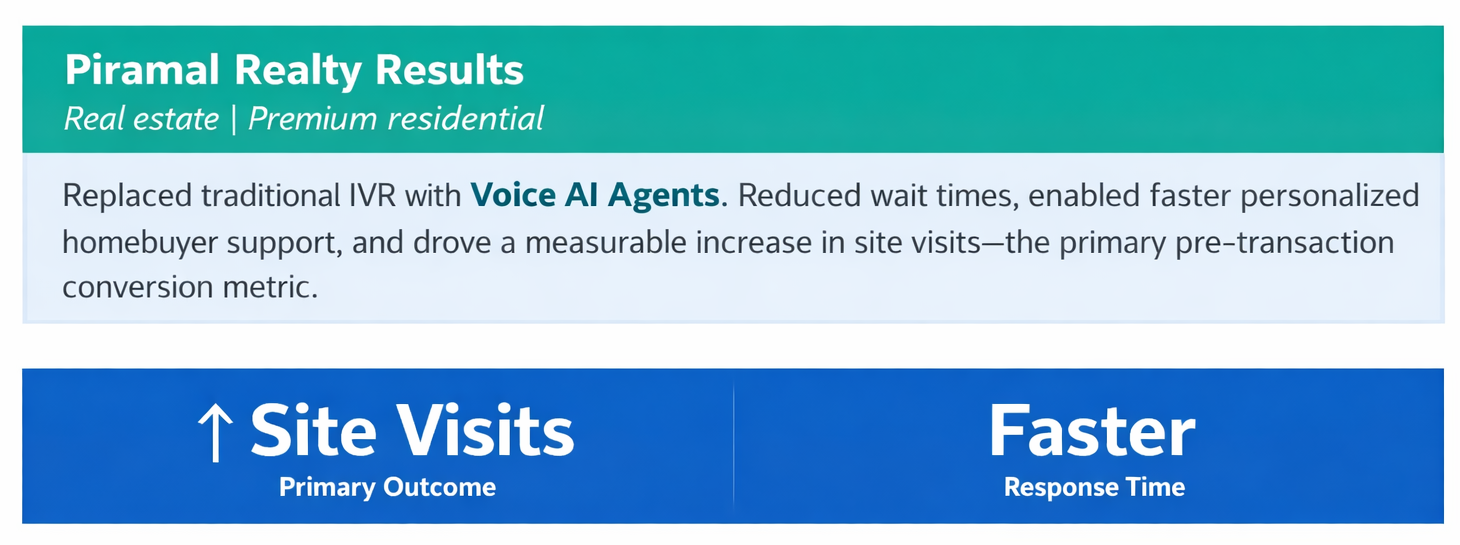
Piramal Realty replaced their traditional IVR with Ozonetel’s Voice AI Agents, reducing wait times and enabling faster, more personalized support for homebuyers at the first point of contact. The measurable effect: higher site visits—the most meaningful conversion metric in residential real estate ahead of a transaction.
A buyer who gets a useful, human-like response in the first 60 seconds of calling books a site visit. A buyer who navigates a menu and sits on hold calls someone else.
Voice Bot ROI: What the Numbers Look Like
It’s worth being specific about the ROI profile here, because the numbers are often better than teams expect—and the payback period is faster than most technology investments of comparable impact.
Across Ozonetel deployments, clients typically see:
- Average handle time — drops from 8–9 minutes to under 3 minutes for automated interactions
- First call resolution — improves from the mid-50s to over 80%
- Customer wait time — effectively eliminated for queries handled end-to-end by the voice bot
- Cost per call — falls from $6–7 to under $1 for automated interactions
Resolution
Automated Call
For a contact center handling 100,000 calls per month with 60% automation, the economics are significant. Agent costs drop by approximately 60%, and when platform fees and reduced infrastructure costs are factored in, total monthly operational spend can fall by more than 50% — delivering substantial savings that compound month over month.
Beyond cost, there’s a second metric worth tracking: agent satisfaction. Teams that stop fielding repetitive, low-value calls tend to be more engaged on complex conversations that actually require human judgment — and agent retention improves as a result.
How to Implement a Voice Bot: A Realistic Timeline
This doesn’t have to be a six-month project. Most teams launch their first voice bot use case within 4–8 weeks.
Weeks 1–2: Define the scope. Pull your call logs and find the top query types by volume. The 80/20 rule applies almost universally—a handful of query types consume the bulk of inbound call volume. Define your success metrics upfront: call deflection rate, CSAT, average handle time reduction.
Weeks 3–6: Build and integrate. Design conversation flows, connect to your CRM and ticketing systems, configure voice and language settings. Confirmation loops, clear escape options (“Say ‘agent’ anytime”), and concise responses all affect resolution rates directly.
Weeks 7–8: Test. Unit testing for individual conversation paths, integration testing for connected systems, and a pilot on roughly 10% of inbound call volume. Address edge cases: accents, background noise, interrupted speech, ambiguous intent.
Week 9 onward: Gradual rollout. Scale from 25% to 50% to full volume across eligible query types. Run weekly conversation log analysis to identify friction points. Retrain the intent model monthly. Expand use cases based on what’s working.
Security and Compliance
All voice data on Ozonetel’s platform is encrypted in transit and at rest. The infrastructure is SOC 2 Type II certified, with built-in compliance support for GDPR, HIPAA, and PCI-DSS. For industries where data sovereignty is a concern, on-premise and hybrid deployment options are available alongside the standard cloud setup. Role-based access controls and full audit trails are included at the enterprise tier.
Future-Proofing Your Contact Center
The contact center you build today won’t look the same in three years — and that’s actually the point. Voice bot technology is moving faster than most enterprise software categories, and the gap between what early adopters can do and what laggards are still figuring out keeps widening.
Ozonetel’s platform roadmap reflects where that evolution is heading: emotion-aware AI, predictive assistance, real-time multilingual translation, voice biometrics, and blended voice-and-video interactions — each building on the same architecture you’d be deploying today.
That matters because every workflow you design, every conversation flow you train, every integration you build compounds in value as the platform evolves.
The businesses that will lead on customer experience in the next few years aren’t the ones who waited for the technology to mature. They’re the ones who got their infrastructure in place, learned from real deployments, and are now positioned to absorb new capabilities as they arrive. The best time to start is now.
Start your voice bot pilot with Ozonetel.
Frequently Asked Questions
A voice bot is an AI-powered system that handles customer phone calls through natural spoken conversation—understanding intent, accessing real-time data from connected systems, and resolving queries without a human agent. It typically automates high-volume, repetitive query types so agents can focus on complex interactions.
A chatbot handles text-based conversations—on a website, app, or messaging platform. A voice bot does the same over a phone call, using speech recognition and text-to-speech instead of typed input. Many platforms, including Ozonetel, let you convert existing chatbot logic into voice-enabled workflows without rebuilding from scratch.
Conversational AI refers to technology that enables human-like dialogue between customers and automated systems—across both voice and text channels. In a contact center context, it means AI voice bots and chatbots that understand natural language, maintain conversation context, and resolve queries without agent involvement.
IVR routes calls using menu trees and keyword matching. A voice bot resolves calls using natural language understanding, real-time data access, and multi-turn conversation tracking. The practical difference: IVR gets a caller to a queue; a voice bot closes the query entirely.
Most teams deploy their first voice bot use case within 4–8 weeks, including conversation design, integration, testing, and pilot launch.
Ozonetel uses confidence scoring. When the score falls below a set threshold, the call transfers to a human agent—with full conversation context already passed over, so the customer doesn’t have to repeat themselves.
The platform supports 22 Indian regional languages and multiple dialects, with the ability to switch languages mid-conversation in the same voice and tone. Global language support extends to 40+ languages overall.
The platform supports HIPAA (healthcare), PCI-DSS (payments), and GDPR (data privacy). SOC 2 Type II certification covers the core infrastructure. On-premise deployment is available for environments with stricter data sovereignty requirements.